‘I’m supposed to be here’: Angel Reese’s road from ridicule to the WNBA finals
A lot of folks owe Angel Reese an apology after Friday night. They should probably form an orderly queue.
Not that the bad-faith take merchants who have spent three years gleefully circulating her missed layups, likening her occasionally awkward footwork to “Bambi on ice” and marveling at the supposed comic genius of “mebounds” are likely to join it. The right-wing culture warriors who turned one of the WNBA’s most naturally gifted rebounders into a punchline were never particularly interested in an honest assessment of her basketball abilities. But after Friday the punch line has never worn thinner.
Reese’s career has been measured against Caitlin Clark’s almost from the moment the two became household names, their rivalry inflated into a culture-war proxy battle that neither player could fully control. Now Reese has reached the WNBA finals before her more celebrated contemporary, a delicious reversal for those who have spent three seasons insisting she didn’t belong in the same conversation. Not that basketball achievement is require to be a zero-sum proposition.
On Friday in Brooklyn, Reese poured in a team-high 22 points as the Atlanta Dream completed a three-game sweep of the New York Liberty with an 85-83 victory, reaching the WNBA finals for the first time since 2013. The 24-year-old scored 18 points before half-time, including a pair of three-pointers, and helped eliminate the 2024 champions on their home floor.
As it happens, Reese had been expecting this moment.
“I manifested this when I came to Atlanta. I knew what I was getting. The finals. The finals,” she said afterward. “This team has poured so much into me. We poured so much into each other.”
Exactly 364 days earlier, while watching last season’s championship series from the couch, Reese had posted a prediction on social media: “Manifesting the finals.”
“I was watching the finals from home for the last two years and kept saying, just give me one playoff game,” she said. “I manifest a lot of things and think it’s important to speak positively into your life and your team, but this is all God. I’m thankful and blessed to be here and won’t take it for granted.”
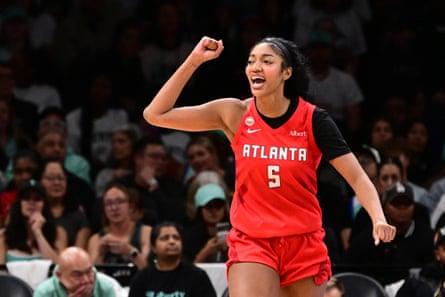
The former Chicago Sky forward, who arrived in Atlanta in an offseason trade, has found more than a new basketball home.
“We have a praying group; eight of our twelve players go to chapel, and we take that seriously,” she said. “It’s a blessing to be around the girls in that locker room.”
Reese’s offensive limitations were always real enough. Her finishing around the basket could be erratic, her shooting needed work and her impatience sometimes got the better of her. But there was an enormous difference between acknowledging those weaknesses and insisting they rendered her accomplishments fraudulent.
Friday’s post-game news conference in the bowels of Brooklyn’s Barclays Center offered a revealing glimpse of the work she has put into addressing them.
“For me, it’s really hard for me to not wan to rush success,” Reese admitted.
She recalled a particularly demanding shooting drill under Dream coach Karl Smesko, who stopped the exercise until Reese made the required shot. Her teammates were left waiting, and her frustration mounted.
“I was upset with him that day, for sure,” she said. “Because I didn’t want to let the team down.”
Smesko remembered the episode, explaining that Atlanta had undertaken substantial changes to Reese’s offensive game. He warned her that the adjustments would not feel natural immediately, but that the work would begin to pay off as the season progressed.
For much of her first two seasons, Reese seemed destined to become a Dennis Rodman for the modern WNBA: a generational rebounder, an indefatigable competitor and the sort of complementary piece whose singular gifts could turn a good team into a great one. That was hardly a modest projection. Rodman was a Hall of Famer and one of basketball’s most influential role players.
after newsletter promotion
But in her third professional season, Reese is making even that comparison look increasingly restrictive. She is no longer merely the sort of player who can elevate a team built around other stars. She’s becoming the sort of player a championship contender can build around.
Her reflections on Friday extended beyond basketball. Reese spoke movingly about her mother, Angel Webb Reese, who raised her and her brother with help from their grandparents and remains her most dependable source of support.
“She’s really proud because she knows the dark moments that I’ve been through,” Reese said. “I can pick up the phone at three in the morning, call her crying, and she’s just been there for me.”
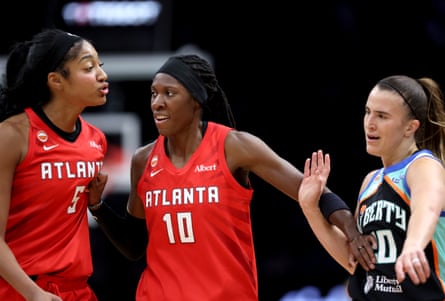
Her mother, she explained, asks for little beyond the opportunity to be present.
“Support me, show up, and love me, and I’ll give you the world,” Reese said. “She’s not very hard on me, but she’s very loving, and she’s very caring.”
It was a reminder of the human being behind the online caricature, and of the private difficulties that cannot be captured in a compilation of missed shots.
Friday’s victory came without injured leading scorer Allisha Gray, whose absence placed additional demands on Reese and Atlanta’s already depleted rotation. Reese said she had promised Gray that she would help finish the job.
“This is what you brought me here for. I got your back. You got my back,” she recalled telling her. “And I’m glad to have her back for the finals.”
Atlanta will face the Golden State Valkyries in the best-of-seven finals beginning on 17 October. For Reese, who spent her first two seasons hoping for even a single playoff appearance, the prospect of playing for a championship remains almost surreal.
“I knew I belonged here and wanted to help this team do whatever it took – not just get out of the first round or semi-finals, but make the finals and win a championship,” she said.
KioskNews shows a cleaned-up reading view extracted from the publisher’s page — the original always lives on their site, not ours.