‘Like many men of his generation, he tends to push his feelings down from his heart to his toes’: Meera Sodha on her father’s homecoming
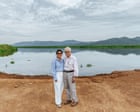
The moment I step off the plane and on to the soil of Entebbe it hits me. Uganda is in my blood. This country that had once existed only in my imagination is finally real. The heat is heavy, the earth bright and rich like dark terracotta. I want to capture this moment – me with my 75-year-old dad, back where he was born. A place he never imagined he would return to. I whoop and reach for my camera, turn it towards my father’s face.
“You’re back!” I say.
“I’m back,” he replies.
“How are you feeling?” He puts his hands in the air. Soft and silly, as always. I, meanwhile, am giddy and overwhelmed. I take a deep breath in. The air smells like Kerala or Goa – rich, roasted and spiced. As we join the world’s slowest immigration queue, I attempt to interrogate him about this profound, meaningful homecoming. Did he ever think he’d be back? He says no … maybe … not really. That’s the most I’ll get for now. When it comes to emotions, Dad is a man of few words. But to understand his stoicism, you have to understand his past.
My dad, Raj Sodha, left Uganda in 1970 on a student visa, two years before Idi Amin expelled all Ugandan Asians from the country, when he became a refugee unable to go home. In any case, the country of his childhood was not somewhere he yearned to revisit. On the rare occasions Dad spoke about it, he described his life there as “a hassle every day”. I know, mostly through speaking to other family members, that it was far more severe than that: a childhood defined by grief, food poverty and hardship.
Dad was four when his mother died in childbirth in the room next door. His baby sister survived. The sudden loss of his mother was devastating, and to this day I still can’t mention her without him bursting into tears. What happened next further compounded the trauma of losing his lodestar. His father married a woman who sometimes withheld food from my dad and his siblings, and if he ever ate too much he was beaten. She locked the food cupboards and after the beating he was kicked out of the house. On occasion, she wouldn’t let him wear shoes or underwear. My uncle, Jamnadas, told me that a day when each of the siblings was allowed one chapati each, rather than one to share, was a very good day. I have come to realise this is why, if Dad is eating a biscuit, he will offer you half. It’s why I grew up with a fridge that was always full of freshly cooked food. I believe it was my mum’s way of showing my dad – and us – that he was safe, cared for and loved. It’s also why when Action Against Hunger, an international organisation that works to help people affected by life-threatening malnutrition, asked me to go to Uganda to visit the country’s refugee settlements, I said yes. So long as I could bring my dad.
I was surprised when he agreed to come. Historically, he had always said no, much to my frustration. Since the early 1990s, President Yoweri Museveni has invited Ugandan Asians back to the country, and over the decades I watched as relatives made the trip. A busload of Gujaratis from Leicester returned on the 40th anniversary of the expulsion, which generated hundreds of photos uploaded to Facebook, but I wasn’t interested in the pictures Mum forwarded to me. I wanted to see it for myself – to witness my ancestral past first-hand. My parents, however, took a firm stand. Whenever I asked if we could return, their response was along the lines of “Why would we want to rewrite the memories we’ve already had there?” The implication being that life had been so idyllic they risked erasing it if they dared revisit. Of course, knowing my father’s past, I found myself wondering if the opposite was true. Perhaps they were guarding me. I wondered if revisiting those places might be too much for him.
Despite their reluctance, the idea of “the return” retained a magnetic pull. It is the same impulse that lies behind diaspora programmes such as Ghana’s Year of Return or Ireland’s The Gathering. Like so many before me, I wanted to find the missing piece of my family’s jigsaw puzzle. I also wanted to better understand the food that is so fundamental to who I am. My mother, expelled from Uganda in 1972, arrived in the UK as a refugee and later taught me how to cook. With each dish she showed me, a new story was revealed – each matoke or kasoori nu shaak recipe came with tales of crabs in the Nile, of elephants and giraffes, of having to turn off the car headlights so lions wouldn’t see them hiding. This was a land so fertile you could throw a mango seed down and watch the tree shoot up like in Jack and the Beanstalk.
I wrote my first cookbook, Made in India, to keep some of these stories alive, but with no real experience or understanding of the places and kitchens the recipes had sprung from. This trip is a chance to fill in the gaps.
As soon as my dad arrives in London from Lincolnshire, I realise he and I have never spent a week together, just the two of us. Not many people do spend stretches of time exclusively with their dads, especially not when they are edging towards 80.
Dad is a man with a sunny disposition, and is always moments away from a giggle. But I can tell he is nervous today, mostly about Mum. He calls her at King’s Cross station when I pick him up, to let her know he’s arrived, then again when we reach my house. Again in the taxi on the way to the airport, and on the plane, before we take off. To check in, to make sure she is safe. Mum has a bad back, and Dad is worried about her being alone. Dad has a bad back, too. He also arrives armed with packets of Imodium. He has had an upset stomach for weeks and has lost some weight. He is weaker than usual. It makes me wonder if I have rushed into this trip without enough thought. Dad is also only partially sighted – not that he has ever complained. Like many men of his generation, he tends to push his feelings down from his heart to his toes, until he no longer feels them any more.
We take the 9.30pm overnight Qatar Airways flight from Heathrow to Doha. They serve us dinner at 11pm and we land at 4am. Dad’s stomach is still bothering him and he has barely slept. With every flight of stairs and long wait in a stuffy airport corridor, I want to protect him, keep him safe in a bubble. It’s the first time the tables have turned like this, where I’m looking after him. Whenever I go home to my parents’ house, Dad is a constant caretaker. He shows his love by doing things. Before I go to bed, he’ll have put some water on my bedside table, and by the time I get up, he’ll have polished my shoes. I’ll be watching Poirot and he’ll come and give me a head massage. Together we have a certain kind of aggressive affection. We hug, we squeeze. Sometimes so tight that you wonder: is this love or pain?
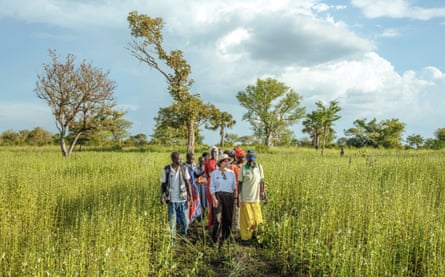
The week would be split in two parts: half will be spent locating his childhood stomping ground, his teenage haunts and all of the other places he was forced to leave behind. The other half will be with Action Against Hunger. Its purpose is humanitarian intervention. Its initial mission is to save lives, but in the long term it helps build resilience to achieve food security, so no one goes hungry again. I was interested in how Dad would respond to meeting refugees. Politically, we’re not aligned. Like many Gujaratis, he was a supporter of Margaret Thatcher, who, in turn, was a fan of Ugandan Asians’ enterprising nature. And enterprising he has been. He currently runs container units for small businesses in Lincolnshire, and over a lifetime has sold more life insurance policies than you could shake a stick at. But of particular relevance to this trip, he’s wary of immigration.
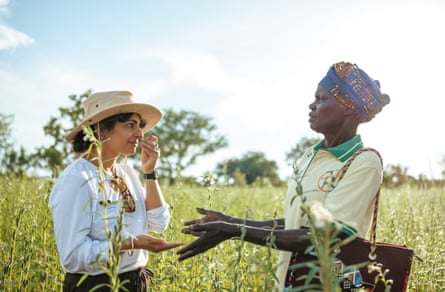
Uganda is the largest refugee-hosting country in Africa. There are about 2 million there, which is extraordinary considering that 60% of its native population are living under the poverty line. On our first day, we make our way to a settlement that houses refugees, many of whom had made a gruelling journey from Sudan. I am braced for destitution, poverty, depression, emaciation and sadness. However, as we step out of the car in Kiryandongo, we are instead greeted by local Ugandans and the refugees singing and dancing together, a euphoric vision backed by the golden sun and green fields of maize. The experience is so extraordinary that I cry. I look at Dad, who begins to dance, his face full of joy.
Once the day is over, and we have been fed a delicious gooey okra dish with the texture of cheese pulls, I check in with Dad to see if anything has shifted, if he has reconsidered the way in which the UK treats immigrants. He thinks for a moment then says he has been blown away by the compassionate treatment of refugees in Uganda. He empathises with those in need of a home. I wait for more – along the lines of, “I’ve changed my mind! I was wrong all along!” Instead, he has an idea.
“Solar panels,” he says. “We could set up a company distributing solar panels to farmers living in mud huts, so they could have electricity.” It’s the closest we get to a full political resolution, but it will do.
The next day is Dad’s birthday. Well, at least what we think is Dad’s birthday. He was born in Parombo, then a tiny rural village with only one car. He thinks his parents didn’t get to register his birth until a few months after he was born. He tells me he has always wanted to visit a national park called Murchison Falls. He had a chance to go when he was a child – there was a school trip that only cost 50p – but his stepmother refused to let him go. Now we are here, at this place he had only ever dreamed of, on his 76th birthday. We eat breakfast by the Nile, and a monkey tries to steal some bananas from the table.
We leave early the next day for another long car journey, this time to a refugee settlement in Adjumani. It is here I meet Adong Grace, a beautician working out of a salon that doubles as a training centre. Young women learn to braid hair here. I ask her the hardest part of being a refugee. She doesn’t hesitate. “Waking up,” she says, “and remembering I’m not who I thought I’d be.”
She had wanted to be a journalist. I think of my own career – chosen freely, never once threatened by a border. And I think of my mother, who was given 90 days to leave the only country she knew, and who had to build a new life from scratch. I cannot imagine what it is like to have a door shut on you. To wake up every day and find it still closed.
That night we stay in a fishing lodge where the floor is uneven and there is no outdoor lighting, so I have to instruct Dad where to put his feet every step of the way to our room. On my bed, there are bits of broken ceiling and dozens of dead flies. I go to put on a new T-shirt for dinner and a lizard jumps out of it. We make our way down for dinner, and it’s exactly what we’re advised not to eat: a buffet of cold food, all meat. At least there is beer! But no glasses, so Dad pours it into a bowl instead and drinks out of it like a French duke.
after newsletter promotion
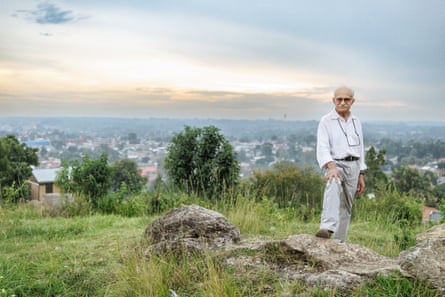
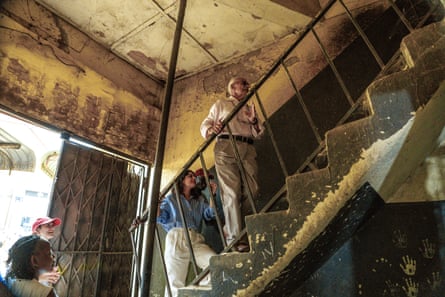
At the top of Dad’s to-do list is a trip to Arua, where he lived as a teenager. On the way there, I sense a tension in the car: he’s quieter than usual, and I worry about how it will be for him, if he’ll be able to identify his family’s home, if he will be bewildered by the memories. Instead, I see him transform. With every location we find, his body language accelerates. We locate a hilltop he used to sit on, a mango tree he climbed to hide from his stepmother, the spot where he got bitten by a scorpion. Dad is so excited when we find the local cinema that he runs upstairs – a bundle of energy, eager to revisit. Mostly he wants to find people who remember his family – or any of the other Ugandan Asians from his time.
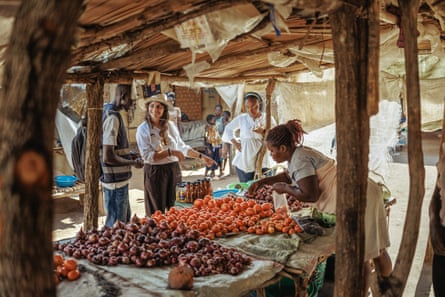
So begins two hot and frantic days in Arua and Parombo – a wild goose chase after memories. The first man we approach, a pharmacist, is 73 and points us towards an older man, Fabiano, who is 76 and has polio. We talk to him: he remembers Isaac and Abdul, Iranian brothers. Fabiano suggests we speak to Leonard, whose house is set a bit back from the village. We find Leonard and he remembers “Bana Dogo” (“short man”), who was Dad’s friend. Leonard suggests Dad speak to his mum, who is more than 100 years old. We go and meet her: she’s blind and sitting with, among others, her 63-year-old grandson at a monthly pension and free meal event held under the tree in the village. She remembers everything and everyone: Isaac and Abdul, Bana Dogo, “Pata Potea” (the “fat man” who was key in looking after Dad’s baby sister when his mum died). Everyone except for Dad’s dad, Laxmidas. As we hop from person to person, I am constantly holding my breath to see what will unfold. What if he is disappointed? And what might happen if he is confronted by the hardship and sorrow of his youth?
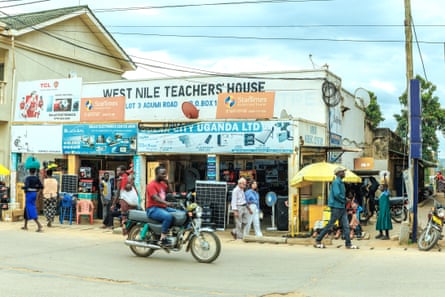
Then, as we walk down potholed streets, Dad identifies the shop his father owned. It sold soap, sugar, bicycle parts, men’s trousers and shirts. Suddenly he scurries down an alleyway with an open drain in the middle and broken pavement either side. At the back of the shop, we find a group of people who are washing dishes.
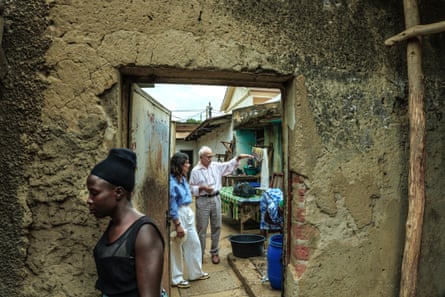
“I think my dad used to live here,” I say.
“Come in,” one man gestures. Dad goes inside and I lean against a wall, prepared for a long wait. Instead, he comes back out again within seconds. I ask if it was the wrong place.
“No, that was it,” he says.
“But you’ve come back out again so quickly.”
He won’t say why. But I assume he had a physical reaction. There was no part of his body that wanted to stay in the house that contained his unhappy childhood memories. I ask if we can go in together, and he agrees. There are two rooms in the main building behind the shop. It is a tiny space for five sisters, three brothers, his dad and stepmother. Dad wants to leave again. He reassures me he is OK, and we get back in the car. He sits on his union jack embroidered cushion, and I ask if he has taken his medication. We share a bag of cassava chips. He is quiet for the rest of the journey back to our hotel, but says he is happy to have met people, to have been remembered, to have been back.
There is one final destination before our flight: Pakwach, a town Dad only lived in for two months, but which has so much importance. This is where he worked for my mum’s dad – and where he first met my mum, although he was 16 and she was 10. Dad was in charge of taking her to school in Gulu one day. He held her hand as they walked to the bus, and they sat next to each for the short journey. The memory of this fleeting yet prophetic moment makes him chuckle. It is so strange to think that 60 years ago, he held a small girl’s hand on the way to school. That girl became my mother, a woman he would meet again a decade later in Lincolnshire. Now he is here, holding his daughter’s hand.
The next morning, we arrive at the airport and, in typical optimistic, relaxed Ugandan style, the flight is delayed. I ask if Dad might use the time to call his brothers and sisters to tell them that he went back to the family house. He shakes his head. “Your mother is the media and communications centre, not me.”
We fly back to the UK with the Ugandan football team. It is a packed airport, noisy, total chaos. Nobody offers Dad a seat, but he finds a table to sit on, and I watch him, tired and fed up, his hat in his hand. I have spent a week taking his arm over broken paving, reading him the small print on menus, asking if he has taken his tablets. He has spent 44 years looking out for me. Most of all, he did this. He came with me to Uganda; he gave me this unforgettable gift. Because I needed to stand there, to feel Uganda, touch it and taste its rawness, beauty and magic. That is something I would never get from a story, a photo or a plate of food.
Back at home, Dad united with Mum, me with my husband and two girls, I tell them how beautiful Uganda is: the fertile earth, the simplicity of life. I tell them how many giraffes I saw in one go – 100, I think – and how absurd it is to see such a gigantic mammal run. I tell them about potholes so big they could swallow a car. I tell them that in one of the poorest countries in the world, we met people on the edge of life who are also the most joyful, welcoming and generous people I’ve ever met. I tell them about Dad – how his story made him the strong, smart and silly grandpa that he is today. I tell them how lucky we are to wake up every morning and know that the door is always open.
As told to Harriet Gibsone.
Meera Sodha travelled to Uganda with Action Against Hunger, for whom she is an ambassador.
KioskNews shows a cleaned-up reading view extracted from the publisher’s page — the original always lives on their site, not ours.