CWA warns of potentially deadly waves
SWELL: A marine weather expert said that long-period waves can become a hazard when near-shore topography causes them to break and crash against the shore
By Rachel Lin and Shelley Shan / Staff reporters


The Central Weather Administration (CWA) yesterday warned the public of potentially deadly hazards posed by swells, known locally as “crazy dog waves,” which have claimed more than 770 lives in the past 25 years.
From 2000 to November last year, the CWA recorded 445 incidents involving freak waves along Taiwan’s coasts, resulting in 778 people falling into the sea.
Offshore abnormal wave events were also reported, with 206 incidents recorded from 2000 to June 2023 involving 936 people, CWA data showed.
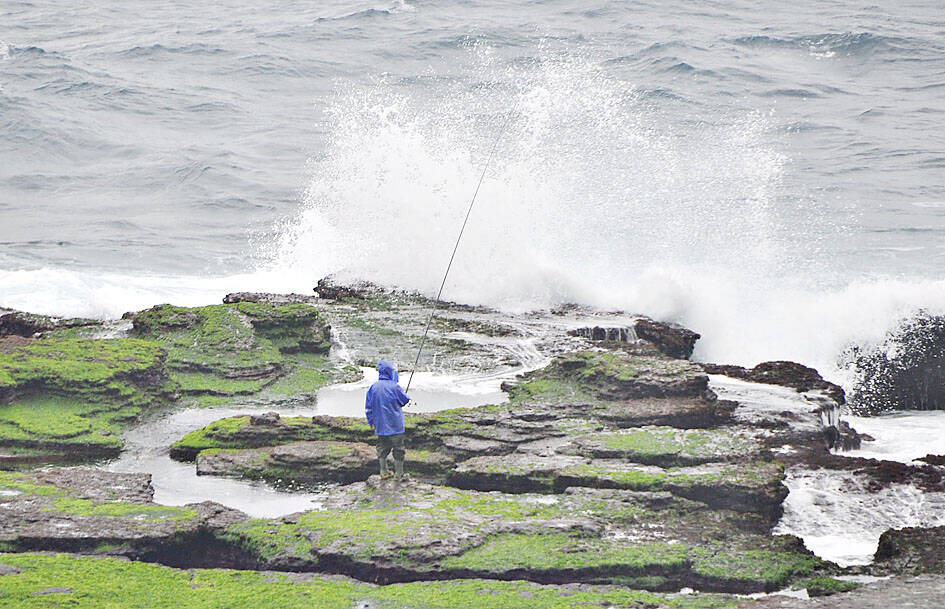
An man fishes in an undated photograph.
Photo: CNA
Lin Fang-ju (林芳如), a specialist in marine meteorological technology at the CWA’s Marine Meteorology and Climate Division, said long-period waves, or swells, can sometimes become hazardous.
The CWA has established separate warning systems for abnormal waves in coastal waters and the open ocean.
Wave conditions are primarily affected by wind speed, the size of the area over which the wind blows and the duration of the wind, Lin said.
Stronger winds blowing over a wider area for a longer period produce larger waves with greater energy, she said.
Wind waves are generated locally by winds blowing across the sea surface, while swells are generated by strong winds farther away and continue to travel after leaving the area affected by the winds, she added.
Swells are also known as long-period waves, Lin said.
Because swells have longer periods and travel faster than normal waves, they can reach speeds of more than 100kph, she said.
By comparison, typhoons generally move at about 5kph to 20kph. As a result, swells generated by a distant typhoon can reach Taiwan’s shores one or two days before the storm itself, she added.
When swells enter shallow waters, coastal topography can cause high waves that break and crash, creating dangerous conditions, she said, adding that unusually large waves despite calm local winds could indicate severe weather systems offshore.
The CWA provides real-time swell information when wave heights reach at least 1.5m and periods are eight seconds or longer, except during typhoon warnings.
In cooperation with National Cheng Kung University’s Coastal Hydraulics Center, the CWA has developed a Coastal Abnormal Wave Warning System to improve warnings of dangerous waves near shore.
The Ocean Abnormal Wave Warning System uses nonlinear wave theory and wave models to provide the probability of abnormal waves occurring in the following 24, 36 and 48 hours.
The CWA also uses data from buoys to monitor waves, currents, water temperatures, wind, air temperatures and atmospheric pressure.
The solar-powered buoys generally collect observations hourly when sufficient power is available, although fishing nets, ship collisions and ropes tied to the buoys can affect data quality.
In cooperation with Kenting National Park, the CWA provides warnings when forecast wave heights reach specified levels, and forecasts of high and low tide lines to help prevent people from becoming stranded on beaches or sandbars.
KioskNews shows a cleaned-up reading view extracted from the publisher’s page — the original always lives on their site, not ours.