Does the AG share the view that a house arrest order is not capable of execution, there being no legal provision in Malaysia? — Hafiz Hassan
SEPTEMBER 21 — Nine months to this day, High Court judge Alice Loke (as she then was) delivered her judgment dismissing a judicial review application by former prime minister Dato’ Sri Najib Razak seeking orders of mandamus to allow him to serve his imprisonment sentence under house arrest.
Concluding her judgment, the learned High Court judge said as follows:
“[T]he [Yang di-Pertuan Agong] is a constitutional monarch, and he exercises powers and functions in accordance with the provision of the Constitution. The exercise of the prerogative power of mercy is no exception. It must be exercised within the legal framework providing for safeguards and limits in the Constitution.”
Earlier in her judgment, the learned High Court judge considered Article 42 of the Federal Constitution as “essentially the prerogative of mercy” and the following as the essential features of the Article:
1. the YDPA has the power to grant pardons, reprieves and respite;
2. the Pardons Board for the Federal Territories shall comprise of the Attorney General, the Minister responsible for the Federal Territories of Kuala Lumpur, Putrajaya and Labuan and three other members appointed by the YDPA;
3. the Pardons Board tenders its advice to the YDPA for the purpose of exercising his powers of pardon;
4. before the Pardons Board tenders its advice, it shall consider any written opinion of the Attorney General; and
5. the Pardons Board must meet in the presence of and be presided over by the YDPA.
The learned High Court judge then referred to the case of The Attorney General of Malaysia v Dato’ Sri Mohd Najib bin Tun Hj Abdul Razak and another appeal [2025] where the Federal Court explained that the powers of clemency are subject to procedural limits in Article 42 of the Federal Constitution when exercising powers of pardon.
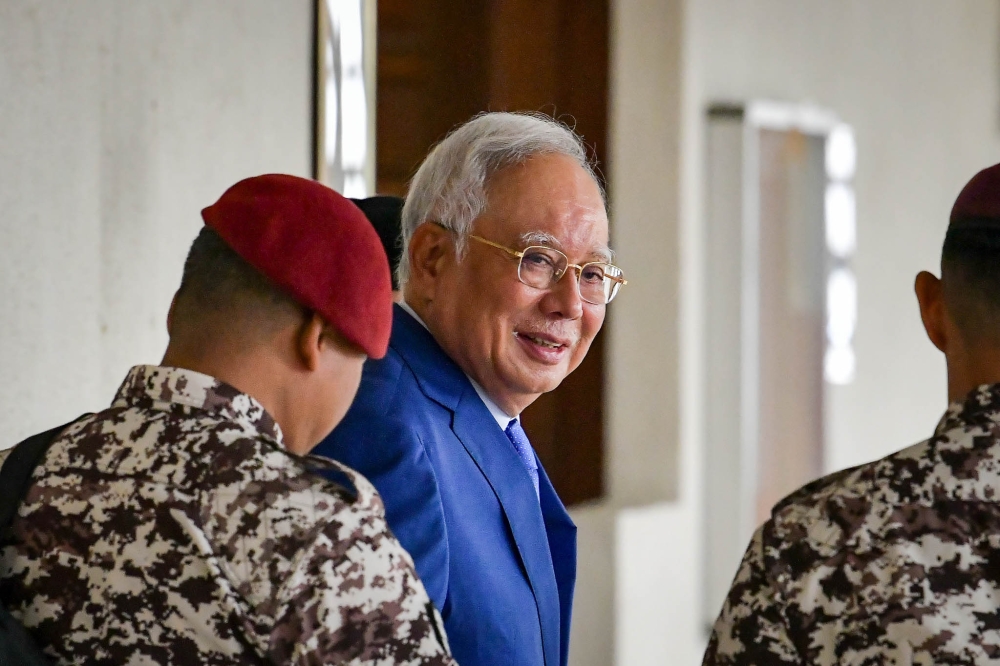
Former prime minister Datuk Seri Najib Razak is pictured at the Kuala Lumpur Court Complex December 6, 2024. — Picture by Firdaus Latif
The apex court said:
“Article 42 of the Federal Constitution governs the royal prerogative of mercy, whereby the Yang di-Pertuan Agong (YDPA) is empowered to grant pardons, reprieves, and respites in respect of all offences committed in the Federal Territories of Kuala Lumpur, Labuan, and Putrajaya.
“The exercise of such clemency by the YDPA is not absolute. It is to be carried out in accordance with the constitutional limits prescribed by Article 42, particularly through the framework of advice and procedure embedded therein.
“Pursuant to Article 42(4)(b), the YDPA is required to act on the considered advice of the Pardons Board for the Federal Territories. His function in the clemency process is therefore inextricably tied to the deliberations and recommendations made by the Board established for that purpose.
“The Pardons Board for the Federal Territory of Kuala Lumpur is constituted under Article 42(5) of the Federal Constitution, and comprises the learned Attorney General, the Prime Minister [sic], and three other members appointed by the YDPA.
“Article 42(8) further mandates that any meeting of the Pardons Board must be held in the presence of the YDPA, who shall preside over its proceedings. This requirement is both procedural and constitutional in nature.”
“Any failure to adhere strictly to the procedural safeguards and substantive requirements under Article 42 will render the entire clemency process susceptible to constitutional challenge and judicial review.”
Now, in respect of a house arrest, the learned High Court judge said that a “house arrest order made in exercise of the powers of clemency is without precedent” and “fundamentally alters the nature of the imprisonment term”.
Significantly, the learned High Court judge was of the view that “a house arrest order is not capable of execution, there being no legal provision for such mechanism in Malaysia”.
Shamsul bin Bolhassan (with Ahmad Hanir bin Hambaly @ Arwi, Nurhafizza bt Azizan, Safiyyah bt Omar, Ainna Sherina bt Saipolamin and Zulkifli bin Sulaiman) from the Attorney General’s Chamber appeared for the respondents.
In that The Attorney General of Malaysia v Dato’ Sri Mohd Najib bin Tun Hj Abdul Razak and another appeal case, the Attorney General (AG) himself appeared before the Federal Court.
We can agree that the learned High Court judge’s views are obiter and therefore not the binding part of her judgment. But her views are now widely known by the public to the extent that calls have been made for the AG’ written opinion on Najib’s house arrest to be made public.
So, does the AG share the learned views of Justice Alice Loke?
* This is the personal opinion of the writer or publication and does not necessarily represent the views of Malay Mail.
KioskNews shows a cleaned-up reading view extracted from the publisher’s page — the original always lives on their site, not ours.