‘¡Qué Horror!’: Mexico’s World Cup honeymoon is over but is Rafa Márquez really to blame?

When a new coach ascends to lead Mexico’s national team, fans say he is sitting in “la silla mas caliente” – the hottest seat in town; one that can also burn.
Usually the coach arrives with a new idea, a new vocabulary, a new promise. For a while, everyone agrees that something has changed. Then comes the first bad night. The mood changes. The new idea becomes a failed experiment; the promise, another deception; the coach becomes just another name on a long list of those who were supposed to fix Mexican soccer, but couldn’t.
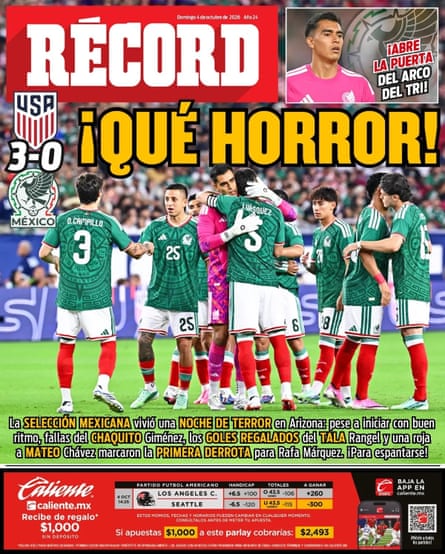
Rafael “Rafa” Márquez, the former star player turned coach, is only a month into his tenure coaching El Tri and the old machine is already grinding. The Mexican press is running think-pieces on whether his hiring was the right decision, and the headlines are scathing.
Márquez was part of the coaching staff, working under manager Javier Aguirre, that oversaw Mexico’s best performance at the 2026 World Cup in decades. Under their leadership, the team managed to overcome a psychological barrier that had haunted them since 1986, the last time they won a knockout stage game. This time around they beat Ecuador in the last-32 before a brave loss to England, raising the hopes of an entire nation that a long-running curse of underperformance had finally been lifted.
Then came Mexico’s first four friendly matches after the World Cup, and a starkly different picture began to emerge: a 1-1 draw against Colombia, another 1-1 draw against Peru, and, on Saturday in Arizona, a 3-0 defeat to the United States. Tuesday’s 2-0 loss against Chile was salt in the wound.
Four matches, one downward spiral. First, Colombia: optimism. Then, Peru: unease. Then, United States: despair. And finally Chile: nightmare.
“It is difficult to recognize this team from the one that played just a few months ago,” said TV Azteca analyst Álvaro López Sordo in a telephone interview with the Guardian. “One might think that the World Cup was an illusion, that playing at home favored Mexico, the altitude, the support of the fans.”
Though these games were just friendlies, they delivered a cold “dose of reality,” he said, summing up the bewilderment of Mexican fans who are flooding social media to complain about the team. It’s not just the heavy defeat to their arch-rival, the United States. It’s that the triumphant World Cup team seemed to have found something special that they are now seeking desperately to regain.
The first temptation in the Mexican football world is to see the results as a referendum on Márquez. But in fact, the painful defeat to the US resurfaces the more systemic problems with the national team.
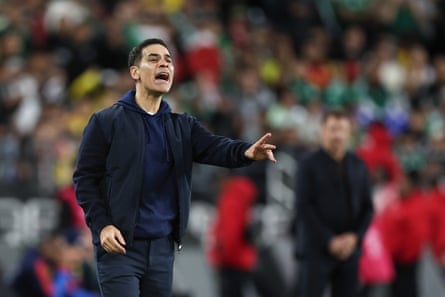
Márquez’s appointment post made sense. He knew the players, he was part of the leadership during the World Cup and had a long career behind him that made him one of the biggest names in the history of Mexican soccer. He captained the national team, played for Barcelona, and excelled on some of the most important stages in European soccer.
But he also inherited an obvious challenge: his experience as a top-level coach is limited. Shortly after his appointment, his former national team coach, Argentinian Ricardo La Volpe, told Claro Sports that “Not all good players are good coaches; without getting into a debate, there’s the case of Maradona or Pelé.”
But for López Sordo, these first few matches should be read less as an evaluation of Márquez’s overall coaching performance than as an X-ray revealing the problems he will have to overcome.
after newsletter promotion
Márquez knew that he was inheriting high expectations: he immediately tried to temper them.
“I adapt to what I have,” he said at a press conference in late September before the friendlies. “It’s not that I’m going to impose a style of play, because obviously, who wouldn’t want that? I was a Barça player, I want to play like Barça. But you don’t have the raw material, so you have to adapt to that.”
López Sordo agrees.
“Mexico’s problem is not that they don’t have good players, it’s that they don’t have enough of them. I think Pep Guardiola or José Mourinho could come to Mexico, and it wouldn’t change much,” he said. “Because, ultimately, the game belongs to the players.”
Mexico has spent years searching for the ideal coach, as if the manager were the missing piece. Meanwhile, the supply of elite players has changed. There are fewer established Mexicans in the major European leagues than in previous generations (there are 16 now, none of them playing for a top team in their respective league). The national team’s bench is shallow. An injury, a suspension, or the poor form of one or two players can significantly alter the team’s level.
“That reduces Rafa’s margin for error,” López Sordo said. “I think a solution will require him to scout the players more closely and carefully. It’s tough because there aren’t many options, but he’ll have to be more assertive. This defeat against the United States is a burden Rafa has to carry, and if you keep adding burdens, the load becomes very heavy.”
The friendlies weren’t all bad news. The draw against Colombia showed the team playing with a different style, possessing out from the back and creating attacking opportunities. Colombia scored first, but Mexico responded with Gilberto Mora, the teenager who became the youngest goalscorer in the national team’s history. The match ended 1-1.
Against Peru, the team surprised everyone by changing the entire starting XI to distribute playing time and reserve their best players before the match against the United States. The decision made sense. The point of these friendlies is not simply to win but offer a controlled glimpse of what players might look like when the stakes are higher. Mexico drew again, this time 1-1.
And then came that game against the neighbor to the north, where it was clear that without El Tri’s three key figures: Raúl Jiménez, Julián Quiñones, and Mora, the team lacked striking power.
Mexico know this script. Defeats become doubts. Doubts become crises. A crisis requires someone to blame. The coach becomes responsible. The questions are already swirling: why continue with Márquez? If he continues this losing streak should the team try someone new?
And Mexican football starts its cycle all over again.
The real test will be whether Mexico can learn, for once, to distinguish between a coach who is just starting out and a system that has been searching for answers for years.
KioskNews shows a cleaned-up reading view extracted from the publisher’s page — the original always lives on their site, not ours.