China, Russia and US at Apec: 3 presidents, 3 nuclear powers and 1 historic precedent
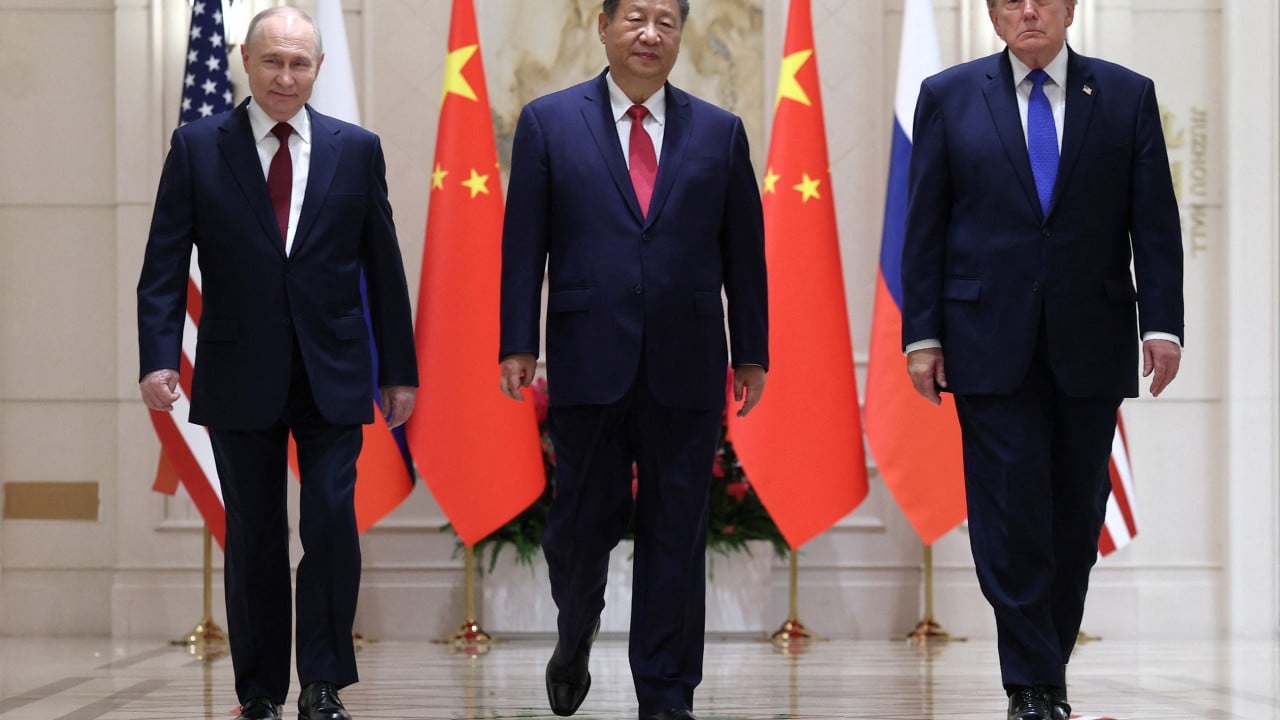
The trio acknowledged the importance of the meeting alone, with Xi hinting that there may be more to come.
“History tells us that when major countries live in harmony, the world enjoys peace; when major countries clash, the world falls into turmoil,” Xi said, according to the Chinese statement on the meeting.
“The three countries should maintain regular high-level exchanges, keep dialogue channels open at all levels, and establish crisis communication and prevention mechanisms to minimise miscalculation, keep differences under control, and prevent frictions from escalating.”
21:51
Live: Donald Trump departs Shenzhen
Trump also agreed on the importance of such dialogue.
“No problems were ever solved under the old school [of] refusing to talk about it. So no peace was ever forged by declining opportunities for engagement and speech. Together we are choosing a different course,” he said in his opening remarks.
“A historic summit offers the chance to seek out new opportunities and approaches on a range of very important issues.”
Xi also invoked the three nations’ World War II alliance, recalling how they “fought side by side” more than 80 years ago to urge cooperation over confrontation.
The point was echoed by Putin, who said the three states were the victors in World War II. “We hold joint responsibility for maintaining international peace and security,” he added.
In the meeting, Xi highlighted the need for the three big powers to respect each other’s sovereignty and to not cross each other’s “red lines”.
“China, Russia, and the United States have different national conditions. We should respect each other, seek common ground while reserving differences, and pursue common development, including respecting each other’s sovereignty and territorial integrity,” he said.
“On major and sensitive issues concerning one another, we should communicate in advance, put ourselves in each other’s shoes, and act prudently, especially by not crossing each other’s red lines.”
While differences on major issues such as cutting nuclear stockpiles and Ukraine meant there were low expectations going into the talks, the three big powers managed to forge consensus on some principles, including boosting fuel supply and reform of the United Nations.
02:48
Xi, Trump and Putin meet for historic trilateral summit at Shenzhen Apec meeting
In a peace declaration released after the meeting, China, Russia and the US said they planned to increase the production and supply of refined petroleum products “for the benefit of countries around the world”.
They “reaffirmed the importance of the stable flow of energy”, according to the statement, though it remains unclear how the Iran crisis was discussed in the meeting. In their bilateral meeting earlier, Xi and Trump emphasised the need to keep the Strait of Hormuz open for oil and energy transit.
There were no specifics about nuclear weapons control, but the three leaders agreed to establish a framework for nuclear non-proliferation and risk-reduction dialogue on the basis that “a nuclear war cannot be won and must never be fought”, according to the declaration.
The declaration also contained a pledge to overhaul the UN, stressing the importance of state consent and official immunity and the need to prevent overreach by bodies like the International Criminal Court.
Calling the trilateral “fruitful”, Xi concluded the meeting by saying that the three countries shared a consistent view on maintaining world peace.
“All three remember the history of fighting side by side during World War II, and emphasise the need to cherish this hard-won peace, noting that major powers should respect the legitimate security concerns of all nations,” Xi said.
“Dialogue and negotiation are the right choices for resolving differences; as long as dialogue continues and the door remains open, there is hope for peace.”
He also said the trilateral meeting would have a lasting impact.
“The seeds sown at today’s trilateral summit will surely take root, sprout, blossom, and bear fruit,” he said.
Ukraine, the Middle East conflict and the Korean peninsula were also discussed during the summit, the Chinese statement said.
Analysts said the meeting offered an alternative approach to big-power politics.
“Viewed within the context of this Shenzhen meeting, the value of this framework lies in its offering of a new perspective – one that departs from both the Yalta-style division of spheres of influence and the model of unipolar hegemony,” said Wang Wen, dean of Chongyang Institute for Financial Studies at Renmin University of China.
“It does not seek to form alliances among major powers; instead, it explores a path for major powers to exercise self-restraint and collectively stabilise the global order within a multipolar world,” he added, referring to Xi’s call that major powers must learn to respect each other’s “red lines” and refrain from interfering in one another’s internal affairs.
He said the principles laid down by Xi suggested that major powers could indeed coexist, a counter to the idea of the Thucydides Trap, which maintains that conflict arises when a rising power threatens to displace a dominant one.
Instead, it tried to lay down the principle that avoiding conflict and confrontation must be an inviolable bottom line for the big powers.
In a press conference on Thursday night, Putin noted that he was particularly impressed by the “free discussions” that took place among the three leaders once the official, media-attended portion of the trilateral concluded.
But the Russian leader stopped short of giving a direct answer to whether he would go to the G20 in the US in December.
If Putin attends the meeting, the three leaders will again be present in a multilateral conference, which will certainly raise expectations about a second trilateral meeting in the year.
While the trilateral meeting dominated the two-day Apec summit, there was a series of other closely watched events.
Before meeting Putin, Xi and Trump had their third face-to-face discussions for the year. Xi urged the US to “do the right thing” on the Taiwan issue and called for more dialogue to prevent risks from artificial intelligence, according to the Chinese read-out.
Earlier, in his keynote speech leaders of the Asia-Pacific Economic Cooperation forum, Trump said he opposed rules that would “stifle” the AI industry, adding: “We won’t allow that to happen.”
The US president used the bilateral with Xi to call on China to import more American farm goods. The Chinese Ministry of Commerce said later that the agricultural working team under the US-China Board of Trade will hold its first meeting in the near future.
Russian presidential aide Yuri Ushakov confirmed that Trump and Putin also met for about 40 minutes and discussed Ukraine. Trump said later he also spoke to Xi about ending the war in Ukraine.
Australian Prime Minister Anthony Albanese used his keynote address at the summit to direct a call to Putin to end the war in Ukraine.
Close attention was also paid to Japanese Prime Minister Sanae Takaichi as she held her first face-to-face talks with Putin. During the half-hour discussion, she urged Russia to free a Japanese journalist. South Korean President Lee Jae Myung also held talks with Putin.
As the meetings wrapped up and the leaders flew home on Thursday night, Beijing signalled its hopes for Shenzhen to continue to play a role in forging international cooperation.
Xi said China would provide US$20 million to support Apec cooperation, and establish a “centre for Asia-Pacific community studies in Shenzhen to conduct policy research and exchanges and provide intellectual support”.
Additional reporting by Victoria Bela, Khushboo Razdan and Dewey Sim
KioskNews shows a cleaned-up reading view extracted from the publisher’s page — the original always lives on their site, not ours.