Why some USB ports are yellow (and less common than others)

Yellow USB-A ports usually mean Always On charging, but the particulars are up to the manufacturer.

luisleyra/Shutterstock
A yellow USB port usually marks an "Always On" port, meaning it will continue to charge your device once you turn the computer off. It's one of several colors on USB-A ports, but none are an industry standard.
For example, the USB Implementers Forum (USB-IF) recommends one insert color, a specific blue, to help people tell the difference between USB 2.0 and USB 3.0 ports. However, this is just a suggestion, not a mandate. Every other color, yellow included, is a convention manufacturers can follow or not.
Lenovo, for example, jumps around with colors. The older IdeaPad Y400 and Y500 feature yellow USB-A ports that are specifically for Always On charging. Later Lenovo models dropped the yellow entirely and replaced it with battery icons.
Always On still needs power, and sometimes a setting

zgharbi/Shutterstock
Yellow USB-A ports are not a common sight because they're a specialty feature that manufacturers only include on specific enterprise or business laptops. Manufacturers are also shifting toward symbols instead of a variety of colors.
A battery symbol next to a USB port indicates a port that's good for charging. A trident symbol also indicates the USB implementation, like USB 3.0 or USB4. On top of that, USB-C ports on many PCs and laptops are skipping the color coding entirely, since one connector shape tends to cover a wide range of capabilities.
If you come across a yellow port, don't assume it's ready to roll right out of the box. Depending on the PC or laptop, you may have to enable the Always On setting in the BIOS. Some laptops also ship with the "Charge in Battery Mode" disabled, so you can only charge devices when the laptop is plugged into AC power.
Which USB port color is faster?
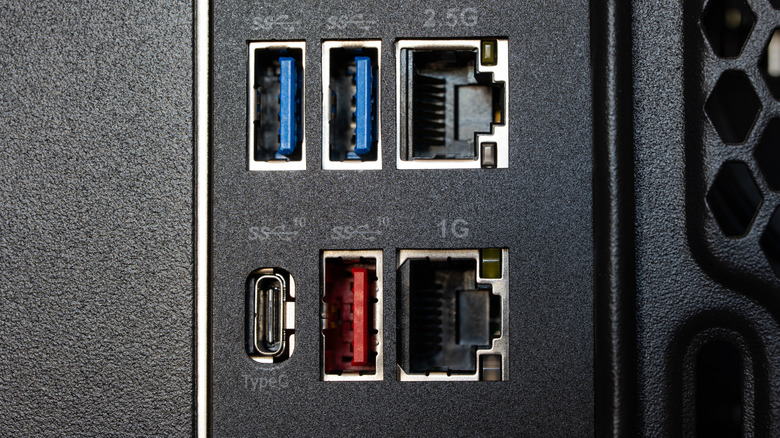
Octavian Lazar/Shutterstock
Red is generally the fastest of the color-coded USB-A ports and is commonly used for 10 Gbps to 20 Gbps connections. Yellow doesn't really have a spot on the speed ladder, and color charts can't even agree on its place. Corsair lists yellow ports as either USB 2.0 or USB 3.0, and USB Memory Direct's color guide places yellow on a level playing field with red.
If you see a teal USB-A port, you're probably looking at a USB 3.1 Gen 2 or USB 3.2 Gen 2 connection, with speeds up to 10 Gbps. Black and white USB-A ports sit on the lower end, while blue is typically 5 Gbps USB 3.0. Everything you just read is subject to manufacturers' discretion.
Charts just aren't a safe bet for confirming data transfer speeds. If a yellow port turns out to be USB 2.0, it'll work fine for a keyboard, mouse or basic accessories. An external SSD, on the other hand, needs to be plugged into a port with a 5 Gbps rating or higher.
While yellow may indicate Always On charging, the only way to know for certain is to check for a label or icon, then confirm it in the user manual or on the manufacturer's spec page.
KioskNews shows a cleaned-up reading view extracted from the publisher’s page — the original always lives on their site, not ours.