OAC and university developing maritime AI drone system
COORDINATED MISSIONS: The system would bolster Taiwan’s maritime defense, rescue capabilities and whole-of-society resilience, the Ocean Affairs Council said
By Shelley Shan / Staff reporter


The Ocean Affairs Council (OAC) yesterday said it is funding a National Cheng Kung University (NCKU) team to develop an artificial intelligence (AI)-powered system to coordinate different types of drones to enable wide-area maritime surveillance and sustained monitoring.
Developing a multilayered coast guard surveillance network and enhancing maritime domain awareness are core strategies to address maritime law enforcement needs and various forms of “gray zone” harassment from China, the council said.
Regional conflicts in the past few years have shown that drone technology has evolved from single-aircraft operations to coordinated missions involving multiple types of drones and fleets operating in swarms, it said.
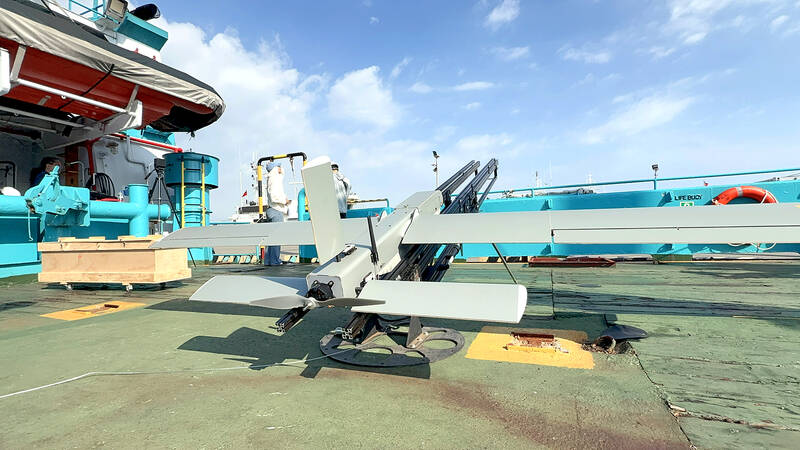
A fixed-wing drone developed by National Cheng Kung University is pictured in an undated photograph.
Photo courtesy of the Ocean Affairs Council
The AI-powered drone swarm system being developed by the research team achieved a breakthrough by coordinating different drone fleets, providing wide coverage and continuous monitoring over territorial waters, the council said.
“This system would bolster Taiwan’s maritime defense, rescue capabilities and whole-of-society defense resilience,” it said. “It has laid a solid technical foundation to build a smart and multilayered coast guard patrol system and demonstrated Taiwan’s research and development capacity in marine technology and smart aerospace sectors.”
The team, led by the university’s aeronautics and astronautics associate professor Chueh Chih-che (闕志哲), built an intelligent multiple drone operating system by integrating AI, vertical takeoff and landing fixed-wing drones, flight dynamics, and swarm coordination and control technology.
The team explored the strengths and control models of three types of drones used in the project — Jump 20, V-Bat and Flexroter — through 3D shape modeling, aerodynamic parameter analysis and “six degrees of freedom” flight simulation, the council said.
The team further used AI multi-agent reinforcement learning technology to enable multiple drones to autonomously assign missions, plan flight paths and coordinate with one another, flying in formation like a flock of geese.
To improve formation flexibility and flight safety, the research team incorporated “leader-follower formation control” and “intelligent dynamic obstacle avoidance,” enabling the drone swarm to adjust its flight path according to mission requirements and autonomously respond in real time to sudden environmental changes or obstacles, the council said.
The team has completed simultaneous flight simulations of two drone fleets, comprising a total of 20 drones, it said.
To avoid drone swarm collisions, the team has incorporated into its control algorithm the 3D separation distance and a minimum vertical separation of 30.5m, the council said.
The team would further test the reliability and feasibility of drone fleets under different marine environments by conducting hardware-in-the-loop and prototype integration tests, as well as real-world flight tests over open water, it said.
KioskNews shows a cleaned-up reading view extracted from the publisher’s page — the original always lives on their site, not ours.