Orange skies in Indonesia as haze crisis spreads
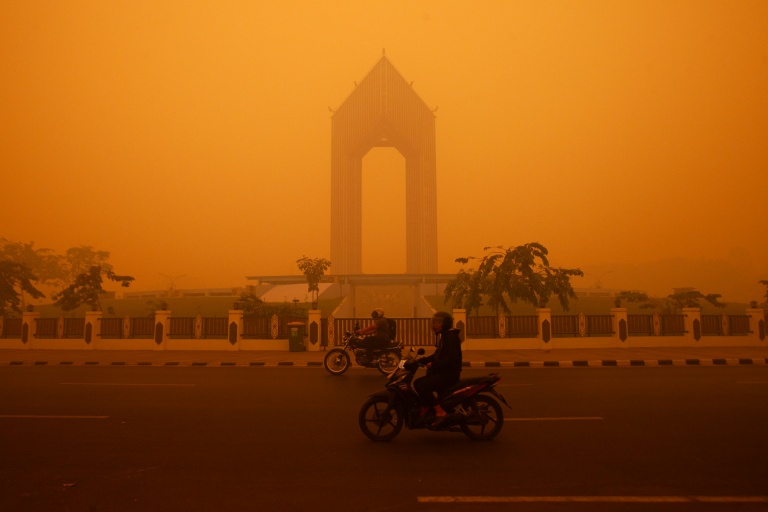
PALANGKARAYA, Indonesia - Thick haze turned the skies in this Central Kalimantan city apocalyptic shades of yellow and orange on Thursday, reducing visibility to a few dozen metres as wildfires cause a regional air pollution crisis.
Kuala Lumpur topped the IQAir ranking of most polluted major global cities by Thursday, followed closely by Singapore, and with Indonesia’s Medan and capital Jakarta just behind.
Fires burning for months in Indonesia have sent smoke across the region, and on Thursday Timor-Leste began a three-day school closure prompted by the haze.
But those most affected are residents at the epicentre, including in Kalimantan’s Palangkaraya where skies turned deep orange on Wednesday night and remained a grimy yellow on Thursday.
“These past few days, the smoke has been thick, and since I work outdoors, I’m forced to breathe it in even though I wear a mask,” said motorbike taxi driver Heri, who like many Indonesians uses a single name.
“My eyes have started to sting because of the dust from the burned debris flying around in the smoke,” he told AFP.
“I still have to work and have been struggling in the haze for four months now, if I don’t work, I won’t earn any money. Everyone is forced to fight against this dense smoke.”
‘Very dangerous’
In Timor-Leste, people were out in the capital Dili under a yellow-tinged sky, but most were wearing masks, as the government advised a day earlier in announcing the school closures.
Residents welcomed the decision, although they said the pollution had been even worse earlier in the week.
“Recently, the pollution in Dili has been very severe,” 30-year-old midwife Sonya da Costa Soares told AFP.
“We can’t see the sun, the pollution is heavy,” she added.
Though her child is still too young for school, she said the decision to keep students home was “very important so that children are not put in danger.”
Indonesia experiences wildfires regularly during its dry season, but this year the blazes have been especially severe because a strong El Nino has brought drought.
The fires have burned through hundreds of thousands of hectares of forest and plantations in Sumatra, Borneo and Papua, and caused air pollution to surge locally, as well as in Malaysia, Singapore, the Philippines and Timor-Leste.
Vitaliano da Costa Calapes, an 18-year-old student at Dili’s St. Ignatius Loyola College, said he was preparing for upcoming exams.
“We believe in the coming days there will be no pollution and school will return to normal, that’s what we hope,” he said.
Felicidade Alves dos Santos Martins, whose daughter Febrianti was home from middle school, said the pollution had been even worse earlier in the week.
“It felt like smoke from fires was covering all of Dili and the mountains,” she said. “This pollution is very dangerous, it can make us sick.”
Dry ice experiment
Indonesia has deployed tens of thousands of firefighters to tackle the blazes, but has struggled to bring the flames under control.
On Thursday, it was due to try dropping dry ice over parts of South Sumatra to “break up the smoke”, according to chief security minister Dudung Abdurachman.
“God willing, if it succeeds we will continue in other key regions,” he said announcing the plan Wednesday.
Research has found much of the haze comes from fires burning in peatlands.
These blazes are difficult to extinguish because they burn underground when the normally water-logged ecosystems are dried out for cultivation.
While drought contributes to the fires, experts say deforestation and drying of peatlands has damaged previously fire-resistant landscapes.
The estimated cumulative total estimated fire emissions “still remain lower than in 2015,” Mark Parrington, senior scientist at Copernicus Atmosphere Monitoring Service told AFP.
But he noted there are still several weeks of fire season to go and “the air quality impacts have been very severe and persistent.”
KioskNews shows a cleaned-up reading view extracted from the publisher’s page — the original always lives on their site, not ours.