Between adolescence and parenthood: Photo stories of Filipino teen parents
Already have Rappler+?
to listen to groundbreaking journalism.
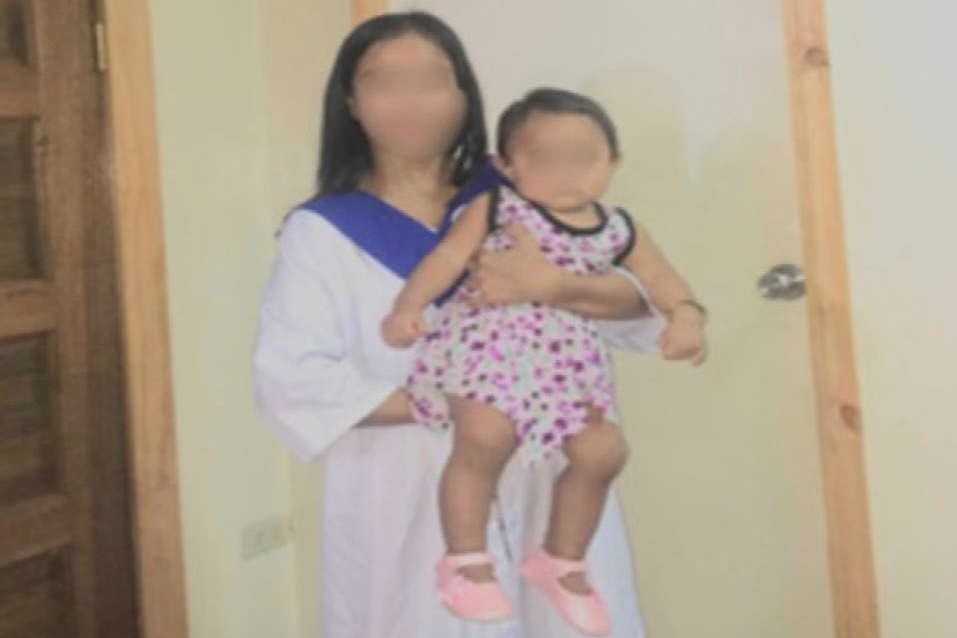
YOUNG MOM. “Joyce” holds her child in a photograph titled, “Hindi hadlang ang pagiging ina sa pag-aaral” (Motherhood is not an obstacle to studying), reflecting her experiences of pursuing her education while raising a child.
CONTRIBUTED PHOTO
Through photographs, young Filipino parents offer glimpses into lives shaped by responsibilities that arrived alongside adolescence
AT A GLANCE
- The study from Ateneo de Manila University explores the complex identities of teenage parents in the Philippines, highlighting their experiences through a photovoice approach.
- Teenage parenthood is a significant issue in the Philippines, with rising rates of teenage pregnancies and a need for better support systems and programs tailored to young parents' lived experiences.
- The research emphasizes the importance of involving young fathers in support programs and calls for gender-responsive strategies to address the challenges faced by teenage parents while recognizing their agency and ongoing development.
This is AI-generated. Read the article for full context. Report any errors.
“I’m a student, a worker, and a mother. Sometimes, I feel like I have three bodies.”
For this senior high school student, motherhood meant learning to carry several parts of herself all at once. Her days meant moving between school, work, and caring for her child — growing into adulthood, even while already being responsible for someone else.
This ongoing negotiation of identity, in which teens experience the push and pull of being adolescents and parents, is vividly illustrated in a new study from Ateneo de Manila University that explores through photographs — a research technique called “photovoice” — what it means to grow up while becoming a parent.
Teenage parenthood remains a pressing concern in the Philippines, with an estimated 150,000 teenage pregnancies recorded in 2022 and a 35% rise in births among girls younger than 15. Behind these statistics, studies point to gaps between existing laws and programs and teenage parents’ lived experiences, including stigma and inaccessible or irrelevant services.
Positioning teenage mothers and fathers at the center of the research process, this Ateneo study was conducted as a needs assessment to inform the development of a parenting program for teenage parents. It was designed and implemented by researchers Dr. Liane Alampay, Dr. Bernice Landoy Mamauag, and Jennel Reyes, in partnership with Masayang Pamilya Organization, Inc.
The researchers invited nine Filipino teenage parents, aged 15 to 20, from low-income communities in two provinces in Central Luzon, areas identified by the researchers’ partner organization as priorities because of their high rates of teenage pregnancy.
Through the photovoice approach, participants documented their lives by capturing or choosing images that represented their experiences and sharing the stories behind them, allowing their perspectives to inform the support and programs being developed for them.
There were no photography lessons, no tips on lighting or framing. Instead, participants were simply asked to make sure that their photographs represented something meaningful to them.
That distinction mattered. Because taking photographs was already part of the participants’ everyday lives, the method provided a familiar way to express their experiences. Some participants even used photographs symbolically rather than literally: crayons became a representation of family, while a permanent marker represented the lasting effects of sexual interactions.
What those images revealed was a life that could not be reduced to the label ‘teenage parent.’
Through their photographs, the young parents offered glimpses into lives shaped by responsibilities that arrived alongside adolescence. They spoke about uncertainty and conflict in their relationships, changes in friendships and family dynamics, and the demands of caring for a child while pursuing education or employment.
For one participant, motherhood existed alongside being a first year college student and a food server. For another, friends became family, highlighting the role of peers as a source of support and a safe space to speak openly.
Across their photographs and discussions, the researchers identified eight core themes: managing stresses and conflicts in partner relationships; peers as a source of emotional support; support and strain in family relationships; shifts in normative adolescent experiences and priorities; strain and agency in balancing roles; desire to enhance parenting knowledge and skills; environmental drivers of early sexual exposure; and sexual knowledge from social media.
Viewed through the lens of Life Course Theory, these challenges are shaped by relationship dynamics and structural norms in low-resource contexts, influencing the transition to parenthood.
The researchers found that teenage parents navigated these circumstances in different ways. Some continued their education or pursued employment, while others expressed a desire to improve how they cared for and related to their children. The researchers saw these choices as forms of agency amid the constraints they faced.
Fathers and partners emerged in the narratives in contradictory ways: as sources of both stress and support.
Several mothers described conflict-laden relationships marked by imbalanced household responsibilities, financial control, and verbal and physical conflicts, tensions compounded by the adolescents’ still-developing emotional regulation capacities. Yet when fathers shared caregiving, this enabled mothers to continue their education, illustrating how paternal involvement functions as a critical resource.
The paper calls for gender-responsive strategies to bring young fathers meaningfully into support programs to strengthen family functioning, and to shift the traditional gender norms that leave adolescent mothers disproportionately bearing the burdens of early parenthood.
The Ateneo study underscored the need for accessible counseling, healthier communication and conflict resolution, and stronger support systems for young parents, alongside comprehensive sexual and reproductive health education.
At the heart of the study is the recognition that teenage parenthood is shaped by more than its challenges. It is also shaped by the relationships, circumstances, and choices through which young people find their way.
The photographs did not offer a single story of teenage parenthood — one where becoming a parent becomes the whole story of a young person’s life.
Instead, they opened a window into lives shaped by relationships, responsibilities, uncertainty, support, and choices. They revealed young people who are still growing and still finding their way while learning to care for someone else. What emerged were stories still unfolding, of young people still becoming. – Rappler.com
Nina Linly Capulong, Liane Peña Alampay, Bernice Landoy Mamauag, and Jennel Drezza Fe C. Reyes published their research, “Using Photovoice and Life Course Theory to Understand the Lived Experiences of Filipino Teenage Parents,’ in the August 2026 issue of the Journal of Research on Adolescence.
KioskNews shows a cleaned-up reading view extracted from the publisher’s page — the original always lives on their site, not ours.