‘No beardos, no weirdos’: Hegseth deepens Pentagon purge as China channels reopen
As Beijing and Washington take tentative steps to keep a military crisis from erupting, US Defence Secretary Pete Hegseth is reshaping the top ranks of the American military while facing questions about his own future at the Pentagon.
Hegseth told junior officers and sergeants on Wednesday that the military had already cut its generals and admirals by 10 per cent and planned to cut another 10 per cent. He called the 20 per cent reduction the bare minimum, dismissing critics who called the shake-up a “purge”.
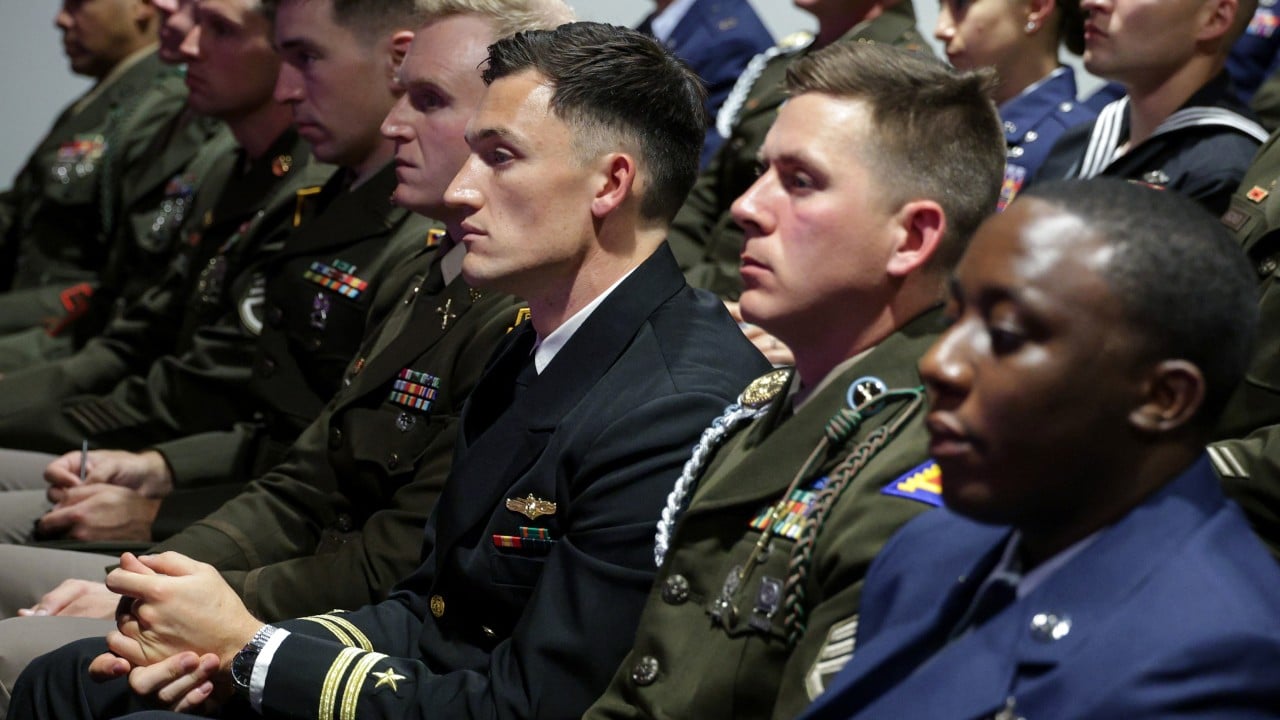
“The number crunchers say we fired 10 per cent of the generals and admirals across the force, and that number sounds about right,” Hegseth said in a “State of the Force” address at Marine Corps Base Quantico in Virginia.
“And I know, because I directed it, that we’ve also reduced the overall number of general officer slots by an additional 10 per cent. So yes, a 20 per cent reduction across the board.”
“The media calls that a purge,” he said. “I call it accountability, and long overdue.”
Hegseth also used the speech to spell out the kind of force he wants. He used a string of derogatory terms for people he said should not serve in the military: “No fatties, no t******s, no beardos, no weirdos, no wimps, no radicals. Just warriors.”
The larger cut is due to be completed by January 1 next year. It doubles an order from May last year calling for at least a 10 per cent reduction in general and flag officers.
The cuts were only one part of Hegseth’s plan. He also announced a four-star Autonomous Warfare Command with service-like authorities to accelerate the development and deployment of drones and robotic systems across the military.
“The pace of war is changing faster than the process to support it,” he said.
An interim programme, Project Agincourt, will run for the next year under Defence Innovation Unit head Owen West and US Navy Seal senior chief Max Strasiser. It will bring operators, engineers and private companies together in shorter development cycles, with decisions and funding pushed closer to combatant commands. A four-star commander has yet to be named. The command is expected to be fully established by October 1 next year.
Hegseth also announced a 120-day study of future warfare, Project Meridian, to be led by Elon Musk, Anduril Industries co-founder Palmer Luckey and former US House speaker Newt Gingrich. Pentagon technology chief Emil Michael will oversee the project.
Hegseth said the study was not intended to produce a new strategy, but to “identify the domains that we must conquer, and capabilities we must master”, from below the ground to beyond the moon. None of the three co-leaders has served in the US military. Musk and Luckey already hold multibillion-dollar defence contracts.
SCMP Plus is a new premium news platform that gives you an
all-inclusive edge to stay ahead on China news.
To access our exclusive content you’ll need to subscribe.
Already a subscriber?
LOG IN
Hegseth’s speech came just four days after China’s foreign ministry said Beijing and Washington had agreed to conclude a memorandum on “crisis communication and prevention” as soon as possible.
The agreement was reached at the summit between Chinese President Xi Jinping and his American counterpart Donald Trump in Washington from September 23 to 25.
People familiar with the matter said communication had improved at multiple levels – not just between the two defence ministers – since Trump returned to power in January last year.
On July 29, US deputy assistant defence secretary Alvaro Smith told a reception at the Chinese embassy that the channel was “stronger than it has been in years” and that a repair was proceeding under Hegseth.
But Hegseth’s own position has grown precarious.
The SCMP reported in August that Trump was privately losing patience with the stalled Iran war and that Hegseth was close to losing his job. The White House has since said the president has complete confidence in the Pentagon chief.
The New York Times reported on Wednesday that Hegseth’s relationship with Republican lawmakers had deteriorated. A Democratic takeover of the US House of Representatives on November 3 could bring renewed calls for his impeachment. Republican congressman Thomas Massie filed articles of impeachment against Hegseth last month.
The New York Times reported last month that Hegseth had fired or blocked the promotions of more than 80 generals and admirals.
The Trump administration has overseen a rapid shake-up of top military brass, replacing five of the eight members of the Joint Chiefs of Staff – the senior military officers who advise the president. The departures have included Joint Chiefs chairman General Charles Q. Brown Jnr and Admiral Lisa Franchetti, both of whom were dismissed early last year.
The turnover has also extended to the Pentagon’s civilian leadership, with US Army Secretary Dan Driscoll resigning on September 1.
The Iran war hangs over the shake-up.
A CNN/SSRS poll conducted in mid-September found that just 26 per cent of US adults approved of Trump’s handling of Iran. Among Republicans, approval had fallen from 73 per cent in March to 60 per cent.
A Reuters/Ipsos poll on September 21 put Trump’s approval at 32 per cent, a career low, and found registered voters preferring Democrats over Republicans for the midterm elections by 43 per cent to 35 per cent.
At Quantico on Wednesday, Hegseth defended the war as an operation “every red-blooded American is proud of” and said reporting he disliked was “treason, actually”.
KioskNews shows a cleaned-up reading view extracted from the publisher’s page — the original always lives on their site, not ours.