Donovan’s Deep Dives: Taiwan’s defense buildup needs more than shiny new toys
New fighters, tanks and ships are arriving, but personnel shortages threaten Taiwan’s ability to turn hardware into combat power
By Courtney Donovan Smith / Staff Columnist


On Oct. 2, after years of delays, Taiwan’s air force took delivery of the first two F-16V Block 70 fighter jets at Chihhang Air Base in Taitung County. In a sign of how eagerly anticipated this arrival was, speculation and rumors had been flying as to why they had been sitting for weeks in Hawaii en route to Taiwan.
These are part of a total of 66 F-16V Block 70s on order. There are hopes the rest will arrive by the end of next year, but no one will be surprised if that extends into 2029 or even later. Worse, in the two that have already arrived, according to an Air Force briefing of the legislature on Oct. 12, the Viper Shield electronic warfare suite is only partly installed and its software is still in development
On Sept. 24, AIDC delivered the final two aircraft in the 66-aircraft Brave Eagle trainer program. One aircraft had previously been lost in a crash. In July, the last AT-3 jet training mission ended, and the F-5E/F jets are being phased out.
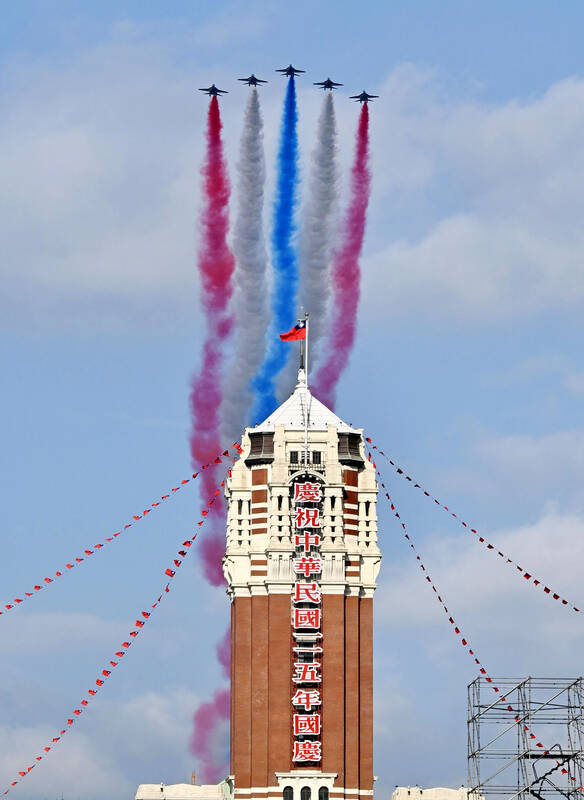
Brave Eagle jet trainers fly past the Presidential Office Building on Oct. 2.
Photo: Peter Lo, Taipei Times
Taiwan’s armed forces — the Army, Navy, Air Force and Military Police — and Coast Guard are in the midst of a boom in (typically delayed) arrivals of shiny new weapons systems and kit. Far more is on order or planned. According to Taiwan Security Monitor’s September estimate, there is a US$29.72 billion (NT$968 billion) backlog in orders from the US.
Alongside the increased annual defense budget, lawmakers approved a special procurement framework authorizing up to NT$780 billion in US arms purchases over 2026–2033, subject to subsequent appropriations. Separately, the government is investing NT$44.2 billion over 2025–2030 in developing Taiwan’s drone industry.
In April, the Army received the final batch of the controversial 28 M1A2T Abrams tanks purchased from the US, bringing the total to 108. The Army is also planning to procure 178 domestically developed Cheetah armored vehicles between next year and 2033.
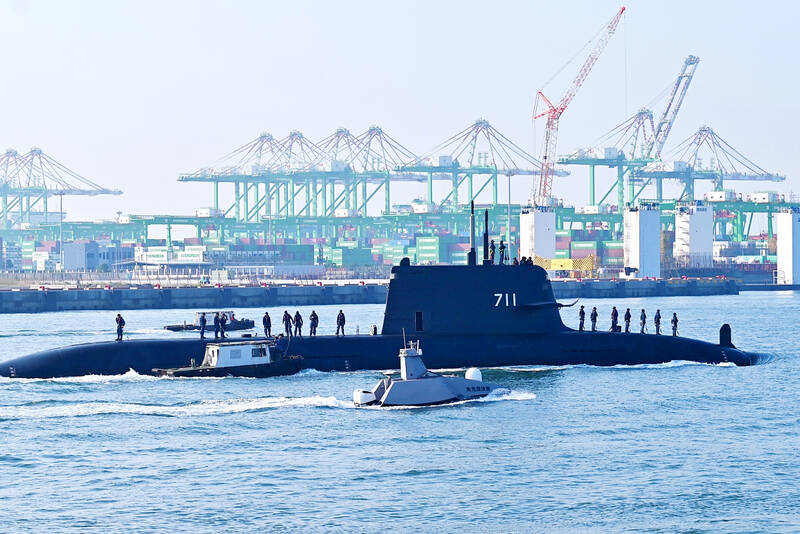
Taiwan’s first domestically built submarine, the Hai Kun (Narwhal) on Oct. 15 makes a test run in Kaohsiung.
Photo: Lee Hui-chou, Taipei Times
According to a Taipei Times report last month citing a military expert, Taiwan’s first domestically built submarine, the Hai Kun (Narwhal, 海鯤), could be delivered to the Navy as early as this month. This is the first of eight planned submarines.
Both the Navy and Coast Guard have been taking delivery of various types of ships in recent years. On Oct. 2, the keel-laying ceremony was held to launch construction on the Coast Guard’s second 5000-tonnes high-latitude oceanic patrol vessel, out of a planned six total by 2031.
These examples highlight some of the flashier headline-grabbing additions currently flooding into system to defend Taiwan, but there are many, many more. There are smaller ships growing the Navy and Coast Guard fleets, mine-layers and missile systems for the Army and Air Force and hardly a day passes without some missile, unmanned vehicle or drone program being announced.
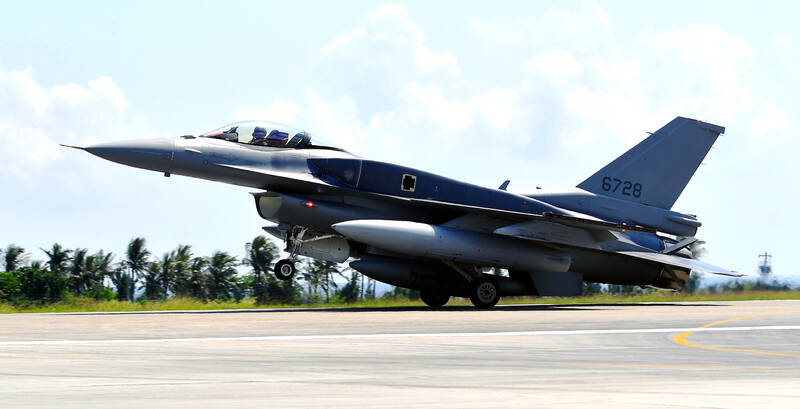
An F-16V Block 70 fighter jet, one of two delivered to Taiwan from an order of 66 aircraft from the US, on Oct. 2 arrives at the Chihhang Air Base in Taitung County.
Photo: Yu Tai-lang, Taipei Times
Surely that is all good news, right? Maybe.
PEOPLE NEEDED
To illustrate the problem, imagine if you received a top-of-the-line Formula 1 racing car. No doubt for many fans, that would sound like a dream come true. But what would you do with it?
A first thought would be: how do I drive this thing? These are not for amateurs; you had better get some training.
On reflection, the challenge gets harder. They require pit crews, supply chains of highly specialized and very expensive parts, and specialists to keep them in top running condition. There are legal and insurance issues, never mind finding a place to simply park it.
The challenges would be enormous, but nothing compared to what is required to fly and maintain those two new F-16V fighters and the 64 more that are expected to arrive soon. They will join 139 older-version F-16s, 52 aging French Mirage 2000s, 129 indigenously developed F-CK-1 Ching-kuo fighters and the aforementioned Brave Eagles.
Despite the Hollywood glamor and prestige of flying a fighter jet, the Air Force is struggling to maintain enough pilots for its existing fleet. They may struggle to have enough pilots for the new jets as they arrive, or be required to ground existing ones.
It takes years of flight, simulator and operational training to prepare a fighter pilot. In a report to the legislature, the Ministry of National Defense proposed scrapping the maximum length of service for air force pilots amid a shortage of experienced pilots, many of whom leave the military to fly for civilian airlines. Reportedly, civilian pilots make about NT$100,000 to NT$200,000 more a month.
Under current law, pilots holding the rank of lieutenant colonel can serve a maximum of 26 years and colonels a maximum of 30 years, so pilots at these ranks must generally leave military service at about 48 and 52 years of age, respectively. The new proposal would extend their service to around age 58.
If the Cabinet approves the proposal and it takes effect, the ministry aims to retain 72 pilots ranked lieutenant colonel or colonel in service longer. Hopefully, the proposal is accepted and all those pilots are retained; they will be needed.
The problem is that may not be enough. Gray zone incursions by Chinese forces are in part designed to wear down the personnel and the jets themselves. Exhaustion may make those higher-paid civilian jobs, with their regular schedules, look even more appealing.
Now spare a thought for the equally critical, highly skilled crews needed to keep those planes flying. They face all the exhaustion and stress without the sexy job title of fighter jet pilot. Does the Air Force have enough of them?
‘GOOD AS DEAD’
Recently, gray zone incursions have increasingly been at sea. The brunt of handling those falls on the Coast Guard, and there the situation is dire.
A report by the National Audit Office found that at the end of June last year, of 108 vessels in service, only four had a full complement of sailors. That means that 96 percent were sailing without full crews. The same report found that the problem is getting worse, just as the Coast Guard is rapidly adding new vessels.
A report in Storm Media paints a grim picture. Because gray zone incursions can happen at any time, sailors can be forced to respond, regardless of holidays or personal plans. The Chinese can use their far larger navy and fishing boat militia to probe endlessly.
That report describes how in calmer times, a three-day tour meant exactly that. Now, sailors on vacation can be called to active duty for up to 15 days, put in dangerous standoffs with Chinese vessels and often called to duty sleep-deprived. With spotty cell phone service, one insider quoted in the report told Storm that some spouses complain that their husbands are “as good as dead.”
Unsurprisingly, despite offers of high salaries right out of police colleges, the Coast Guard is struggling to recruit sailors willing to take on this challenging, unglamorous and exhausting job that offers little personal freedom or control over their lives.
The government is acutely aware of all of this, and has actively been working to boost pay and benefits to make these jobs more appealing. They have also restored the one-year mandatory conscription, up from four months, which may help with some of the more mundane tasks.
Already struggling with personnel issues in both the military and Coast Guard, and with automation filling the gaps years away, the ability of the military to handle the influx of new platforms is a significant concern.
Though they disagree on how to go about it, both the administration and opposition parties agree that making these careers more attractive is a priority.
Faced with a demographic meltdown, they have their work cut out for them.
Donovan’s Deep Dives is a regular column by Courtney Donovan Smith (石東文) who writes in-depth analysis on everything about Taiwan’s political scene and geopolitics. Donovan is also the central Taiwan correspondent at ICRT FM100 Radio News, co-publisher of Compass Magazine, co-founder Taiwan Report (report.tw) and former chair of the Taichung American Chamber of Commerce. Follow him on X: @donovan_smith.
KioskNews shows a cleaned-up reading view extracted from the publisher’s page — the original always lives on their site, not ours.