Korea’s Q2 current account surplus tops Germany and Japan combined for first time
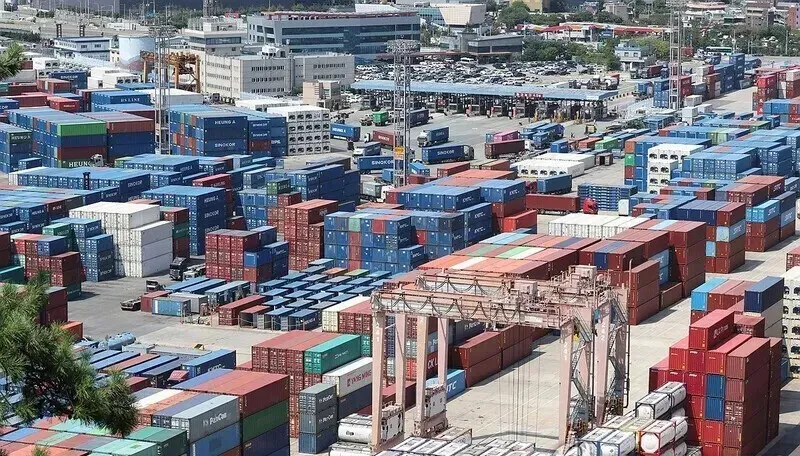
Freight containers fill Busan Port. (Yonhap)
Korea’s current account surplus in the second quarter exceeded the combined surpluses of Germany and Japan, two of the world’s leading manufacturing countries, the latest figures show.
Data from the International Monetary Fund accessed through the Bank of Korea’s Economic Statistics System on Sunday showed Korea posting a current account surplus of US$116.63 billion in the second quarter. That was second among 36 major economies, behind only China’s $193.72 billion.
Germany came in third with US$52.28 billion, followed by Japan with US$50.62 billion. Their combined surplus of US$102.89 billion was US$13.74 billion short of Korea’s.
Korea’s second-quarter surplus was about 4.1 times larger than its surplus of US$28.39 billion in the same period last year. By comparison, Germany’s surplus grew 11.9 percent and Japan’s only 5 percent.
Korea also ranked second in the first half of the year, with a surplus of US$191.01 billion, behind China’s US$378.03 billion. It was well ahead of Germany (US$126.39 billion), Japan (US$112.12 billion), Norway (US$55.32 billion), Switzerland (US$51.03 billion) and the Netherlands (US$50.54 billion).
The trend has continued into the third quarter. Korea’s combined surplus for July and August was US$88.19 billion, US$7.37 billion more than the combined total of Germany and Japan, which stood at US$80.82 billion. Germany’s surplus over those two months was about US$36.85 billion and Japan’s about US$43.97 billion.
In its October World Economic Outlook, the IMF projected Korea’s current account surplus for this year to reach US$421.95 billion. That ranks second among 190 countries and territories, behind China’s US$863.21 billion, and is three places higher than South Korea’s fifth-place finish last year.
The Bank of Korea is even more optimistic. In its assessment of economic conditions published Thursday, the central bank said, “The current account surplus is expected to remain large and exceed the previous forecast [of US$450 billion for the year], supported by robust semiconductor exports.”
The IMF expects Korea’s surplus to stay above US$400 billion next year and in 2028. It then forecasts a fall to US$295.66 billion in 2029 and US$177.49 billion in 2031.
Behind that projection is the assessment that the boom in semiconductor exports, which drove the surge in the surplus, may soon reach its limits. That is because the boom has relied more on rising prices than on growing volume. The forecast also assumes that competitors, especially China, will increase their chip supply.
KioskNews shows a cleaned-up reading view extracted from the publisher’s page — the original always lives on their site, not ours.