Navy planning for submarine rescue vessel
SUBMERGED RESCUE: The fleet wants at least one dedicated submarine rescue vessel in commission in order to support its expanding complement of submarines
By Lo Tien-ping and Jonathan Chin / Staff reporter, with staff writer


Taiwan is planning to build an NT$13.8 billion (US$420.2 million) submarine rescue ship from next year to 2034, with the possibility of at least one more to ensure redundancy, the Ministry of National Defense said.
In a proposed budget report to the Legislative Yuan, the defense ministry said it would build one submarine rescue ship first to provide a search-and-rescue capability for the navy’s planned 10-boat submarine fleet.
When asked, multiple sources in the armed forces said the budget plan’s phrasing, which emphasized that the ship would be a “first” purchase, suggests an intent to buy at least one more ship in the future.
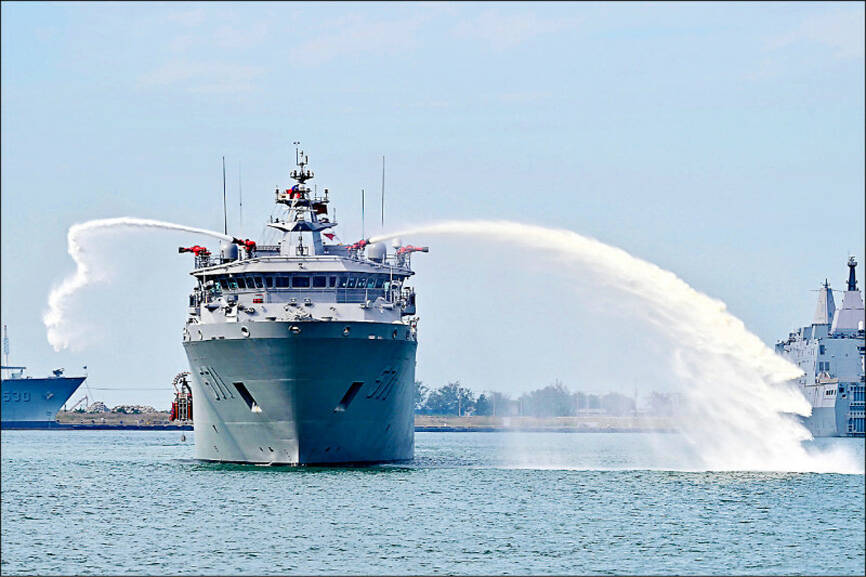
The Da Wu-class rescue and salvage ship is pictured in an undated photograph.
Photo: Taipei Times
Submarine rescue ships are not often used, but they must be available when needed, which means the navy needs to keep at least one extra vessel in readiness, they said.
The navy is unlikely to bend on that point, as maintenance and repair of a submarine rescue ship typically takes several months at a time, the sources said.
One rescue ship for every 10 to 20 submarines is a common rule of thumb for the world’s navies, including South Korea, which operates two rescue ships on rotation for its fleet of 20 subs, they said.
Taiwan, with the complex submarine topography in the nearby seas, requires at least two rescue ships, both for redundancy and the capability to deploy one rescue vessel each in the main island’s western and very deep eastern seas, they said.
Budget realities dictate that the armed forces must first secure the funding to obtain a capability before thinking of perfecting it, sources said.
The first ship would be an important test bed for the navy to refine the system integration between the rescue ship and its deep submergence rescue vehicle, as well as practicing rescue operations, they said.
The budget outlined plans for the navy to acquire two additional Da Wu-class rescue and salvage ships to field additional vessels capable of surface towing and submarine rescue to a depth of 100m.
The Da Wu-class ships would be expected to enter service concurrently with the dedicated submarine rescue ship to compose a high-low mix in the navy’s search-and-rescue capabilities, sources said.
Separately, a defense official said the navy envisions fielding its 10 planned attack submarines as ambush weapons from the deep against high-value enemy vessels at strategically crucial waterways.
Commenting on condition of anonymity, the official said the service is confident that a small, highly-trained submarine force can effectively counter superior Chinese numbers, if asymmetric tactics are used.
Building 10 submarines is key because this number would allow the navy to deploy three subs, retrain three subs and put the remaining three to four vessels through rest and refit, they said.
If the navy deploys the submarines in a conflict with China, the boats would fight primarily in the depths of the Miyako Strait, the Bashi Channel and the seas east of Taiwan proper, not the shallow waters in the Taiwan Strait, they said.
Fighting Chinese ships head-on in the strait would be an inefficient deployment scheme, when Chinese carriers, amphibious assault ships and supply lines could be attacked more effectively at chokepoints, they said.
Superior knowledge of the underwater topography and quieter diesel-electric design would be crucial for the success of Taiwanese submarine tactics, they said.
The Hai Kun (Narwhal, 海鯤) and improved Chien Lung-class submarines, using US sonar, combat systems and anti-submarine aircraft support would be able to reach advantageous ambush positions before their Chinese opponents, they said.
The navy has devoted considerable effort over the years to map the topography of Taiwan’s surrounding ocean floors to identify sonar blind spots and build a three-dimensional anti-submarine kill net, the official said.
The expansion of the Taiwanese submarine fleet is a necessary response to the increasing military build-up of the Western Pacific, they said.
The navy’s strategy does not reflect an intention to fight an all-out war with China in the open ocean, but to keep Chinese military planners wary of the submarine threat.
Taiwan’s ability to threaten key waterways means that China would have to deploy 10 times the resources to anti-submarine warfare, which would slow down the pace of Chinese naval operations and buy time for Taiwan, they said.
KioskNews shows a cleaned-up reading view extracted from the publisher’s page — the original always lives on their site, not ours.