Watch – The pipeline between US white supremacists and the SA right
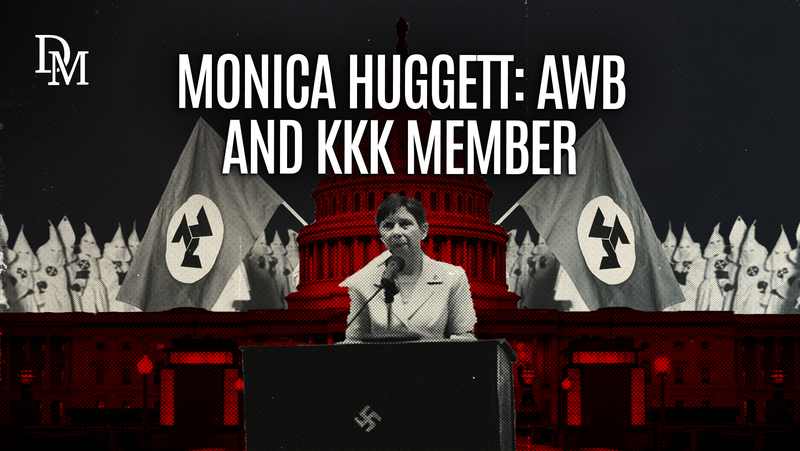
Decades before Ernst Roets lobbied the US, a little-known Kempton Park woman linked the AWB to global neo-Nazis – a story that sheds light on international support for the farm murder cause.
Reporting by: Rebecca Davis
Filmed by: Joel Seboa
Edited by: Anda Tolibadi
Produced by: Emilie Gambade
Creative lead by: Malibongwe Tyilo
Sub-edited by: Kevin Flynn
Support journalism that protects democracy. Become a Maverick Insider.
Over the past few years, we South Africans have become used to hearing that groups like Afriforum and its recent spin-off Lex Libertas have been visiting Washington in an attempt to convince influential Americans that white people in South Africa are being treated very badly. In reality, campaigns of this kind in the US focused on South Africa are not new - it’s just that up till now, they have been driven by some of America’s most notorious white supremacists. To help illustrate the historical ties between these groups and their counterparts in South Africa, I need to tell you the extraordinary true story of a tannie from Kempton Park who helped forge links between the AWB and the Ku Klux Klan.
I’m Rebecca Davis, senior journalist for Daily Maverick.
Let’s go back 14 years ago, to February 2012, when a small group of white supremacists climbed off a charter bus in Washington DC and set off towards the US Capitol.
All but one of them were men, wearing neat shirts and ties. The Anti-Defamation League reported that they had been given instructions in advance on how to dress; they were told no Ku Klux Klan robes, no Nazi uniforms, and all racist tattoos to be covered, because they were posing for the day as civil rights activists.
At the Capitol, they unfurled a banner reading “STOP WHITE GENOCIDE IN SOUTH AFRICA.”
Standing between two men holding the banner was the group’s only woman, around 70 years old and wearing what Americans might have taken as a somewhat severe-looking khaki shirt. In reality it was a uniform stripped of its original insignia, which consisted of three interlocking red number sevens radiating from a central point: the symbol of the Afrikaner Weerstandsbeweging (AWB). She always wore it on occasions like this.
The woman’s name was Monica Huggett, and she was a long way from her birthplace of Kempton Park. Her story is virtually unknown in South Africa these days, but last year it was painstakingly reconstructed by American researcher Molly Conger for the podcast ‘Weird Little Dudes’.
In 2012, 14 years before Ernst Roets’ group Lex Libertas would set up a farm murder protest in almost exactly the same spot in Washington, Huggett had helped mobilise small-scale demonstrations in this and 12 other sites across the USA under the umbrella of a campaign called the South Africa Project.
She was able to do this because since the 1970s, Huggett had been working to build relations between white nationalists in South Africa and the US: a transnational relationship which current farm murder activists are still tapping into.
Monica Huggett’s story starts for our purposes in 1980, when she first appears in the historical record. Before then, all we really know is that she was the daughter of a past Kempton Park mayor.
In 1980, Huggett emerges in media reports from the time as a member of the Wit Kommando: a tiny white terrorist group whose targets included thinktanks and university academics associated with promoting racial integration.
When Huggett and other members of the group were arrested, police found an arsenal of weapons including hand grenades, landmines, rifles, a machine gun and thousands of rounds of ammunition. Huggett turned state witness.
In court she said: “I was opposed to racial integration, and I still am”.
She told the court that she was a member of both the Wit Kommando and the American Ku Klux Klan, and had obtained bomb-making manuals from her American KKK contacts.
Now this shows that by 1980, information and practical material was already moving between the American and South Africa white rights.
Molly Conger, the US podcaster who stumbled on Huggett’s story, couldn’t find any trace of Huggett’s activities after that 1980 arrest until over a decade later, and neither could I when I searched.
But Huggett resurfaced in the 1990s, while South Africa approached majority rule. She was by this time a loyal soldier of Eugene Terreblanche’s AWB - which was highly unusual for a woman in the intensely patriarchal world of organised white extremism. She was later described as the only woman to have served prison time for her involvement in the AWB.
Huggett placed ads in European fascist magazines to recruit mercenaries to assist the AWB in violent resistance to the transition to democracy. On arrival in South Africa, Huggett would collect the men from the airport and house them at her home until they were given their AWB assignments.
But in March 1994 the operation began coming apart after a shootout with police in which German mercenary Thomas Kunz was killed. Huggett was caught redhanded with a stockpile of weapons. The amount of time she spent in prison, if any, is unclear - but shortly after South Africa’s first black president entered office, Huggett took off for the US.
There’s about 14 000 kilometres separating Kempton Park from Louisiana, where Huggett settled, but her ideological transition appears to have been quite smooth. Huggett found love with a former staff member of the Ku Klux Klan Grand Wizard David Duke, and quickly established herself as an indispensable member of the thriving Louisiana white supremacist scene.
By 2011 Huggett was addressing the Aryan Nations World Congress on the alleged “white genocide” in South Africa in her AWB uniform. The following year she helped launch the South Africa Project, which attempted to draw national attention to the plight of white South Africans.
The Anti-Defamation League reported at the time that participants in the South Africa Project represented all five major strands of organised American white supremacy: neo-Nazis, racist skinheads, traditional white supremacists, Christian Identity adherents and racist prison gangs.
Despite the perils Huggett apparently believed white South Africans faced, she moved back home to live in Kempton Park after the death of her American husband in 2012. There she ran a charity called the Living Waters Foundation, notorious for only providing assistance and food parcels to whites. The foundation’s last Facebook post was in 2021, but there are hints that Huggett, who would now be in her mid-80s, is still alive: Conger found online comments seemingly posted by Huggett as late as 2025.
I emailed Huggett recently requesting an interview, but never received a response.
Even though Huggett has faded even further from public view, her status on the extreme right has endured. Simon Roche, the leader of far-right local group the Suidlanders, was asked on an American neo-Nazi podcast in 2018 which South African organisation people should support if they did not trust his own.
He recommended Huggett, describing her as a “very distinguished, decent lady who has fought for white nationalism”.
Then Roche added: “She’s probably a bit too right-wing for me”.
There was a good reason why Huggett chose to focus her US campaign targeting South Africa on crime. Research shows that one of the most important themes in American white supremacist propaganda for centuries has been the idea that whites are disproportionately the victims of murder by black people, that these attacks are always motivated only by racial hatred, and that the media conspires to conceal the real scale of the crisis.
A number of US white supremacist groups have tried to keep records of white victims of black criminals in America. Just one problem: the available US crime data does not remotely support the idea that there is an epidemic of black-on-white homicide there, with FBI and Department of Justice figures showing that more than 80% of white murder victims are killed by whites.
This is where South Africa comes in, because here there is one particular demographic sub-set - white farmers - who are indeed crime victims, often at the hands of black perpetrators, to an extent which is useful for the argument of US white supremacists.
The plight of Afrikaans farmers crops up again and again in far right propaganda internationally as a cautionary tale of what happens in a country when white farmers population numbers fall below a critical threshold. Norwegian neo-Nazi Anders Breivik, who killed 77 people in his 2011 Oslo attack, wrote a manifesto in which I found at least 44 references to South Africa specifically focused on the issue of farm murders, lamenting “the diabolical way blacks are persecuting whites and massacring the Boers”.
Far-right US campaigning on South Africa did not stop when Monica Huggett moved back to Kempton Park. In 2018, US white supremacist group Identity Evropa staged a farm murder demonstration outside South Africa’s embassy in Washington which had obvious similarities to the 3000 White Crosses on Washington event which Ernst Roets’ group Lex Libertas would stage in September 2026.
In the 2018 protest, Identity Evropa members draped a “Kill the farmer, kill the Boer” banner on the Nelson Mandela statue outside the South African embassy and placed 50 white crosses decorated with South African flags on the lawn.
Identity Evropa was by that stage one of the most notorious white supremacist groups in the US, having helped organise the 2017 Unite the Right rally in Charlottesville, and having been credited with popularising the racist slogan “You will not replace us”.
Why they’re worth mentioning is because of what happened in 2019, when the group’s leader Patrick Casey attempted to rebrand Identity Evropa as the more neutral-sounding American Identity Movement, giving explicit instructions to members that they needed to clean up their image in order to gain access to politicians and media.
This is a trend among white nationalist groups observed since at least 2016, when the Anti-Defamation League described the rise of “clean-cut, besuited” neo-Nazis. The goal, wrote the ADL, is to “bring white supremacist ideology into mainstream conservatism - to make an ideology of hatred more acceptable to ‘normies’, the alt-right’s term for non-extremist white people”.
If you accuse this new, media-savvy breed of white nationalists of being racist, they are more likely to sue than to agree. Belgian far-right leader Tom van Grieken initiated legal action against another Belgian politician in 2024 in response to being accused of racism. That’s a tactic which brings to mind Afriforum and Ernst Roets’ habit of laying complaints against any media outlet which suggests they endorse the myth of “white genocide”.Van Grieken was one of the main speakers at Lex Libertas’ February 2026 Pretoria conference.
Lex Libertas has been in the spotlight lately for its Washington campaigning on farm murders, but what does this group actually stand for? If you go to the Lex Libertas website, the wording is so conspicuously bland that it’s very hard to tell: it refers repeatedly to building “a viable political dispensation for the communities of South Africa” with almost no further elaboration.
Yet the website’s wording elsewhere contains subtle dog-whistles possibly aimed at a very particular audience. In its frequently asked questions section, one of the questions is: What is Lex Libertas’s view of the past? Now, that’s an inquiry impossible to interpret in a South African context as referring to anything other than apartheid.
And here’s the site’s answer: “Lex Libertas views the past as a source of wisdom, not a destination”.
The likes of Ernst Roets would never say anything overtly racist in public. In fact, when Roets was still at Afriforum he wrote a whole essay denying that they were in any way white nationalists. But if you look closely, the political ecosystem in which Lex Libertas is choosing to operate is not difficult to identify.
To give one example, in March 2025 Roets and Orania CEO Joost Strydom gave a lengthy interview in New York to Cyan Quinn of the White Papers Policy Institute. This is another outfit with a totally innocuous sounding name which is in reality a white nationalist group seized with the question of how to prevent white “replacement”. The independent media watchdog Media Bias/Fact Check gives the White Papers Policy Institute a rating of “extreme right wing”.
Every year for the last few years Roets has also travelled to attend CPAC Hungary, a gathering of global far-right leaders. This year at the conference he would have listened to the likes of Dutch provocateur Eva Vlaardingerboek, who reportedly told the audience that Europe, too, was experiencing genocide of the white population, and who called for the ethnic cleansing of European countries.
This is the kind of international white nationalist network in which Lex Libertas is moving, even though many South Africans may be unaware. But the ties between this country’s white right and its American counterparts are particularly strong and longstanding - and the likes of Monica Huggett served as a human conduit for the establishment of that transnational exchange. DM
KioskNews shows a cleaned-up reading view extracted from the publisher’s page — the original always lives on their site, not ours.