How the CAQ’s foreign interference bombshell turned into a dud in the Quebec election
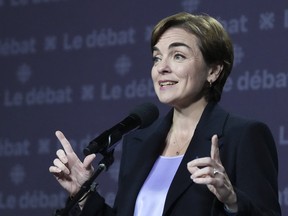
OTTAWA — It was a story that had the potential to be a bombshell, but appears to have blown up in the faces of the Coalition Avenir Québec instead.
Sign In or Create an Account
Allegations of foreign interference made their way into the Quebec election on Friday, when Le Journal de Montréal reported that Ottawa recently warned the Quebec government of possible U.S. interference to help the Parti Québécois get elected.
At the heart of the warning was an unsigned publication from U.S. think tank Defense Analyses and Research Corporation (DARC) dated Feb. 26, which calls for the Trump administration to support separatist movements in Quebec and Alberta.
“The United States should exploit the soon-to-arrive fragmentary moment in Canada as an opportunity to drastically reshape the North American environment into one more amenable to U.S. interests,” the post reads.
“U.S. strategy should be to achieve the fragmentation, not annexation, of Canada.”
As part of these efforts, DARC suggests that the U.S. should consider “covert support” for the PQ ahead of the election, which include overt financial support for the party and “behind-closed-doors trade negotiations” with the PQ to offer Quebec lower tariffs.
The news first prompted Quebec Premier Christine Fréchette to say she contacted Prime Minister Mark Carney to request an emergency meeting on the matter.
A few hours later, Fréchette changed her tune.
Fréchette said in a post on X that her team informed her of a post made by DARC on Saturday, Sept. 19, and contacted Canadian Security Intelligence Service (CSIS) on Tuesday, Sept. 22. A meeting with CSIS took place on Wednesday, Sept. 23.
By the end of the day, the incumbent premier said she received no confirmed information indicating that interference has occurred in Quebec’s electoral process.
PQ Leader Paul St-Pierre Plamondon questioned the timing of the initial news report, which came out just 48 hours before the start of the advance polls in Quebec.
He also openly speculated that the CAQ may have leaked the information to the media.
The PQ leader’s suspicions seemed plausible on Sunday, when Radio-Canada revealed that Fréchette’s team had been contacting reporters about the publication by DARC as early as Sept. 12, 10 days before it contacted CSIS about the alleged interference.
CSIS apparently told the CAQ that the viewpoints expressed by DARC were out in the public sphere, as columnists for The Globe and Mail and Le Devoir mentioned them earlier this year.
Thomas Juneau, a professor at the University of Ottawa’s Graduate School of Public and International Affairs, said it may be too early to jump to conclusions as to whether DARC has attempted to meddle in the Quebec election, in an overt or covert way.
“I think there’s an important point to make here that, as is often the case with foreign interference, especially when we don’t have the benefit of hindsight, it’s very difficult to know what is going on. Are there other attempts that have not been made public?”
But on the surface, Juneau said, the think tank appears to be “very amateurish, very small and marginal.”
The CAQ may have been trying to scare voters away from the PQ, but the most recent numbers show that their ploy is already having the opposite effect.
According to the three polls that came out on Monday — Léger, Synopsis and Pallas — support for the CAQ is going downhill and poll aggregators are already predicting that the party that has been in government for eight years may finish with no seats at all.
The PQ, on the other hand, is steadily headed for a majority government.
Fréchette said on Monday that there is still a week left to the campaign. For now, she has no meeting scheduled with Carney to address the issue.
Meanwhile, the member of Fréchette’s team who was shopping the information about DARC around to reporters in past weeks was still employed as of Monday.
The party leader said there was nothing “criminal” about sending publicly available reports to the media, but she would have preferred being kept in the loop earlier given the sensitive nature of the subject. She added it would not happen again.
Juneau said politicians should be careful to not “cry wolf” each time there is the perception of an attempt at foreign interference, or a low level of foreign interference that it does not merit any kind of attention, to avoid trivializing the issue.
He suggested perhaps Quebec should consider setting up a task force composed of public servants dedicated to monitoring elections for instances of foreign interference. The federal government has had a similar task force in place since 2019.
“It’s probably the least bad way to shield the democratic system from the inevitable accusations that politicians are going to leverage situations like this.”
National Post
calevesque@postmedia.com
Our website is the place for the latest breaking news, exclusive scoops, longreads and provocative commentary. Please bookmark nationalpost.com and sign up for our newsletters here.
Join the Conversation
This website uses cookies to personalize your content (including ads), and allows us to analyze our traffic. Read more about cookies here. By continuing to use our site, you agree to our Terms of Use and Privacy Policy.
KioskNews shows a cleaned-up reading view extracted from the publisher’s page — the original always lives on their site, not ours.