Chip capacity an asset for Taiwan, researcher says
By William Hetherington / Staff writer, with CNA


Countries seeking to advance their artificial intelligence (AI) capabilities are increasingly partnering with leading AI powers to access advanced models, with Taiwan holding a potential advantage because of its chipmaking capabilities, a US researcher said.
He described Taiwan’s position as potentially “the strongest card in the world.”
Most countries recognize that they might be unable to develop their own advanced models from scratch and must explore ways to cooperate with AI powers such as the US and China, said Aalok Mehta, director of the Wadhwani AI Center at the Center for Strategic and International Studies in Washington.
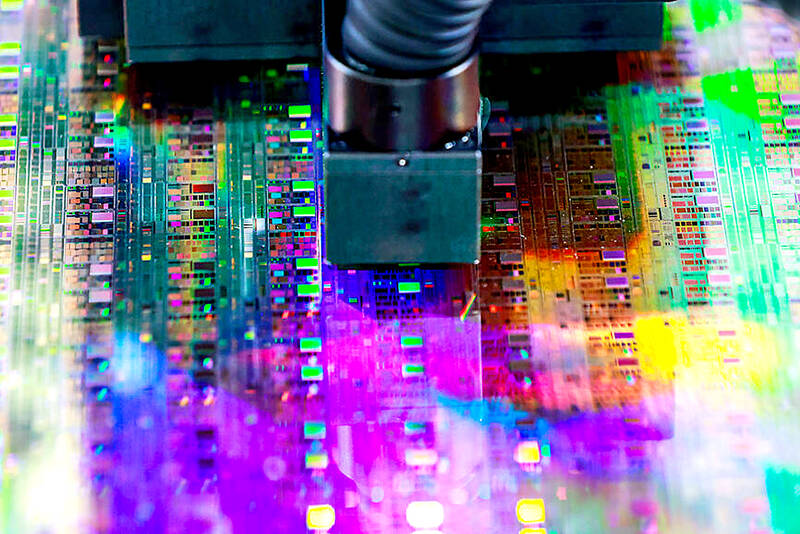
A silicon wafer is displayed during Semicon Taiwan in Taipei in an undated photograph.
Photo: Ritchie B. Tongo, EPA
Countries developing AI are considering which parts of the AI technology they can control and how to use those advantages to secure benefits from nations developing the most advanced AI models, said Mehta, a former Google employee who worked on AI policy.
“In Taiwan’s case, they have maybe the strongest card in the world to play,” he said. “They’re home to the foundries that build and manufacture the most advanced chips in the world.”
That gives Taiwan significant leverage in negotiations with the US and other countries, he said.
“This is an enormous leverage point that can allow Taiwan to really engage in aggressive negotiations with a place like the US,” he said.
For example, Taiwan could seek priority access to the most advanced AI models developed by US companies or preferential consideration when applying for computing resources, he said.
Taiwan produces 90 percent of the world’s AI servers and advanced AI chips. Asked whether Taiwan’s advantage could be affected as Taiwan Semiconductor Manufacturing Co (TSMC) and other Taiwanese companies expand their investments in the US, Mehta said global demand for computing power was growing rapidly.
Existing foundries, particularly those with mature manufacturing processes and high yields, would continue to play an important role, he said.
“All the existing foundries, especially the ones that have very mature manufacturing processes with high yield, they’re going to continue to be really important,” he said.
New foundries under construction would take several years to reach full production capacity, meaning much of the world’s chip manufacturing would continue to rely on existing facilities in the short term.
“Certainly in the near term, Taiwan’s going to continue to be important,” he said.
Taiwan would remain important in the longer term, Mehta said, adding that it could use the scale of investments by companies such as TSMC in the US, as well as its alignment with Washington on export controls and access to AI technology, as geopolitical advantages in negotiations with Washington.
As technological competition between the US and China intensifies, Taiwan is preparing to tighten export controls on AI chips to bring its measures further into line with those of the US, Minister of Economic Affairs Kung Ming-hsin (龔明鑫) told Bloomberg.
The move would put Taiwan alongside US President Donald Trump’s administration in efforts to combat the smuggling of advanced semiconductors to China.
Taiwan is already deeply connected to the US in many respects, including technology, broader geopolitical and economic interests, and military and security matters, Mehta said.
To some extent, Taiwan has already chosen a side, he said, adding that further aligning its export controls and technology-access policies with Washington would not necessarily further damage relations with China.
Instead, such alignment could improve and enhance Taiwan’s relationship with the US, he said.
KioskNews shows a cleaned-up reading view extracted from the publisher’s page — the original always lives on their site, not ours.