King to give speech to Commonwealth leaders as Burnham opens slavery apology talks – UK politics live
Good morning. In a Today programme interview broadcast this morning at 8.10am, Shabana Mahmood, the home secretary, ended by saying this about her plans to tighten the rules that determine when foreign workers and their dependants can get settlement.
As a result of these changes, roughly half a million people who were going to settle at five years are not now going to settle. So on any measure, these are still very significant changes.
She is right, as Libby Brooks explains in her First Edition briefing on the story this morning.
But that does not mean it has not been awkward for Mahmood, who recorded the Today interview, and other interviews, last night. Although her plans amount to a very significant tightening of the indefinite leave to remain (ILR) rules, they are notably less strict than the version she announced last November, which is why they are reasonably being described as a U-turn. In her interviews she had to make two significant concessions.
-
Mahmood appeared to accept that her U-turn could cost billions. She insisted that, compared with doing nothing, her plans will lead to significant savings. But she would not dispute claims that the savings would have been far higher if she had stuck to the 2025 plans. When the BBC’s Iain Watson put it to her that the concessions would in effect cost about £7.5bn, Mahmood just said an impact assessment would be published in due course.
-
Mahmood refused to deny that she was in effect ordered to change her plans by Andy Burnham.
I will post more from these interviews soon.
Mahmood was also quite interesting on freedom of movement, an issue which has been yanked into the headlines again by an interview that Burnham gave to ITV for a documentary being broadcast tonight. Burnham said:
I have not proposed freedom of movement coming back.
I do believe that we should have an honest discussion with people about how immigration has changed since the Brexit vote because the shorter-term migration of people coming from Europe and then going back has been replaced with long-term settlement in bigger numbers, and that was the Boriswave …
I think public opinion has changed nationally.
But I want to be really clear on this issue. I will not run ahead of public opinion. The public need to be the boss when it comes to whatever happens with Brexit.
This is true, and in some respects just old news. Burnham has not made any specific proposals for a new relationship with the EU; he has just opened a debate on this.
But, in opening that debate, Burnham clearly implied that there would be a strong case for fighting the next election on a pledge to take the UK back into the single market, which would involve accepting freedom of movement rules. And Burnham has said that he would like the UK to rejoin the EU in his lifetime, which of course would also mean embracing freedom of movement. The language in the ITV interview implies Burnham is a bit nervous about being seen to have pre-judged where the debate might end up.
Freedom of movement also came up in Mahmood’s interviews. On Sky News, she refused to say what she felt about the UK rejoining the freedom of movement system. And, on the Today programme, she implied that she had not had much warning about Burnham’s decision to open up a debate on this in his speech to Labour’s conference. She also stressed that Labour was “absolutely bound by the terms of our manifesto”, which ruled out single market membership before the next election. She gave the impression that, like John Healey and Jonathan Reynolds, she is not 100% aligned with Burnham’s pro-EU aspirations.
Here is the agenda for the day.
10am: Kemi Badenoch gives a speech on defence at a rally in London.
11.30am: John Healey, the chancellor, takes questions in the Commons.
Noon: Downing Street holds a lobby briefing.
After 12.30pm: MPs resume their debate on the budget.
2pm (UK time): Andy Burnham and King Charles attend the opening ceremony for the Commonwealth heads of government meeting (Chogm) in Antigua. Later Burnham will be attending a heads of government meeting.
I’m afraid we are no longer able to have comments open below the line every day on this blog. If you want to contact me, please email politics.live@theguardian.com. You can use this email to flag up corrections, comments for publication, questions or complaints.
Key events
Ex-Reform UK MP cleared after committee overrules parliament's standards watchdog over N-word rules breach
MSPs call for 'much greater transparency' from Swinney about how Scottish government will fill £5bn funding gap
Badenoch says pupils must be taught 'good and bad of our history' - but says it's 'lie' to claim wealth came from slavery
Badenoch says, if she was PM, she would only visit China in return for British prisoners being released
Badenoch says purpose of slavery apology 'is to make us look weak'
Badenoch says dynamic alignment with EU regulations 'red line' she could never accept
Badenoch says she thinks Burnham's revised EU deal on food exports might 'make things worse, not better'
Mahmood does not contest claim care worker ILR U-turn will mean DWP saving billions less than under original plan
Deal finalised to remove Brexit checks on food and animal products
Burnham says he has not proposed return to EU freedom of movement, and that voters 'need to be boss' on Brexit rethink
A Commons committee has overruled a finding by the parliamentary commissioner for standards that former Reform UK MP James McMurdock broke Commons rules by posting the letter “N” online and starting a racial slur.
The Commons standards committee has decided that McMurdock will not be subject to any further action, even though it also rejected McMurdock’s claim that he was not responsible for the letter N being posted from his phone on the social media platform X.
The N appeared underneath a post containing a picture of Nigel Farage with a black journalist, and it led to what is known as an N-Tower – individuals each posting a single letter so as to get the N-word to appear on a social media platform without moderating tools blocking them.
The incident happened in August last year, and the report published today is the outcome of an investigation that commenced soon afterwards after the Tory MP Ben Obese-Jecty submitted a complaint to Daniel Greenberg, the parliamentary commissioner for standards.
Complaints about MPs breaking parliamentary rules are investigated by the commissioner who presents a report to the Commons standards committee. Normally the committee accepts the commissioner’s findings and decides on an appropriate punishment but – in a move that is unusual but not unprecedented – the committee said it disagreed with Greenberg.
Greenberg was investigating whether McMurdock was in breach of rule 11, which says MPs must not do anything that would cause “significant damage to the reputation” of the Commons.
McMurdock told the commissioner that the original N must have been posted from his phone either by one of his children or as a result of a pocket post. Greenberg did not accept that, and concluded that McMurdock posted it himself.
But Greenberg concluded it was “impossible to establish Mr McMurdock’s intention when posting the letter ‘N’”. McMurdock said he deleted the post when he was made aware of it, about an hour after it went up.
However, Greenberg did criticise McMurdock for failing to take steps to disassociate himself from the post, or to explain that it had been put up in error. In his own report to the committee, he concluded:
It seems clear to me that the initiation of an N-Tower by a member of parliament is action that “would cause significant damage to the reputation and integrity of the House of Commons as a whole, or of its members generally”. The N-word is one of the most offensive terms in the English language. The use of an N-Tower is designed to encourage the use of a racist term in a manner intended to avoid moderation. To initiate an N-Tower on a public forum gives the impression that members of parliament are content to incite racist abuse. I have found that Mr McMurdock posted the “N” on X and therefore started the N-Tower. This is conduct that causes significant damage to the reputation of the house.
Mr McMurdock then took no steps to correct the public record and allowed the perception that he had deliberately started an N-Tower to continue. Mr McMurdock’s rationale for doing so is that he wished to protect himself from embarrassment. For a member to prioritise personal embarrassment over the ongoing perception that he had encouraged the use of a racist insult is extraordinary. I note that, even when my investigation was started, Mr McMurdock still did not deprecate such language or acknowledge the severity of the situation. That is not to his credit. Indeed, Mr McMurdock has tried to minimise the event, referring to it as “nonsense” …
In short, Mr McMurdock’s actions allowed a natural inference to be drawn that members of parliament condone and incite racist abuse.
But the standards committee, which is chaired by the Tory MP Alberto Costa who sits with six other MPs and seven lay members, decided that McMurdock had not broken rule 11. It said this was because it could not be sure that McMurdock posted the letter N with the intention of starting an N-Tower and that, even if he did, “we do not believe that unintentionally starting an N-Tower amounts to a breach of rule 11, however much we abhor the creation of a racial slur”.
Explaining the latter point, the committee said in its report:
Even if we had been able to conclude that Mr McMurdock had posted the letter “N” with the intention of initiating the creation of a racial slur, we do not consider that that bar [the test for a breach of rule 11] would have been met. The conduct would have undoubtedly been abhorrent, but the damage would have been done to Mr McMurdock’s own reputation, and not to that of MPs in general.
Unusually, one lay member of the committee, Mehmuda Mian, published a dissenting opinion saying she thought McMurdock had intended to start a N-Tower. She explained:
It is not clear for what reason Mr McMurdock would have made such a post, other than the reason alleged by the complainant. If it was in some way accidental, it would be an astonishing coincidence for that specific letter to appear by accident under that post. If there was another reason for an intentional post, then Mr McMurdock would surely have supplied it in evidence. I also believe that, had the letter N been posted accidentally or for some other purpose, Mr McMurdock would have acted differently once the offensive implications of his post were drawn to his attention. I therefore conclude that, on the balance of probabilities, Mr McMurdock made the post in order to start an “N tower”.
And three other lay members of the committee published a dissenting opinion saying they did not accept the majority view that McMurdock would not have broken rule 11 even if he had been intentionally starting an N-Tower.
McMurdock was a surprise Reform UK election winner in 2024 when he took the South Basildon and East Thurrock constituency with a majority of just 98. Reform UK was subsequently embarrassed when it emerged he had been detained as a teenager for repeatedly kicking his then girlfriend.
In July last year McMurdock resigned the Reform UK whip over allegations relating to his business conduct during Covid. But he was subsequently cleared, and today’s finding from the standards committee may revive speculation that he will be allowed to rejoin the party.
Severin Carrell is the Guardian’s Scotland editor.
John Swinney has been urged to be much more open about the Scottish government’s attempts to close a near £5bn funding gap by a cross-party Holyrood committee.
MSPs on the Scottish parliament’s finance and public administration committee also warned the first minister faces “substantial risks” if his government’s plans to cut the public sector are not delivered on time and in full.
They said “much greater transparency” was needed about how Swinney plans to close the gap and called on his ministers to update the Scottish government’s public sector pay policy and tax strategy as soon as possible.
Its report in advance of this December’s Scottish budget said that within three years, Swinney’s minority government faces a £2.6bn shortfall in day-to-day spending and a £2.1bn spending shortfall for capital projects. In addition, there is a £720m shortfall in tax receipts next year, which exceeds its borrowing limits.
Swinney has already announced proposals to merge local authorities, cut the number of health boards and reduce civil service numbers in an effort to cut spending.
Economics think tanks have warned his government faces “a reckoning” over public spending, and the toughest budget in the history of devolution, after failing to control public sector pay rises and overspending.
A government spokesperson said ministers noted the committee’s comments, and that they expected a £650m real terms cut in Treasury funding next year, which made matters worse. They said:
This government has delivered a balanced budget every year and a comprehensive strategy and delivery plan has been published which sets out how we will close the gap between funding and spending by 2029-30.
Q: Do you think that a confident nation should be able to teach children about the bad things that the country has done in the past as well as the good things?
Badenoch replied:
If you start teaching a history about our country that tells young people that they should be ashamed, that tells young people that actually they don’t belong here for whatever reason, and tells young people that the wealth and prosperity of this country was built on the back of evil things like slavery and colonialism, you are lying to them.
You have to tell them the truth. The wealth of this country was built on property rights, freedom, free trade, freedom of speech, free markets, enlightenment values – the classic old school liberal values.
If you teach them that [wealth] just came from taking from elsewhere, we are selling them a lie. And then we start losing the understanding of what it is that makes countries wealthy.
We need to tell the good and the bad of our history. What’s happening is that we’re focusing only on the bad.
With lots of people, they’ve got books to sell about how terrible this country is. They’re making money out of splitting the country. The Conservative party wants to bring people together, whatever they look like …
If we keep pretending that this country has a unique history of evil and that we need to start paying everybody and apologising to everyone, we forget that we are actually one of the better countries, that a lot of this evil was happening all over the world, and we were the ones who fought to end so many of the terrible practices, including slavery, that were making lives a misery all around the globe.
Q: If Burnham did agree to pay slavery reparations, would you cancel them if you got into office?
Badenoch said she did not want to waste time talking about slavery. She said:
There is nothing wrong with an apology, but we have done that already. We don’t need to keep apologising. Everyone knows that slavery was wrong. It happened everywhere and we were the ones who ended it. We should be proud of that.
I’m not going to be wasting my time talking about reparations and apologies if I’m prime minister. I’m going to be focussed on the serious issue that this country faces.
We’re not going to be giving any money to people just because they’re asking for an apology. That’s not the Conservative way, and that is not what we’re going to do.
Q: Andy Burnham has refused to say what his ideal number would be for net migration. What level do you think it should be at?
Badenoch said she was not going to pluck numbers out of the air. The Tories were in favour of a cap, she said. But it would be based on the country’s needs “at a particular moment”.
Q: Do you regard China as a threat? And, if you were invited to China, would you got there and meet President Xi?
Badenoch said she had always been clear China was “an economic threat”. And it is a country spying on the UK, she said.
She went on:
What I am saying is that we need to take [China] seriously. I’m not saying we need to go to war with China, but what I’m saying is that what they want is economic dominance, and the more dominant they are, then the more susceptible we are to coercion.
So if I’m prime minister of this country and I get an invite, depending on what China has been doing recently, I might go, but not when it is holding dissidents, British citizens in its prisons, and not releasing them.
I would be going and getting those people released.
Keir Starmer went to China and got humiliated, got absolutely nothing. That would not be happening with me.
Badenoch may have been referring in particular to Jimmy Lai.
Q: Do you think the UK should reconsider Commonwealth membership, given other countries just keep asking us for slavery reparations?
Badenoch said she did not agree with that “because most Commonwealth countries aren’t doing this”.
She said the Commonwealth could be a force for good. But it had become “distracted”, she said.
Q: What do you say to the argument that an apology for slavery could be good for British security and British interests, particularly in terms of relations with China?
Badenoch said China would not be impressed by the UK apologising. She went on:
China did all sorts of things. It’s not out there apologising.
The purpose of the apology is to make us look weak. It is to make this country look weak. And once we start looking weak, then we have every man and his dog making demands and sending us an invoice, which the British taxpayer has to pay.
We don’t have money for that anymore. We are running out of money. The little we have is being spent on welfare. Anyone who thinks that an apology is serious trade and economic policy … I’ve got a bridge to sell them, they don’t know how this stuff works.
Q: Would you support the food deal with the EU if it required dynamic alignment with EU regulations? Or is that a red line for you?
Badenoch replied:
Dynamic alignment is a red line because it gives away the biggest freedom that we have from leaving the European Union, which is to control our own laws. That’s why it doesn’t make any sense …
Look at AI, for example. We are doing so much better than them. Europe is going backwards, regulating a sector that doesn’t exist.
Q: Angela Rayner says she is stocking up on wine. What are you stockpiling?
Badenoch replied:
Water. Water’s the most important thing.
I don’t blame Angela Rayner for wanting to stock up on sauvignon blanc. I would if I was in that party with all of those people in there. I’d need a drink.
Q: Do you support the deal with the EU to end checks on food exports?
Badenoch said she did not know what the deal was.
She said she wanted to see Labour negotiating and improve the trade deal; the deal negotiated by the Tories was one that would need to be updated, she said.
But she said she was worried that Burnham’s deal with the EU would make things better.
She said:
The reason why we left the EU was so we could make our own rules. But if what the government is signing up to is just following EU rules, then what was the point of leaving? They are too scared to actually use the Brexit freedoms that we have.
The free trade agreement that we have with the EU, like many others, is one that needs constant negotiating. So I want to see Labour negotiating and improving on deals with all countries. That’s what you do when you have your own trade policy. That’s what it means. It’s a never-ending process.
But she said she was worried Burnham was giving too much away.
[Burnham] doesn’t know how to negotiate. I say this as a former trade secretary. I’m very worried that what he is saying he’s going to do is actually going to make things worse, not better.
Q: Do you see any benefits in a closer relationship with the EU?
Badenoch replied:
We need to start having a closer relationship with all our allies. What we need to stop pretending that the only way to do that is to be inside the EU. It is a false conversation. The debate has been settled. It’s time for us to move on.
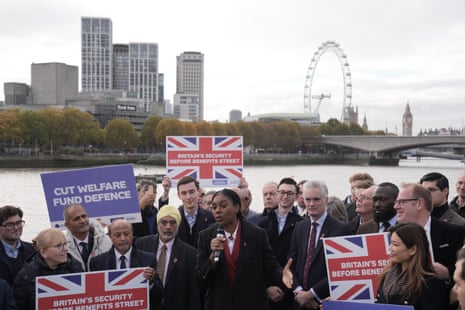
After her speech, Badenoch took questions from journalists.
Q: Should companies take responsibility for their own cyber security, or is it a job for the state?
Badenoch said private companies should take their security seriously, and get their systems upgraded.
But the government had to work with them too. And it needed to get its own house in order, she said.
Kemi Badenoch has been giving a speech on defence at a rally in London. Here are extracts released by CCHQ overnight.
Hackers have taken control of supermarket fridges and freezers across Europe, turning up the temperatures and destroying thousands of pounds of food. Imagine someone being able to ruin the food in your local supermarket without ever setting foot inside …
North Korean hackers have just stolen more than $6bn in cryptocurrency. Hostile states can steal billions to help finance their regimes without firing a single shot …
Hackers targeted power and heating plants in Poland, shutting down equipment at one facility supplying heat to 50,000 people. The operators prevented a wider disruption, but imagine someone being able to threaten your heating from behind a computer screen …
The threats are already reaching into our everyday lives, but Labour is failing to take them seriously. Last week’s Budget was the moment to fund defence, but instead we got more delays, more excuses and another plan to make a plan.
While Britain faces growing threats, Labour is busy apologising for things that happened 200 years ago, entertaining demands for reparations and watering down immigration plans to please its backbenchers. Meanwhile, businesses are closing, welfare spending is rising and defence is being neglected.
This is what Shabana Mahmood said in her interview with the BBC’s Iain Watson when he put it to her that the care worker U-turn in her ILR announcement yesterday (see 9.11am) would mean the government saying £7.5bn less than under the original plans. This figure seems to be based on Mahmood saying earlier this year the original plans would save £10bn, and her estimate that three-quarters of workers who would have been covered are now included in the exemption announced yesterday.
Look, I’m not going to just give you a number. It will be laid out properly in an impact assessment.
But we do already know that the changes that I have announced today, including the changes for the cohort that will now not get settlement at five years, including care workers not working in care who are most likely to fall upon the state once they got settlement, they will now be waiting longer, and that does represent billions in savings to the DWP.
If you are interested in where the £10bn figure came from in the first place, what it means and whether it is fair, there is a lot more on that in an analysis here.
The EU and the UK have completed their deal to remove Brexit checks on imports and exports of food and animal products ranging from sausages and cheese to leather goods and flowers, Lisa O’Carroll reports.
Good morning. In a Today programme interview broadcast this morning at 8.10am, Shabana Mahmood, the home secretary, ended by saying this about her plans to tighten the rules that determine when foreign workers and their dependants can get settlement.
As a result of these changes, roughly half a million people who were going to settle at five years are not now going to settle. So on any measure, these are still very significant changes.
She is right, as Libby Brooks explains in her First Edition briefing on the story this morning.
But that does not mean it has not been awkward for Mahmood, who recorded the Today interview, and other interviews, last night. Although her plans amount to a very significant tightening of the indefinite leave to remain (ILR) rules, they are notably less strict than the version she announced last November, which is why they are reasonably being described as a U-turn. In her interviews she had to make two significant concessions.
-
Mahmood appeared to accept that her U-turn could cost billions. She insisted that, compared with doing nothing, her plans will lead to significant savings. But she would not dispute claims that the savings would have been far higher if she had stuck to the 2025 plans. When the BBC’s Iain Watson put it to her that the concessions would in effect cost about £7.5bn, Mahmood just said an impact assessment would be published in due course.
-
Mahmood refused to deny that she was in effect ordered to change her plans by Andy Burnham.
I will post more from these interviews soon.
Mahmood was also quite interesting on freedom of movement, an issue which has been yanked into the headlines again by an interview that Burnham gave to ITV for a documentary being broadcast tonight. Burnham said:
I have not proposed freedom of movement coming back.
I do believe that we should have an honest discussion with people about how immigration has changed since the Brexit vote because the shorter-term migration of people coming from Europe and then going back has been replaced with long-term settlement in bigger numbers, and that was the Boriswave …
I think public opinion has changed nationally.
But I want to be really clear on this issue. I will not run ahead of public opinion. The public need to be the boss when it comes to whatever happens with Brexit.
This is true, and in some respects just old news. Burnham has not made any specific proposals for a new relationship with the EU; he has just opened a debate on this.
But, in opening that debate, Burnham clearly implied that there would be a strong case for fighting the next election on a pledge to take the UK back into the single market, which would involve accepting freedom of movement rules. And Burnham has said that he would like the UK to rejoin the EU in his lifetime, which of course would also mean embracing freedom of movement. The language in the ITV interview implies Burnham is a bit nervous about being seen to have pre-judged where the debate might end up.
Freedom of movement also came up in Mahmood’s interviews. On Sky News, she refused to say what she felt about the UK rejoining the freedom of movement system. And, on the Today programme, she implied that she had not had much warning about Burnham’s decision to open up a debate on this in his speech to Labour’s conference. She also stressed that Labour was “absolutely bound by the terms of our manifesto”, which ruled out single market membership before the next election. She gave the impression that, like John Healey and Jonathan Reynolds, she is not 100% aligned with Burnham’s pro-EU aspirations.
Here is the agenda for the day.
10am: Kemi Badenoch gives a speech on defence at a rally in London.
11.30am: John Healey, the chancellor, takes questions in the Commons.
Noon: Downing Street holds a lobby briefing.
After 12.30pm: MPs resume their debate on the budget.
2pm (UK time): Andy Burnham and King Charles attend the opening ceremony for the Commonwealth heads of government meeting (Chogm) in Antigua. Later Burnham will be attending a heads of government meeting.
I’m afraid we are no longer able to have comments open below the line every day on this blog. If you want to contact me, please email politics.live@theguardian.com. You can use this email to flag up corrections, comments for publication, questions or complaints.
KioskNews shows a cleaned-up reading view extracted from the publisher’s page — the original always lives on their site, not ours.