Four swordsmen: How China is reshaping its fighter jet fleet
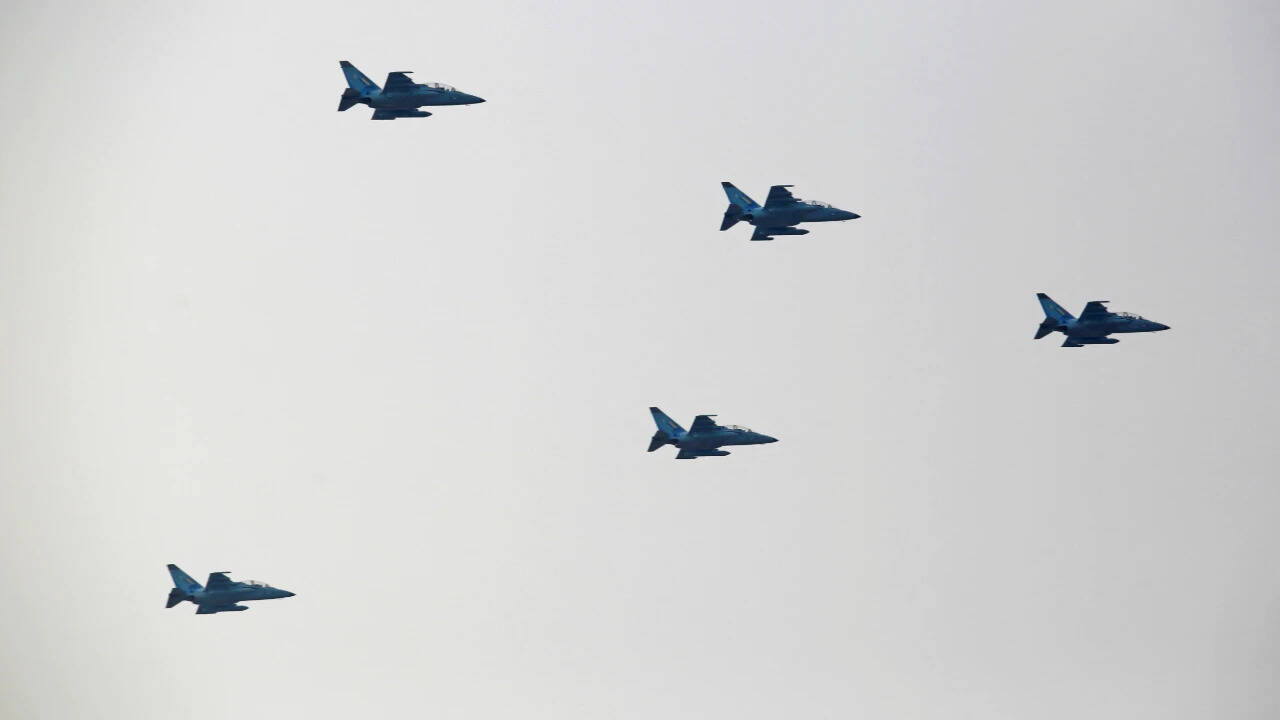
This approach is also relevant to the growing competition over sixth-generation fighter technology (Representative image)
China has expanded its frontline fighter aircraft concept from the traditional 'three swordsmen' to a new 'four swordsmen' formation, adding its J-35A stealth fighter to a lineup that includes the J-20, J-16 and J-10C.
The development marks another step in the modernisation of the People's Liberation Army Air Force (PLAAF).The J-35A made its public debut at the Zhuhai Airshow on November 12, 2024. With its induction, China has become the second country after the US to develop and operate two fifth-generation stealth fighter aircraft. The US currently operates the F-22 Raptor and F-35 Lightning II. The J-35A, a medium-sized stealth fighter, has also drawn comparisons with the American F-35 because of its broadly similar design.According to a report by The Eurasian Times, Chinese military commentators and state broadcaster CCTV have increasingly presented the four aircraft as an integrated combat formation rather than separate platforms. The shift comes as China continues to expand its military aviation capabilities and prepares for the next generation of aerial warfare.
What each fighter brings
For years, the J-20 heavy stealth fighter, J-16 multirole fighter and J-10C lighter multirole aircraft were collectively described by Chinese military analysts as the PLAAF's 'three swordsmen'.
The three aircraft were designed to complement one another. The J-20 provides stealth and advanced situational awareness, while the J-16 and J-10C contribute additional firepower and multirole capabilities.In a November 2022 interview with CCTV, J-16 pilot Zhang Yang explained how the aircraft worked together, with the J-20's situational awareness capabilities guiding the other two fighters, while the J-16 and J-10C delivered their firepower.The addition of the J-35A expands this approach by bringing another fifth-generation stealth platform into the formation. Chinese state media used the second anniversary of its public debut to highlight improvements in avionics, situational awareness and weapons integration. The aircraft could also eventually receive the full version of China's domestically developed WS-19 turbofan engine, although its development remains ongoing.The J-16, meanwhile, continues to provide substantial firepower. A recently reported configuration, described by Chinese defence experts as 'Beast Mode', showed the aircraft carrying eight PL-15 beyond-visual-range air-to-air missiles and two PL-10 short-range missiles.The PL-15 is designed for long-range aerial engagements, with an estimated range of around 200km, while the PL-10 is intended for close-range combat.
The J-16's large weapons payload and advanced sensors make it an important component of China's aerial combat capabilities.
Why China's fighter strategy is evolving
The four-swordsmen concept reflects a broader shift towards network-centric warfare, in which stealth fighters, multirole aircraft and other military platforms operate as an integrated system.The J-20 and J-35A bring stealth and advanced sensing capabilities, while the J-16 and J-10C provide additional weapons capacity and operational flexibility.
Advanced data links could allow the aircraft to share battlefield information and coordinate their actions.This approach is also relevant to the growing competition over sixth-generation fighter technology. The US is pursuing its Next Generation Air Dominance (NGAD) programme, centred on the F-47, while China has attracted attention with the development of aircraft identified as the J-36 and J-50.
Future combat aircraft are expected to incorporate artificial intelligence, advanced electronic warfare, greater stealth and the ability to operate alongside unmanned combat drones.For China, the expansion from three to four swordsmen is therefore more than an addition to its fighter inventory. It signals an effort to build a more integrated air combat force capable of combining stealth, firepower and battlefield information-sharing as military competition with the US intensifies.
KioskNews shows a cleaned-up reading view extracted from the publisher’s page — the original always lives on their site, not ours.