Silk Road in orbit: China to build 20-satellite ‘space AI’ system for Oman

Hangzhou-based Star Vision will build Oman a network of 20 satellites that use AI to process images in orbit and spot ships and floods in real time, in what the company called China’s most valuable commercial space contract ever.
The deal – worth over US$200 million according to the start-up – was signed in Beijing last week with Omani firm Oman Lens during a landmark state visit by the country’s ruler, Sultan Haitham bin Tariq.
Besides the constellation, the package includes a satellite assembly and testing centre in Oman, scholarships for 30 Omanis to pursue master’s and doctoral degrees in China, and training for 1,000 local specialists. The two sides will also set up a joint lab for space artificial intelligence.
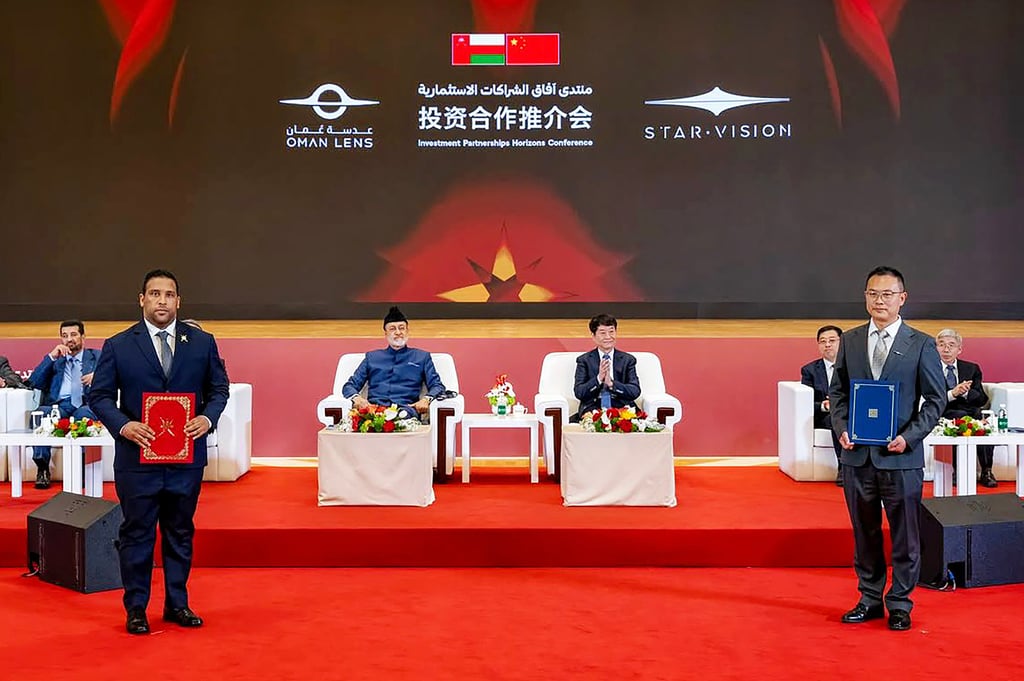
Liao Zhenhua, head of Star Vision’s Oman project, said smaller nations wanted satellites of their own so they were not left behind as the major powers filled up space. “They may not have as many as the US, but with even one or two, they could look wherever they want,” he said in an interview.
Countries no longer want to turn to the United States, Europe or China whenever they need a picture, according to Liao. “So we are not just selling a product – we are helping them build their own capabilities,” he said.
Each satellite – about the size of a washing machine – will carry computers that run AI software to pick out targets such as vessels, buildings and bridges in the pictures it takes. Liao said only the useful information would be beamed down, saving bandwidth and speeding up responses to disasters.
He compared the idea to a traffic camera that reads licence plates on the spot instead of sending every frame to a distant data centre. “We don’t have to send down all the images – only the valuable information we want,” he said.
Star Vision has not disclosed the exact value of the contract. But Liao said that if measured by the number of satellites in a single deal it was the biggest and the most valuable.
That record holds only among China’s private space firms. State-owned firms such as China Great Wall Industry Corporation have signed bigger contracts to build and launch communications satellites for Nigeria, Bolivia and Pakistan.
The project builds on OL-1, an Omani remote sensing satellite with an on-board AI processor, which Star Vision helped develop two years ago. Liao said two more were in the works and they could launch by early next year.
The rest will go up in batches, to be upgraded as the technology improves, including a teaching satellite made with Sultan Qaboos University to train Omani students.
03:51
Space computing: what is it, why move computing into orbit and where does China stand?
The two sides will design the spacecraft together, but they will be built mainly with Chinese parts and launched from China. Liao said once they passed checks in orbit, Oman would take ownership and run them – data and all.
He said Star Vision named the project the “Space Silk Road” as a nod to Ming dynasty explorer Zheng He, whose fleets visited Oman four times. “In ancient times, the maritime Silk Road connected people, and in the future a Silk Road in space will do it through satellites and spacecraft,” Liao said.
The company also works with Kenya, Rwanda, Egypt, Bahrain, Saudi Arabia and the United Arab Emirates, from selling imagery to letting partners test their own AI software on its satellites.
Liao said the next step was to link its spacecraft with lasers so they could pool their computing power and run bigger AI models in orbit.
KioskNews shows a cleaned-up reading view extracted from the publisher’s page — the original always lives on their site, not ours.