ICC plans to exercise greater control over T20 franchise leagues

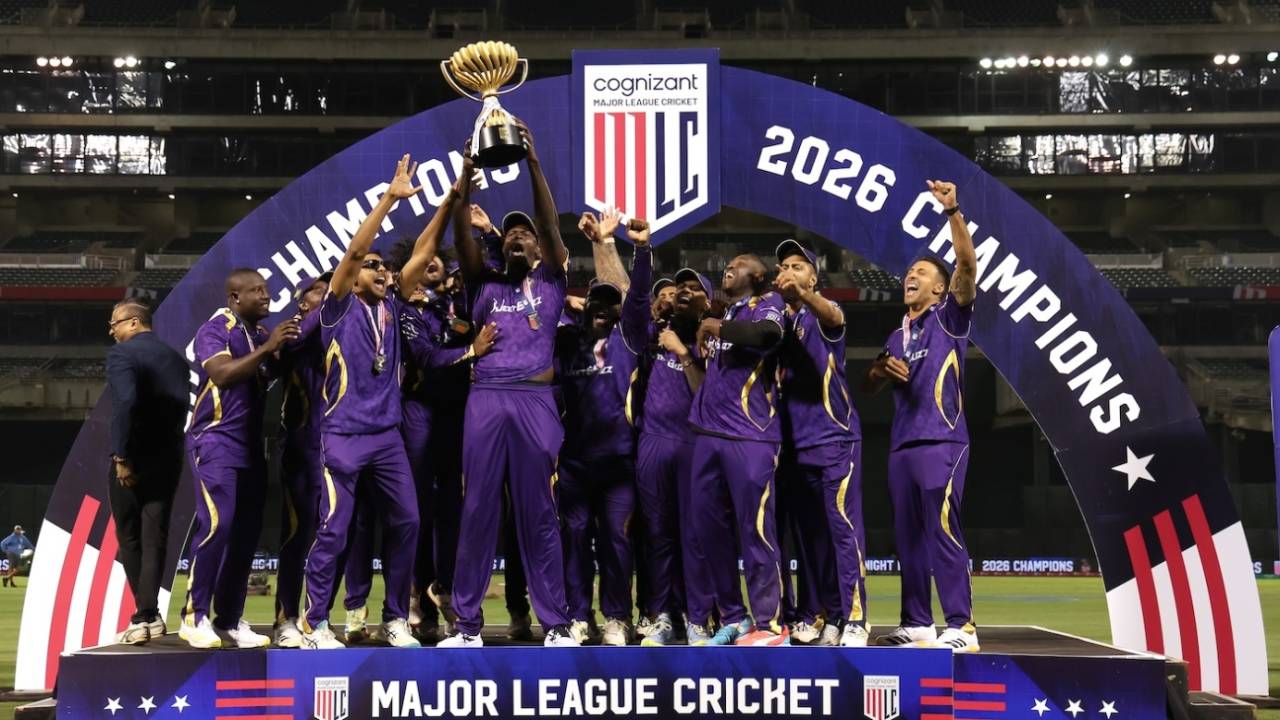
The MLC is a league that relies heavily on overseas star power • Sportzpics
The ICC is planning an expansion of its powers and oversight over T20 franchise leagues, as it tries to balance the impact they are having on the game's integrity and the calendar. The proposals are likely to have significant impact on the viability of several leagues, including the UAE's ILT20 and Major League Cricket (MLC) in the United States.
The ICC's franchise leagues review group, formed in July this year, has made a number of recommendations that cricket's chief executives and board heads will discuss this weekend at a quarterly ICC meeting in Bali. If accepted, they could substantively reshape the franchise ecosystem. The recommendations include:
- Ensuring existing leagues comply with current regulations on an overseas player cap in an XI, which would hit ILT20 and MLC hardest
- Expanding ICC powers so it can review or audit a sanction provided to a league by a Full Member (under current regulations, only Associate Member leagues require additional sanction or approval from the ICC)
- Restricting sponsorship in leagues by betting companies, or surrogates of betting companies, which enables bets to be placed by customers in countries where betting is illegal
- Providing a league sanction on the commitment that it will use the ICC's anti-corruption unit or one approved by the ICC
- Charging a fee to provide sanction for a league
The biggest immediate impact, if the recommendations are accepted, could be on the ILT20 and MLC, which rely heavily on overseas players. The ILT20 currently allows up to nine overseas in an XI, of which at least one must be from an Associate Member; MLC allows up to six overseas in the playing XI. Both leagues were given exemptions the last time the ICC set capping limits in 2023.
A cap of just four overseas players per XI could diminish the commercial viability of both leagues, not to mention limiting opportunities for a number of players who take part in them. Instead, the franchises would have to rely on local UAE and USA players to put out teams. Both leagues also have prominent ties to India, with five out of six ILT20 owners also involved in either the IPL or WPL, and four teams in MLC linked to IPL ownership groups.
Related
WTC expansion to be debated at ICC meeting
Pakistan players to be granted NOCs for Abu Dhabi T10
New leagues subcommittee promises 'checks-and-balances review'
ICC agrees overseas players cap for new T20 leagues
Given the matter required intense deliberations last time it was raised at ICC level, the review group makes clear it sought "external legal advice" on such regulation changes (with particular reference to these two leagues), which confirmed that members would not "have any good legal basis to challenge these changes."
An official from one of the leagues said it was "very concerning" and questioned whether their league could function if such a cap came in. "We were assured before that we were protected under the grandfather clause [which would exempt them as an existing league from new rules]."
The review group is headed by former Bangladesh opener and current BCB president Tamim Iqbal, and includes Richard Gould (CEO ECB), Todd Greenberg (CEO CA) and Devajit Saikia (secretary BCCI). The recommendations, set out in a paper sent to members this week and obtained by Cricinfo, collectively appear to reflect a broader desire for greater oversight over the league landscape - as first signalled by Andy Ephgrave, the ICC's anti-corruption head, in an interview with Cricinfo last month.
They are also an acknowledgment that the sanction process until now has been lax, leading to a growing number of leagues which have been hit by corruption, transient ownership and regular issues with players not being paid. The antidote to that, as recommended by the review group, is for Full Members to be more diligent about, for example, the source of funding for a league, or the protections it has in place for player payments and anti-corruption.
"At the moment, the Regulations do not provide any detailed conditions which must be satisfied by a domestic league and different approaches are therefore taken in the various Member territories," the paper reads. "A more detailed structure should be put in place (through the Regulations) setting out the conditions that a franchise league would need to satisfy before it could obtain a domestic sanction."
Significantly, the ICC also recommends widening its jurisdiction to be able to "step in and review sanctions a Full Member provides to a league." Under current regulations, the Full Member board is the only sanctioning authority for a league in its country (for example, the BCCI sanctions the IPL), with the ICC unable to step in at any stage. But in these recommendations, if the relevant member has not complied with its obligations in issuing a sanction, the ICC could "step in and take over the sanctioning authority (including being able to reject a sanctioning application or removing one which may have been granted by the relevant Member)".
That right, the ICC says, should also be available if it becomes aware of serious integrity concerns around a proposed league before it starts or while it is on.
Ephgrave, who provided input to the committee, said in the interview that the ACU was receiving more reports of approaches made to players on the league circuit now than in international cricket. As a result, one of the recommendations calls for a league to only be given sanction provided it is either using the ICC's ACU for the league, or another integrity unit approved by the ICC.
Where a league's corruption risk is rated high, the ICC's ACU could be engaged with the cost borne by the league organisers on a not-for-profit understanding. If the ACU determines, however, that appropriate mitigation measures could not be put in place, the application will be turned down "without further consideration."
Another major recommendation is preventing betting companies - or their surrogates - from sponsoring teams or leagues, which could impact SA20 and is widespread in many smaller leagues.
"This would address the threat posed by the growth of illegal betting (namely betting on unregulated markets or in countries where betting is illegal)," the paper reads. "Such sponsorship exposes host Members to the risk of facilitating illegal betting in cricket, which carries the potential for increased corruption, and raises clear ethical and governance questions for the sport."
The review group suggests the ICC charge a fee for giving sanction to a league, without the payment of which the application will not be considered. It says the fees could be used to fund outsourced due diligence checks or any subsequent corruption investigations.
As well as the recommendations, the review group has placed several points on the paper it says need further discussion by the chief executives' committee (CEC). One of these is whether members should make mandatory and standardise the solidarity payment. This is the fee a member where the league is taking place pays to the member from which an overseas player is participating - a recognition of the member's role in identifying and developing that player.
Current regulations make a solidarity payment one of the conditions for an ICC sanction. But they allow members to negotiate the amount among themselves, which can lead to the kind of stand-off seen recently between the PCB and the Abu Dhabi T10. The review group asks CEOs to discuss whether one standard fee, possibly as a fixed percentage, should be applied equally across all leagues and players.
The committee also asks the CEC and ICC board to consider the status of legends leagues, which have become prominent in recent years, often blurring the line between the status of active players and retired ones. The committee says they "generate significant integrity concerns," and calls for greater direction on whether they should sit within the ICC's sanctioning framework, and if not, how those players who take part in them and then play approved cricket should be dealt with.
Another point raised for further discussion is the prospect of a limit on the number of leagues an ICC member can hold within its territory, a move which the paper suggests would help with "preserving the crucial role that international cricket plays in developing and promoting the sport globally". This could have implications for leagues staged in the UAE.
The CEC will discuss the recommendations and where appropriate will pass on to the board for approval.
KioskNews shows a cleaned-up reading view extracted from the publisher’s page — the original always lives on their site, not ours.