Japan’s defence minister heads to Australia to meet Marles in wake of melon-gate controversy
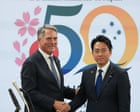
Japan’s defence minister will visit Canberra this week, the highest level engagement with Australia after controversy over Anthony Albanese’s comments about a gift of melons from prime minister Sanae Takaichi.
The defence minister, Shinjiro Koizumi, will meet his counterpart and deputy prime minister, Richard Marles, on Tuesday, with discussions focused on Australia’s acquisition of Japan’s Mogami-class frigates and enhanced security cooperation.
Koizumi is considered a potential future prime minister of Japan. His father, Junichiro Koizumi, was prime minister from 2001 to 2006.
Koizumi’s visit comes after a week in which Albanese defended himself over comments made on the Bush Deep podcast, released last month.
He was discussing a pair of Japanese melons presented by Takaichi during a visit to Canberra earlier this year, and, while appearing to make hand gestures in front of his chest, said “she brought two, as you do”.
Host Nikki Osborne joked: “She came in looking like Pamela Anderson.”
Facing days of criticism from the opposition and in the media, Albanese has insisted his hand gestures and a comment about melons were misinterpreted and were not innuendo about breasts.
The opposition criticised Albanese for putting at risk close relations with one of Australia’s most important partners in Asia.
Public comments from Japan’s ambassador to Australia on Wednesday suggested Takaichi’s government wanted to avoid a diplomatic incident over the comments, which were initially not controversial but soon sparked strong criticism, including by a former envoy to Australia.
Japan’s government refrained from public comments on the issue until Wednesday, when its current ambassador to Australia Kazuhiro Suzuki released a statement not raising any further issue with Albanese’s conduct.
Suzuki noted Takaichi had visited Australia in May – shortly before the interview in question – and had been hosted for dinner by Albanese “in a very relaxed atmosphere, and we believe it helped build a personal trust relationship between the two leaders”.
Albanese had earlier apologised for comments about Australian signer Kylie Minogue made in the same appearance.
A Japanese diplomatic cable sent in July, and leaked during the controversy, blamed “sensationalised reporting in the Australian media” and said Tokyo believed there was no “ill intention” in Albanese’s actions.
The visit comes as part of a five-day trip which will include a stop in India.
“Our relationship with Japan continues to go from strength to strength, and I look forward to welcoming my good friend, minister Koizumi back to Australia this week,” Marles told Guardian Australia.
“Together we will progress efforts to enhance defence cooperation and support our shared commitment to regional security, building on the joint statement announced by our prime ministers in May.
“This includes in the areas of co-developing and co-producing defence capabilities, advanced weapons testing, enhanced training and exercises, and increased information and intelligence cooperation.”
Takaichi has faced mounting political challenges, including on policies to help with the cost of living, and has seen sliding support in opinion polls in recent months.
Koizumi was criticised by China at the weekend for visiting the Yasukuni Shrine, dedicated to Japan’s war dead. Visits to the shrine by senior politicians are regularly criticised by Japan’s neighbours including China and South Korea, who suggest they are symbolic of a lack of remorse for Japan’s actions during the second world war.
In August last year, Labor agreed to buy Japan’s Mogami‑class frigates for the Royal Australian Navy.
Australia will spend $10bn over a decade to buy three of the frigates, with the first expected to be delivered in December 2029.
KioskNews shows a cleaned-up reading view extracted from the publisher’s page — the original always lives on their site, not ours.