By refusing to name a leader, the anti-Netanyahu ‘change bloc’ is making a fatal mistake
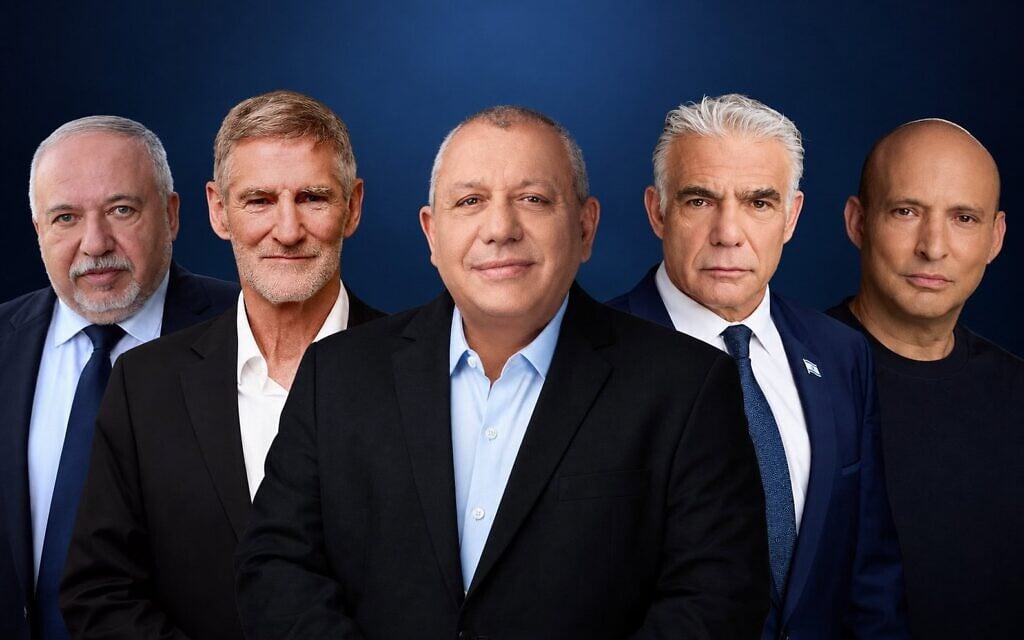
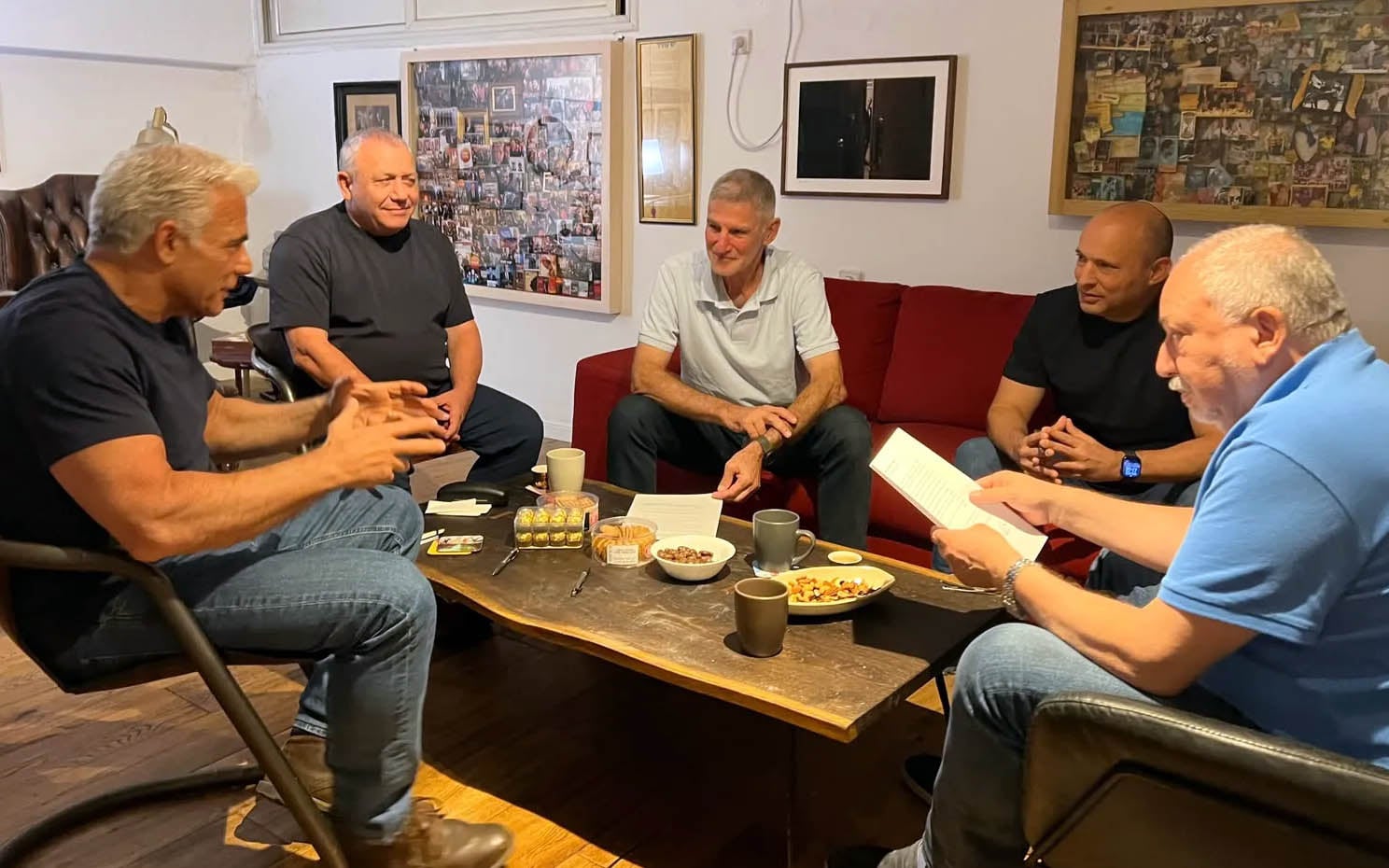
The emergency summit that Opposition Leader Yair Lapid organized on Saturday night in the basement of his Ramat Aviv home — bringing together the leaders of the four anti-Netanyahu “change bloc” parties to sign a non-aggression pact — would have been better held outdoors in a sukkah rather than underground.
Gathering key opposition rivals Gadi Eisenkot, Naftali Bennett, Avigdor Liberman and Yair Golan during the Jewish holiday of Sukkot and sitting in the traditional temporary booth might have at least created a symbolic impression of reconciliation and understanding among all parties under a unifying canopy of peace.
Beyond the photo op, however, not much could realistically come of it. The meeting itself may have been positive and conducted in good spirits — which is certainly something — but it was fundamentally incapable of producing anything deeply significant.
0:00 / 0:00
Promoted: Theatron Hotel and Residences

Anyone who has followed internal party contests and general elections over the past few decades knows that politicians can talk and agree to keep their guns holstered, but no one will leave them there for long. Eventually, everyone starts firing.
The competitive urge and the desire to win will outweigh any campaign discipline, especially as we get closer to the election, now less than a month away, and the polls add and subtract seats from the rival parties, all of which are primarily concerned with their own survival.
Get The Times of Israel's Daily Edition by email and never miss our top stories
By signing up, you agree to the terms
And so, before the ink had even dried on the impressive joint document signed by the leaders of the anti-Netanyahu “change bBloc,” Yair Golan, the former IDF deputy chief who now chairs the left-wing Democrats, went on the offensive.
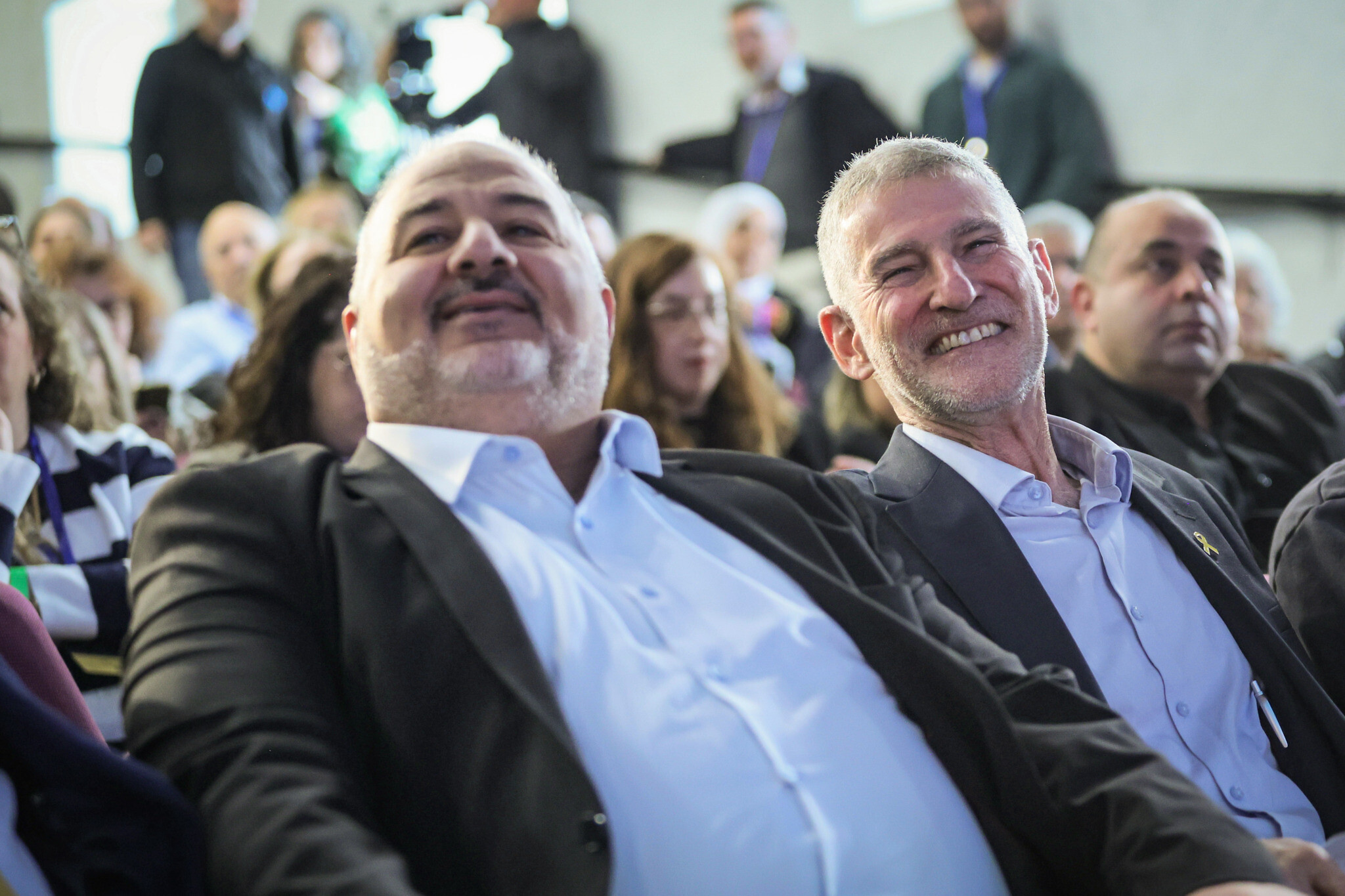
Golan declared in an interview on Sunday with Kan radio that the Arab parties should be part of the next government — not merely voting with the coalition from the outside, but sitting in the cabinet itself — and that Ra’am party chairman Mansour Abbas should serve as a government minister.
All the change bloc party leaders had previously agreed to avoid public arguments over contentious issues. But Golan, appearing on Israel’s highly rated morning radio program, simply could not resist the temptation.
Yisrael Beytenu chairman Avigdor Liberman — who in the past demanded that Golan “keep his mouth shut” until the election because of electorally damaging statements of this kind — did not respond this time. But silence will not help. This is how things will unfold until the final whistle, because politically, there is no other way.
Golan’s position is entirely understandable. These are his genuine views, and he refuses to disavow them, even if his centrist and right-wing colleagues believe they are electorally toxic.
Golan wants to attract Arab voters to his left-wing party. That is exactly why he promoted Arab candidate Somaya Bashir in the Democrats’ primaries, and it is why his party’s No. 3, MK Gilad Kariv, a Reform rabbi, spends days and nights visiting Arab communities across the country to recruit votes.
But Golan’s statement immediately triggered counterattacks and deepened the fundamental ideological dispute fracturing the bloc.
Liran Ben Avishar and Keren Turner — numbers three and five on the slate of the B’Yachad party led by former prime minister Naftali Bennett, who is mounting a political comeback — came out one after another against Golan. They declared that Bennett remains strictly committed to not forming a coalition with Arab parties, much less giving their leaders government positions.
Incidentally, Bennett’s hardline position is completely at odds with that of Lapid, his B’Yachad co-creator and number two on their joint slate. The Yesh Atid leader is fully prepared to rely on Arab parties of any kind in any government that is formed — so long as it ultimately prevents the establishment of a right-wing, ultra-Orthodox government headed by Benjamin Netanyahu.
Meanwhile, former IDF chief of staff Gadi Eisenkot, whose centrist Yashar party currently leads every poll, announced on Saturday night — even before the meeting at Lapid’s home — that his party opposes sitting with Ra’am in the government. His internal polling presumably showed him that embracing the Islamist party would cost him votes, prompting him to stake out an unequivocal position.
Eisenkot also has several firmly right-wing figures in his party who joined recently and are unwilling to compromise on including Arab parties in the coalition or the government.

Netanyahu quickly picked up on this divisive debate and, predictably, continued attacking the rival parties over the Arab issue — which is perhaps the most sensitive wedge issue in this election campaign.
Likud distributed a video featuring a recording of Eisenkot’s interview, warning right-wing voters that “Eisenkot will form a left-wing government with Golan, Liberman, Bennett, and the Arab parties.”
Noticeably absent from that Likud attack ad, however, was the name of Brig. Gen. (res.) Ofer Winter. The controversial, hawkish former IDF commander recently formed his own hard-right People of Israel party. Perhaps Likud has quietly decided to change direction and accommodate Winter’s party, hoping that it will cross the 3.25 percent electoral threshold and avoid throwing tens of thousands of right-wing bloc votes in the trash.
Netanyahu knows a thing or two about politics; this is exactly how he has operated for decades. From his perspective, the parties in his own right-wing bloc can fight over every issue imaginable — as they are doing at this very moment — but they all ultimately line up behind his undisputed leadership.
When there is an agreed-upon leader, even serious internal disputes between his ultra-Orthodox coalition partners, Shas and United Torah Judaism, or between the ultra-Orthodox and the far-right Religious Zionism party, can actually generate public interest and add total votes to the broader bloc, which is what really matters.
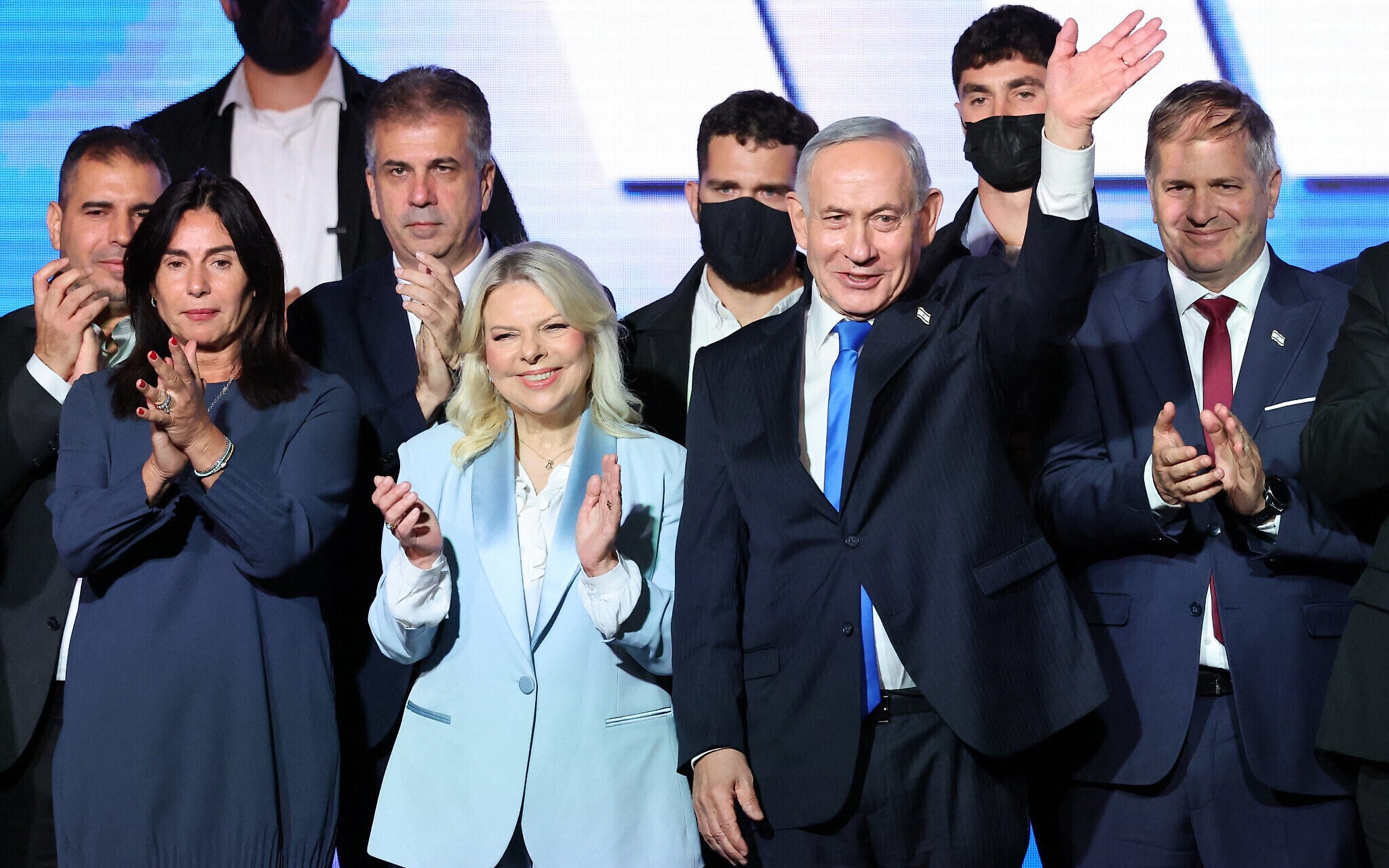
The change bloc refuses to internalize this lesson and declare a single, agreed-upon leader. That failure was on full display in Lapid’s basement on Saturday night.
Politicians can sign all the unity documents they want. But the moment you are running for prime minister and see it as a once-in-a-lifetime opportunity, you need to trample on your political allies to win more seats at their expense. If you do not do it openly, you do it behind the scenes through toxic campaigns and anonymous press briefings.
In Lapid’s basement, the change bloc leaders effectively decided not to rally behind Eisenkot and promote him as their sole candidate for the premiership. That is a strategic mistake that could prove fatal on October 27.
Help us report truthfully on social media

As a multimedia journalist, my job is to take the quality, fact-based journalism produced by The Times of Israel newsroom and make it accessible across every platform — from Instagram posts to podcasts to short-form videos.
This is how many, especially young people, consume news these days. But misinformation is rampant on social media. Our team at ToI produces accurate, responsible short-form reporting on Israel and the Jewish world.
If you believe in the importance of factual social media journalism, please consider joining our reader support group, The Times of Israel Community. Your financial support is essential to sustain responsible multimedia reporting.
— Gabriella Jacobs, multimedia journalist
Support our work Support our work Already a member? Sign in to stop seeing this
KioskNews shows a cleaned-up reading view extracted from the publisher’s page — the original always lives on their site, not ours.