Robert Pattinson was too busy for Primetime. One weekend changed his mind

For one entire weekend, Robert Pattinson sat in front of his television, watching American television presenter Chris Hansen point an accusatory finger at paedophiles. Hansen’s show To Catch a Predator ran on network television from 2004 to 2007; in the United States, it rated phenomenally.
The format was straightforward. To Catch a Predator’s team would go online, posing as sex-curious kids. When adults responded, they would invite them over to a house that had been adapted as a television studio, with hidden cameras and microphones. Knock, knock. In they would come. An adult actor who could pass as adolescent would make small talk, tell them their parents were out for the night, offer iced tea, maybe order in pizza.
Then Chris Hansen would appear from a different room, every inch the television host. “Have a seat!” he would say. “What did you expect to happen?” No point trying to get away now, he would add. “The police are outside.” So was the NBC camera crew. Sometimes, if the prey was big enough, the team went out in pursuit. It was one of these forays that led to the cancellation of To Catch a Predator, amid legal and ethical fallout, after one of the show’s suspects shot himself when he saw the police on his doorstep.
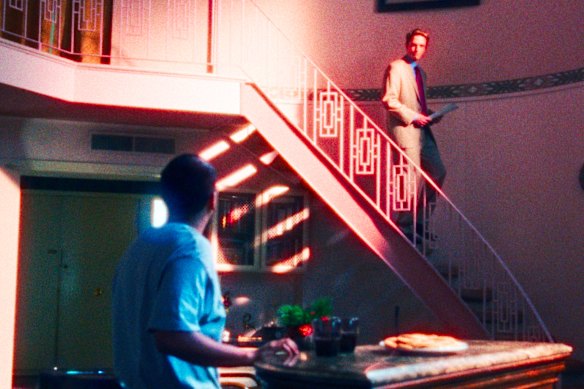
Pattinson was already a producer on Lance Oppenheim’s Primetime, which picks up Hansen’s story and gives it an eye-popping fictional shake. That lost weekend spent bingeing exploitation television convinced him, however, that he really wanted to play Hansen himself. “I watched every single episode in chronological order,” he says. “You can see the change in his persona and performance, the slickness of it.” Hansen now has his own YouTube channel, where he continues to work on luring paedophiles to their doom. “So he’s been doing it for over 20 years. I started imagining what this must be like when you’re doing it every day.”
To Catch a Predator was part of Dateline, an NBC program that regularly featured social issues. “Like ‘what should we be worried about this week?’” The internet was obvious worry material. “When you see the first episode of To Catch a Predator, you see what a novelty the internet was,” says Pattinson. “They’re explaining to parents what the technology is. It’s like an after-school special. The concept of it becoming a hit doesn’t make any sense, but it ended up getting three times the viewership The Office was getting at the time.”
Exposing online perverts was, as it turned out, ratings gold. “And once you start getting those kinds of numbers, it doesn’t matter what the subject is, or whether it’s fictional or non-fictional. The only thing that matters is that it’s a hit.” Over subsequent episodes, he watched Hansen adapting to that new status. “You’re having to adapt constantly and quickly to a completely changing reality, which is always really fun to play.”
He hadn’t wanted the role at first, he says, because he was already so busy. Pattinson, who came to fame as the romantically pale Edward in the Twilight series, is now 40. There were plenty of doomsayers prepared to believe that his career was over when he hung up his vampire fangs, but he has picked his projects carefully – not always with commercial success, but always with artistic integrity – and is now having quite the moment. “There’s years that are, like, fallow,” he says with a laugh, “and then there’s a year of harvest. I haven’t had a moment like this since I started out, where I just wanted to fit in so much of everything.”

Over the last year, he has appeared as Jennifer Lawrence’s distracted husband in Lynne Ramsay’s underrated Die My Love, Zendaya’s rattled fiance in The Drama and, of course, the dissipated leader of the suitors in Christopher Nolan’s monumental Odyssey. Dune: Part Three joins the list later this year. But it doesn’t feel to audiences like a Pattinson overload because he transforms so effectively for each role that you forget you saw him in the same cinema only a month ago. In Primetime, despite its dark subject, he is in himself an entertainment – a flippant, sharp, star of a story that has the hectic velocity of a comic strip.
One person he has signally failed to entertain, however, is the real Chris Hansen. Hansen complained in an interview with The Hollywood Reporter that Lance Oppenheim, hitherto known mostly as a documentary filmmaker, hadn’t asked for permission to use his name or consulted him or his staff for research purposes, or portrayed with any accuracy the “brand” Hansen has built over 45 years. That was before he saw it. When he did, he took great offence at what he said was a portrayal in which almost nothing was true.
“It was so bizarre and so in-and-out of reality,” Hansen said. “Obviously, I’m not objective because the character is, you know, me, but it was so detached from reality or anything I’ve experienced then or now doing the investigations. I’m not sure what the point of it was.” He has said he is considering legal action; meanwhile, he bought advertising time on thousands of American cinema screens to run a denial before the film screened.
Oppenheim shows Hansen as crazy for fame, an embodiment of crude ambition. Hansen already had someone else in mind to represent him in a biopic he wrote himself. “Years ago, I had crafted a script,” he said in one interview. “I thought Denis Leary would be a good guy to play me – depending on the age of it all.” Leary is a comedy actor; you may have heard him voicing Diego the sabre-toothed tiger in the Ice Age films. As for Pattinson, Hansen awarded him a “D” for his performance.
“This version of Chris Hansen [is] so detached, so unhinged, so dark, so unlikeable,” he said. Which is true, although Pattinson wasn’t feeling it. “He’s a pretty sympathetic character to me,” he says. “It wasn’t supposed to be any kind of takedown, but you can’t choose how the audience feels. We’re trying to encompass so many things.”
Primetime, he says, was never intended to be a biopic; it has more of the jumpy, jokey swagger of a film like Dr Strangelove. “Lance always said it was closer to the South Park parody of the show than a biopic,” says Pattinson. Almost from its inception, To Catch a Predator was the subject of satire, parodies, memes and gifs.
“It was brought into mainstream pop culture and normalised. That in itself is so odd to me, but then it had this second life on the internet. There is something about his persona that people attached to. If you look up something like ‘Chris Hansen’s best entrances’, there’s so many of them.” Although Pattinson didn’t set out to imitate Hansen, he did make a point of reproducing those catchphrases perfectly; even Hansen’s family said he got that part right.
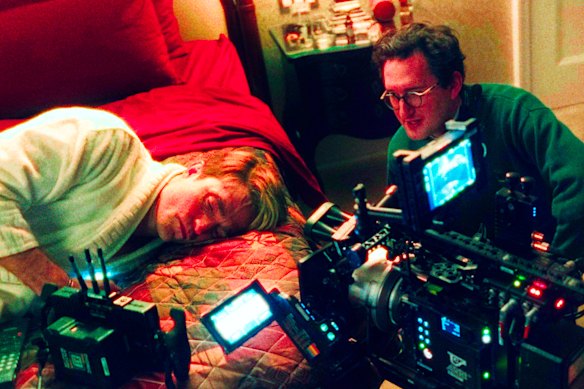
It was South Park’s parody, in fact, that introduced Oppenheim to Chris Hansen in the first place. Oppenheim has quite a body of work behind him, but he is only 30. As a boy, he was obsessed with sketch comedy. Having seen South Park and one or two other comic takes on To Catch a Predator, he sought out the real thing. He found it compelling but odd.
“It definitely didn’t feel to me like a news program,” he says. “It was using a visual language that felt like it was coming straight out of reality television. And yet Chris Hansen himself, before this and still, considers himself an investigative journalist, following in the footsteps of great broadcasters like [bulldog 60 Minutes interviewer] Mike Wallace.”
That fascination lasted into adulthood, by which time Hansen had repackaged To Catch a Predator as a web series called Takedown on TruBlu. Oppenheim had started making much-admired documentaries, including Some Kind of Heaven (2020) about a retirement community and this year’s hit documentary about Elizabeth Holmes, You Can See Everything, co-directed with Nathan Fielder.
He started thinking about Hansen again, he says, when his wife bought him a prize bit of Hansen merch: a video birthday greeting, where the man himself invited him to take a seat, congratulated him on his documentary Spermworld (2024) and followed up with a shout-out for his own ongoing predator-pouncing.
“I thought that was really interesting,” he says. “Because how does he balance that sort of self-aware, hyper-performative version of himself with doing serious investigations into one of the darkest subjects of all time?”
Does he really see Hansen’s work as serious? “I’m a father, I have a son and I would have never disagreed with what Chris Hansen is attempting to do,” says Oppenheim. What is most striking about the target men in Primetime’s re-enactments, in fact, is how pathetic they are, but Oppenheim clearly doesn’t want to seem as if he is soft on them. At the same time, he is intrigued by the show’s contradictions.
“What happens when you are attempting to do something noble, but there is a lot of pressure to essentially commercialise it? Suddenly, it was about finding the highest-impact predators.” Could they get a famous name? A public figure? Pattinson’s Hansen becomes as febrile as Captain Ahab in pursuit of his white whale. “It’s a sort of physiological necessity for him to get that guy.”
As portrayed in Primetime, everyone involved in the show shares something of that obsession. Producer Andie Bender (the excellent Merritt Wever) is fixated on ratings. Decoy Dan (Skyler Gisondo), their teen-alike star who welcomes men into a succession of fake kitchens, will do anything to get his Actors’ Union card. Hansen himself is shown to lose interest in his own, real children – something the real Hansen denies vehemently, but which makes dramatic sense to Oppenheim.
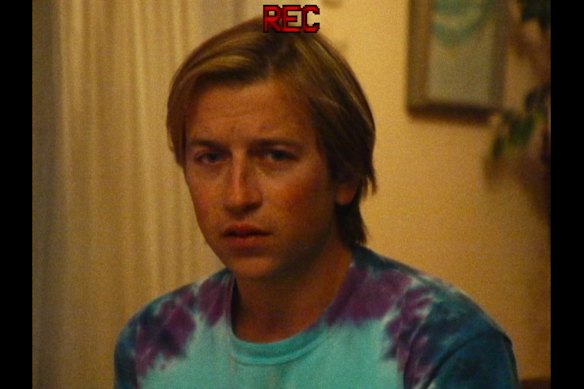
“I like this idea of exploring what happens to your soul when you spend 24 hours a day, more or less, in the darkness with these guys,” he says. “When you spend more time with potential predators than you do with your own family, so that when you go home, it almost resembles a doll’s house, where everything and everyone inside feels a little bit fake.”
Why so many people watched the show – and why Chris Hansen continues to be so popular in his corner of the internet – is a different psychological question. For Oppenheim, it is the showtime of the medieval town square.
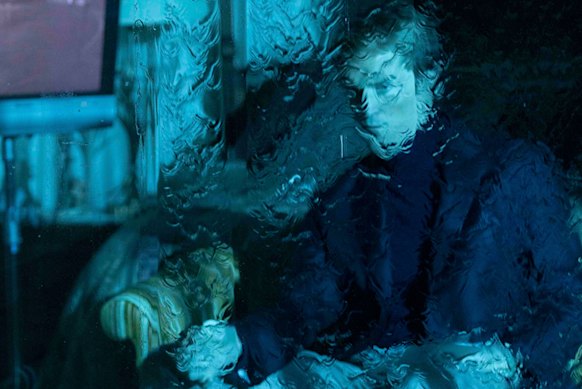
“I feel like for as long as civilisation has existed, there is always a whipping post and a pillory. There was always someone giving out the lashes and there would always be an audience. And there is something carnivalesque about the combination of some of the darkest of human behaviours with Chris Hansen’s catchy one-liners.”
For Pattinson, the show plays on deep but common historic fears. “You have this invisible, insidious enemy who wants to harm children and you don’t know where or when they will appear,” he says. “Because of the internet, it felt like they came through the ether.” In the face of that threat, Hansen can appear as heroic. “He’s trying to be a normal guy, but he becomes the face of justice and normality and light. You have something that is monstrous, but you see these people belittled and humiliated. That’s what you want justice to be, in many ways.”
KioskNews shows a cleaned-up reading view extracted from the publisher’s page — the original always lives on their site, not ours.