TAIEX falls below 40,000 points
US ELECTIONS FALLOUT: Bargain hunters stepped in after the intraday low, while the government yesterday authorized activation of the National Stabilization Fund
Shares in Taiwan yesterday suffered their fourth-largest single-day point loss, closing below the 40,000-point mark following an overnight sell-off on Wall Street, although the market recovered from its intraday low on hopes of government measures to support stocks.
The TAIEX closed down 1,873.08 points, or 4.51 percent, at 39,701.64 after plunging by about 3,700 points in early trading as artificial intelligence (AI)-related stocks led the decline.
Taiwan Semiconductor Manufacturing Co (TSMC, 台積電), which accounts for more than 40 percent of the market’s total capitalization, recovered from an earlier 10 percent decline to close down 4.69 percent at NT$2,135.
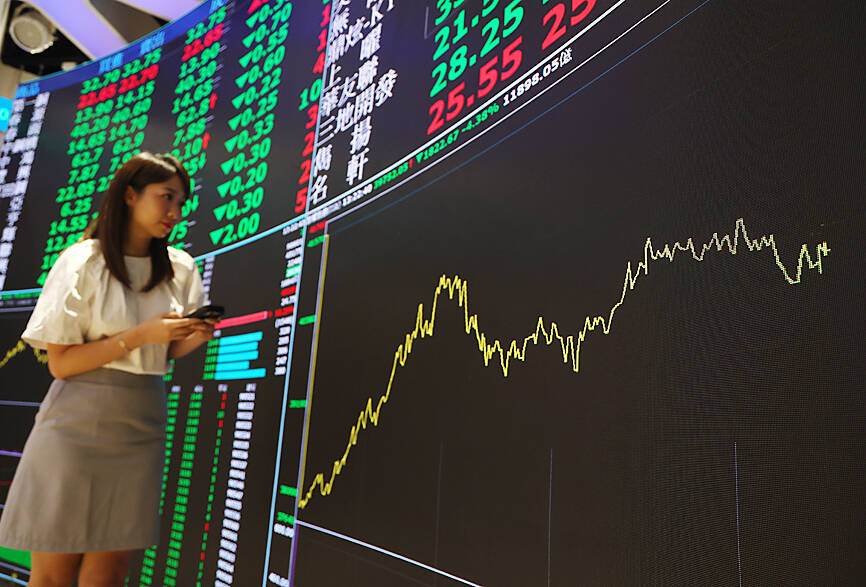
A woman looks at a TAIEX graph at the Taiwan Stock Exchange in Taipei yesterday.
Photo: CNA
Turnover on the main board totaled NT$1.246 trillion (US$38.02 billion), up from the previous session’s NT$926.024 billion, Taiwan Stock Exchange data showed.
Foreign institutional investors sold a net NT$91.19 billion of shares on the main board yesterday and have sold a net NT$705.658 billion over the past seven sessions, the data showed.
Yesterday’s market sell-off followed losses on Wall Street amid concerns over possible restrictions on AI data center development after Democrats won control of both chambers of the US Congress and won gubernatorial contests over Republican rivals in states including Texas, a major data center hub, in Tuesday’s midterm elections.
“After the TAIEX hit its intraday low, however, bargain hunters stepped in around noon, easing the selling pressure as the Financial Supervisory Commission [FSC] said it would convene a meeting later today [yesterday] to discuss possible market supporting measures,” Moore Securities Investment Consulting Co (摩爾投顧) analyst Adam Lin (林漢偉) said.
In addition, the government yesterday authorized the activation of its NT$500 billion National Stabilization Fund to support local shares.
“The government’s statements reassured some investors, encouraging them to buy on the dip,” Lin said.
“Despite the rebound from the day’s low, it is too early to tell when the TAIEX will climb out of the current doldrums,” he said. “Pay close attention to what the FSC will come up with to support the market.”
Yesterday’s sell-off came after New York’s NASDAQ Composite Index plunged 5.5 percent in its worst day — percentage-wise — since April last year when US President Donald Trump unveiled his wide-ranging global tariffs.
The S&P 500 tanked more than 4 percent and the Dow Jones Industrial Average more than 3 percent.
Bloomberg reported that the Philadelphia Semiconductor Index had collapsed about 16 percent this week, putting it on course for its worst run since April last year.
Trading boards were a sea of red across Asia. Seoul briefly plunged almost 9 percent before closing 6 percent lower, with chip giant SK Hynix Inc off more than 10 percent and rival Samsung Electronics Co down 6.4 percent.
The KOSPI more than doubled between the end of December last year and the middle of June, when it hit a record, and has since then lost almost 50 percent.
Tokyo dived 6 percent as Softbank Group Corp gave back more than 10 percent, with Kioxia Holdings Corp off 8.7 percent and Advantest Corp 5 percent lower.
Hong Kong, Shanghai, Sydney, Singapore, Jakarta, Bangkok, Wellington and Manila were also in the red.
KioskNews shows a cleaned-up reading view extracted from the publisher’s page — the original always lives on their site, not ours.