ByteDance grabs one-fifth of China’s data centre capacity as AI drives infrastructure boom
ByteDance accounts for roughly one-fifth of China’s delivered data centre capacity, making the TikTok owner the country’s largest tenant and a main driver of its artificial intelligence buildout, according to new estimates by research firm SemiAnalysis.
The estimate comes from the firm’s tracking of more than 1,000 facilities in China operated by over 60 companies. ByteDance rents nearly all of its data centre footprint, SemiAnalysis said. Its AI products include Doubao, an assistant that ByteDance says has hundreds of millions of users, and Seedance, a video generation model.
While ByteDance’s financials remain undisclosed as a private company, capital spending by its listed peers has surged. Alibaba Group Holding, Tencent Holdings and Baidu spent a combined US$20 billion on capital expenditure in the second quarter, more than double the figure from a year earlier, according to the report published on Friday. All three tech giants posted negative free cash flow in the same quarter for the first time on record.
Alibaba owns the South China Morning Post.
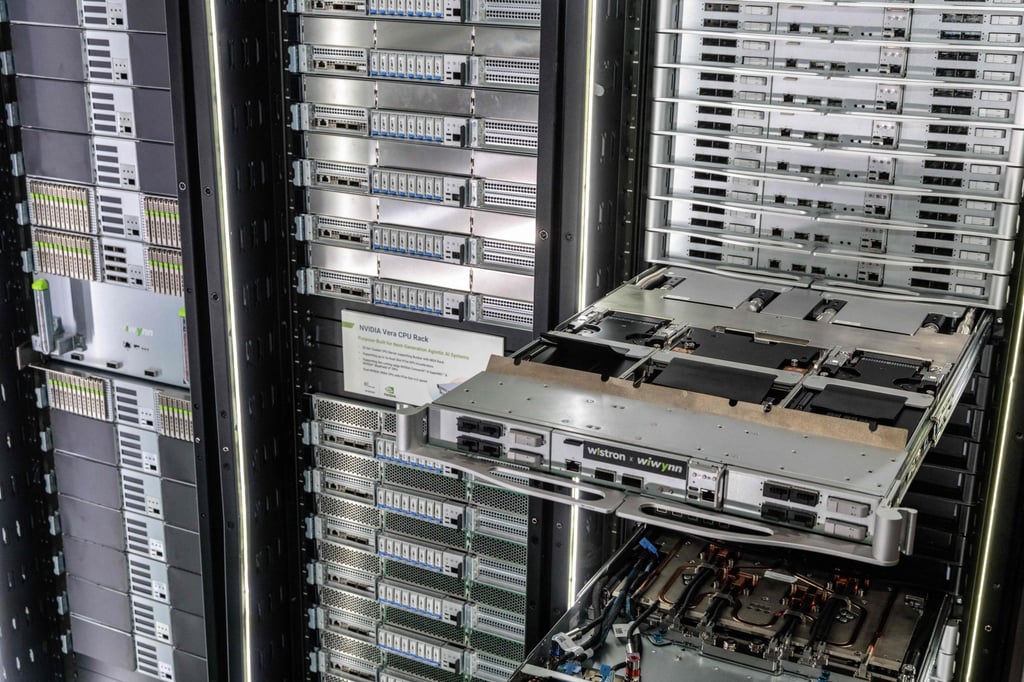
SemiAnalysis estimates that China has more than 24 gigawatts (GW) of delivered data centre capacity. Its model separately tracks about 20GW in the pipeline and another 30GW in announced projects. For comparison, the firm projects 56GW of capacity in the United States by the end of 2026, against about 15GW in the rest of Asia-Pacific and 14GW in Europe, the Middle East and Africa.
That expansion is taking place alongside high vacancy rates at older facilities. The report traces the mismatch partly to the industry’s roots in telecoms: China’s three state-owned carriers still own about a third of national data centre capacity. Many were built to rent small numbers of low-power racks to individual customers and cannot easily accommodate the power demands of AI servers, the report said. Newer facilities leased in bulk to cloud and AI companies are filling more quickly.
“The AI era is wholesale. The legacy retail stock is not participating,” SemiAnalysis said.
The availability of chips presents a further constraint. Goldman Sachs said in a July research note that the pace at which Chinese customers occupied new data centre space had been slower than expected in the first half of 2026, probably because supplies of both domestic and imported chips were tight.
China added 595 eflops of intelligent computing power during the first half, below the 802 eflops added in the second half of 2025, according to figures cited by the bank.
The increase brought China’s total intelligent computing capacity to 2,185 eflops by the end of June, up 177 per cent from a year earlier, according to the Ministry of Industry and Information Technology.
An eflop is one quintillion floating-point operations per second.
Goldman estimated the first-half increase was equivalent to about 0.7GW of AI-related data centre capacity being occupied. It still expected China’s overall data centre demand to grow at a compound annual rate of 20 per cent from 2025 to 2028.
KioskNews shows a cleaned-up reading view extracted from the publisher’s page — the original always lives on their site, not ours.