BPOM, URI explore AI training for future leaders
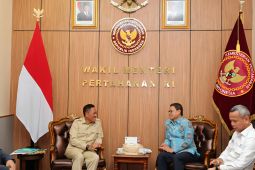
Jakarta (ANTARA) - The Indonesian Food and Drug Authority (BPOM) is exploring AI-focused education with the University of the Republic of Indonesia (URI) to prepare future leaders and strengthen talent for drug and food supervision.
BPOM Head Taruna Ikrar met URI Governor Donny Taufanto to discuss developing a BPOM vocational school and the need to balance AI-driven education with stronger human resources.
“Collaboration among academia, business and government, or ABG, is one approach being promoted to build a human-centered AI leadership ecosystem,” Ikrar said here Thursday.
BPOM also supports integrating AI into cross-disciplinary national leadership curricula, particularly to strengthen data literacy and technology ethics, he said.
The development of AI-based decision simulation laboratories could allow prospective leaders to test policy proposals against real-world scenarios and risks, Ikrar said.
He also stressed developing the BPOM Vocational School as part of a strategy to build a national talent pipeline for drug and food supervision.
“This is increasingly important as supervisory challenges grow more complex alongside advances in pharmaceutical science and technology and threats of crime in the drug and food sector,” Ikrar said.
As of August 2026, BPOM had 6,432 civil servants, or 60.06 percent of its required workforce of 10,710, highlighting the need for specialized human-resource development.
Beyond vocational education, BPOM is exploring cooperation with URI on AI-based training, research into AI governance for drug and food supervision, and a center focused on AI ethics, regulation, impact and auditing.
Related news: BRIN, BPOM to study food registration optimization using AI
Related news: BRIN, BPOM review use of AI for pre-market processed food monitoring
Translator: Hana, Kenzu
Editor: Rahmad Nasution
Copyright © ANTARA 2026
KioskNews shows a cleaned-up reading view extracted from the publisher’s page — the original always lives on their site, not ours.