Taiwan in Time: How five concubines became legends
After five women chose death over surrender alongside the Prince of Ningjing, centuries of retelling reshaped their sacrifice to promote traditional ideals of female loyalty and chastity
By Han Cheung / Contributing reporter


Nov. 2 to Nov. 8
After 41 years in exile and the enemy closing in, the Ming Dynasty’s Prince of Ningjing (寧靖王) decided to meet his end in Taiwan. So did the five women who accompanied him.
The Qing had captured Penghu in July 1683, and the Tainan-based Kingdom of Tungning appeared doomed.
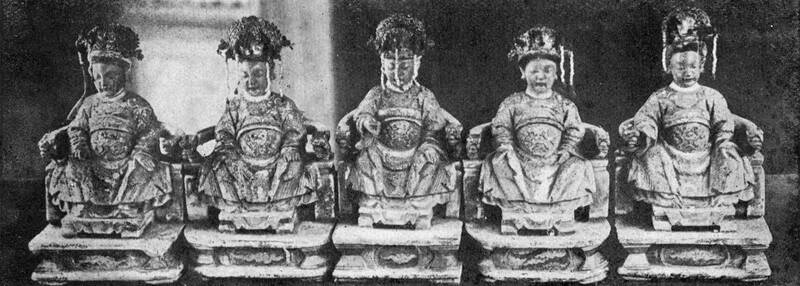
Statues of the Pring of Ningjing’s five concubines are worshipped in the Temple of the Five Concubines in Tainan.
Photo courtesy of Academia Sinica
According to the Taiwan Prefecture Annals (台灣府志), compiled in 1696, the prince announced his intention to his five concubines, telling them they were free to remarry or become nuns. Lady Yuan (袁氏), Lady Wang (王氏), Xiugu (秀姑), Sister Mei (梅姐) and Sister He (荷姐) replied, “If our lord lives, we live; if our lord dies, we die with him. We beg you to grant us silk cords so that we may die alongside our lord. In this way, we may at least remain faithful to one man until death.”
The prince personally buried the women. The next day, he put on his royal robes and headgear, handed his imperial seal to Kingdom of Tungning’s boy ruler, Cheng Ke-shuang (鄭克塽), and hung himself after composing a farewell poem.
A ninth-generation descendant of the Ming Dynasty’s founding emperor, Chu Shu-kui (朱術桂) was the only Ming prince-in-exile in Taiwan to choose death over surrender. The other 16 were sent back to China along with Cheng and his officials.
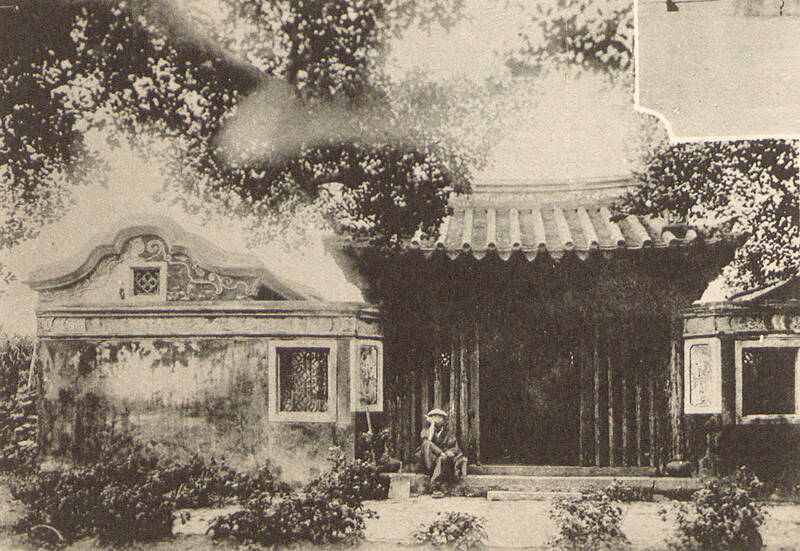
A photo of the Temple of the Five Concubines published in 1915.
Photo courtesy of National Central Library
Over the centuries, the suicides of the five concubines became the focus of poems and stories lauding their loyalty and chastity far more than the prince’s own death. The Temple of the Five Concubines was built over their grave in 1746 and renovated and expanded several times, with the latest repairs starting last month and slated for completion in 2028.
In “The unbearable heaviness of widowhood: A reconsideration of the deaths of Prince Ningjing’s five concubines in the perspectives of gender and social history” (妾身敢作未亡人?明寧靖王從死五妃史事的性別與社會史分析), however, Lei Chin-hau (雷晉豪) argues that their deaths may have been romanticized over time to glorify traditional ideals of female virtue. Without discounting their sacrifice and dedication, he notes that in a patriarchal society where women had few means of supporting themselves independently, they might not have had much of a choice.
FALLEN PRINCE
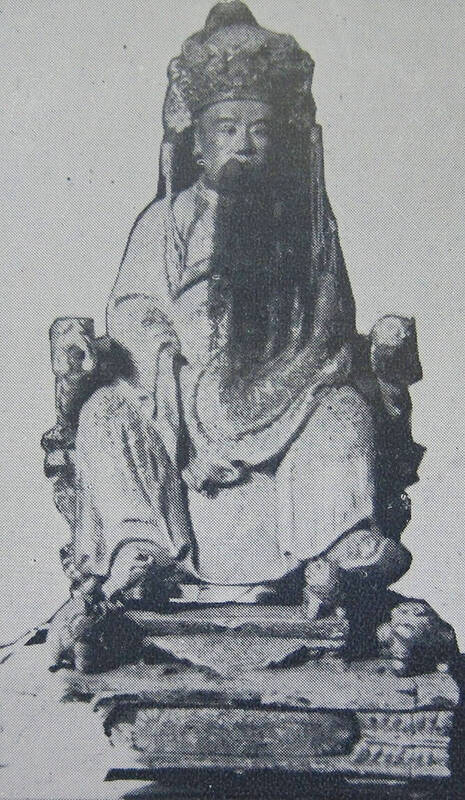
A statue of the Prince of Ningjing at Zhuhu Huashan Temple in Kaohsiung’s Lujhu District.
Photo courtesy of Wikimedia Commons
According to the Taiwan Prefecture Annals (台灣府志), compiled in 1696, the prince, Chu Shu-kui (朱術桂), was born in 1617 in today’s Hubei Province. The invading Qing army captured his hometown in 1642, beginning his life on the run. The Ming Dynasty collapsed two years later, and Chu joined other royals in the resisting Southern Ming. Emperor Longwu bestowed him the title Prince of Ningjing and assigned him the role of military supervisor.
The Qing continued to push south, and by 1650 Chu had fled to Kinmen where he sought the protection of warlord Cheng Cheng-kung (鄭成功, Koxinga).
Koxinga drove out the Dutch from Tainan in 1662 and established the Kingdom of Tungning. His son, Cheng Ching (鄭經), invited Chu to Tainan in 1663 and built him a residence. Chu arrived with his principal wife, Lady Lo (羅氏), as well as the five concubines. His biological son died young, so he adopted a relative, Chu Yen-chen (朱儼?), as his heir. Lo died before Chu and the five concubines.
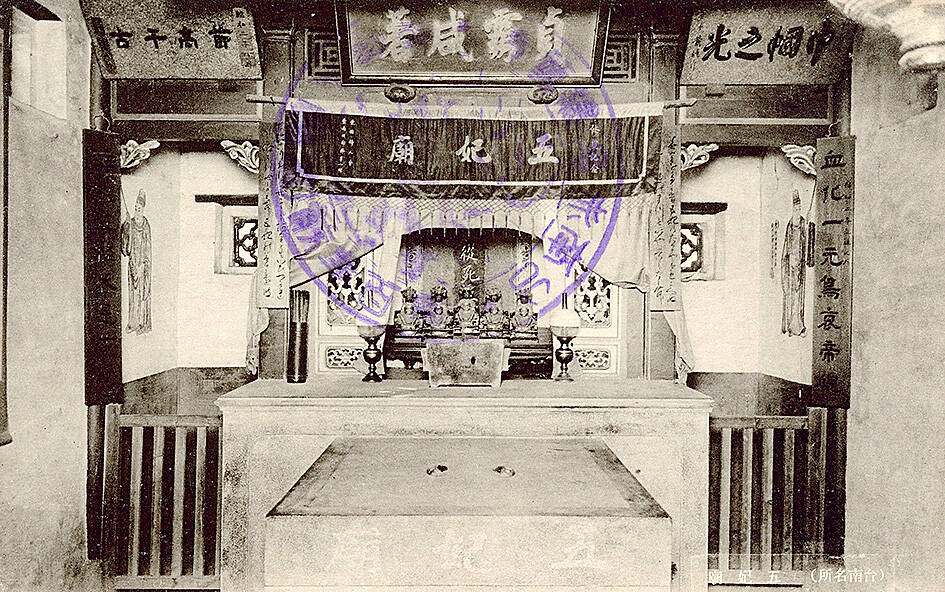
A Japanese-era postcard showing the Temple of the Five Concubines in Tainan.
Photo courtesy of National Museum of Taiwan History
According to the Taiwan Prefecture Annals, Cheng Ching eventually discontinued the living stipend for Chu’s household. Chu turned to cultivating land in present-day Lujhu District (路竹), Kaohsiung, but the Cheng regime imposed taxes on the land as it was waging a campaign to retake China, adding to the prince’s financial difficulties.
It’s said that before Chu’s death, he gave his land to the tenant farmers. To thank him, they buried him in Lujhu along with Lady Lo and his son, and built 100 fake tombs in the area to spare it from Qing destruction. It wasn’t identified until 1937. Chu’s residence in Tainan was later converted into the Tainan Grand Matsu Temple (大天后宮).
LITERARY EVOLUTION
Most early literary works focused on Chu’s death, writes Wang Chien-kuo (王建國) in “Political narratives and historical divergence: Poems about Prince Ningjing and the Five Concubines in Qing-era Taiwan” (政治書寫與歷史衍異─清代臺灣寧靖王與五妃題詠現象及其詩作論析).
The earliest known poem dedicated solely to the five concubines appeared in the 1720 Taiwan County Annals (台灣縣誌) by Lin Chung-kui (林中桂). Lin described seeing lingering haze and glow surrounding their grave in Kuishan (魁山), just outside Tainan and much more accessible to visitors than Chu’s unmarked tomb in the countryside. Many other poems mention the grave, which had become a temple site marked by official steles commemorating the women’s deed.
In the same volume, Shih Shih-pang (施世榜) wrote, “Ordinary women know only to share a pillow in life; the Five Concubines alone were seen to share death as one.”
This idea of their act transcending gender norms continued in other poems: “Do not say that women who follow their men are merely concubines; their righteous deaths deserve the praise given to men,” wrote Ho Chieh-yi (何借宜).
Chang Mei (張湄) took it further: “Their loyalty is comparable to Tien Heng’s 500 followers,” referring to the men who committed suicide after learning of their lord’s death rather than submit to the Han Dynasty.
After the 1720s, Wang noted that works praising or mourning the five concubines greatly surpassed those of the prince. A possible factor was the 1721 Chu Yi-kuei (朱一貴) rebellion. Since Chu shared a surname with the Ming royal house, he revolted under the banner of “reviving the Ming Dynasty.”
PRACTICAL CONCERNS
Not much is known about the concubines’ backgrounds, but many modern sources describe them as “young beauties” and add expressions of affection and sorrow absent from the original text, heightening the tragedy of their deaths, Lei writes.
However, according to Chu’s biography in the Annals of the Southwest (西南記事), he married Lady Yuan and Lady Wang in 1644, which would put them at least in their mid-to-late 50s by 1683.
The fact that the family’s heir, Chu Yen-chen, was adopted also complicated matters. Under Ming custom, concubines could not manage or dispose of family property on behalf of an adopted heir, leaving their economic future uncertain amid the imminent collapse of the Kingdom of Tungning. Sources indicate that the family was already in financial difficulty, while women in their position had few ways to support themselves independently. Chu Yan-chen eventually surrendered to the Qing and was taken to China.
As for remarrying, they would have had to wait until the three-year mourning period was over. Remarriage was also frowned upon, as widows were expected to remain chaste. Becoming nuns was another unlikely option: Lei notes that there were few monks in Taiwan at the time and apparently no nunnery in the area.
These circumstances raise questions about how much freedom they had to choose another future.
Taiwan in Time, a column about Taiwan’s history that is published every Sunday, spotlights important or interesting events around the nation that either have anniversaries this week or are tied to current events.
KioskNews shows a cleaned-up reading view extracted from the publisher’s page — the original always lives on their site, not ours.