North Korea has opened up bridges to Russia and China – in which direction will it go?
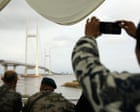
For more than a decade, local Chinese residents pilloried it as nothing more than an empty bridge that led to a North Korean vegetable patch on the other side.
Fast forward 12 years and dozens of trucks are now traversing the bridge linking China to North Korea, boosting trade for the reclusive regime. But it has also triggered concern that it could intensify a struggle for influence over the North between Beijing and the region’s other major power, Russia.
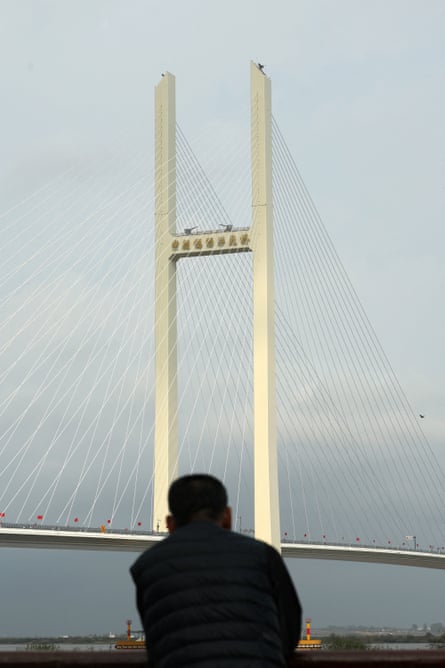
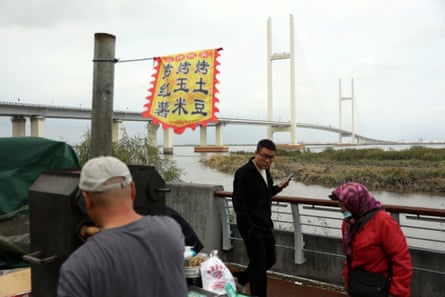
The New Yalu River Bridge connects the north-eastern Chinese city of Dandong with Sinuiju in North Korea and has four lanes and stretches 3km (1.9 miles) across the Yalu river. It is expected to ease congestion on the ageing Friendship Bridge nearby.
It opened on 15 October, about a month after another major crossing – this time between North Korea and Russia. The first road bridge across their short shared border, named the Yakov Novichenko Bridge, reportedly made Chinese officials uneasy, coming on top of signs from the North Korean leader Kim Jong-un that he is prioritising ties with Moscow.
“China’s interest in buttressing its influence in North Korea is certainly reinforced by the diversifying North Korea-Russia relationship — ties that China tolerates but watches closely as they add complexity to its relationship with its provocative neighbour,” says Carla Freeman, director of the Johns Hopkins School of Advanced International Studies’ Foreign Policy Institute.
Since late 2024, the North Korean leader has sent ammunition and as many as 16,000 troops to support Vladimir Putin’s war in Ukraine, and has held two summits with the Russian president in the past three years. In 2024, the leaders signed a mutual defence pact that includes a clause requiring the countries to come to each other’s aid if attacked.
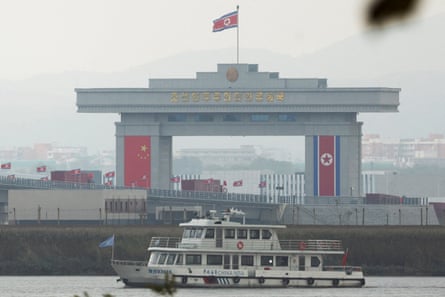
Photograph: Florence Lo/Reuters
In return for arms and combat soldiers, Pyongyang is getting hard currency, real-time battlefield experience for its troops, weapons technology and the opportunity to extend political and economic cooperation beyond its traditional ally China.
North Korea stands to benefit from increased trade but for China, the bridge could be of more geopolitical value than economic given how little trade China does with its neighbour compared with its other partners.
However, the insular regime in Pyongyang is thought to be reluctant to increase its economic dependence on China, by far its biggest trading partner and aid donor, and may still resent Beijing’s previous support for UN sanctions targeting the North’s nuclear weapons programme.
In the past two years, however, Russian and Chinese support for UN sanctions has collapsed. “The main restriction on trade with North Korea is not the infrastructure but international sanctions,” says Justin Hastings, a professor of international relations and comparative politics at Sydney University. “However, because China’s enforcement of UN sanctions has become desultory and Russia has actively repudiated their enforcement, North Korea is in a position to benefit from increased trade and weapons help (at least from Russia).”
The North’s “open” border with China contrasts dramatically with the one it shares with South Korea. In 2024, the North said it would sever all rail and road links with its neighbour, months after Kim said he would abandon the goal of peaceful reunification and declared South Korea his country’s “principal enemy”.
But Fyodor Tertitskiy, a North Korea expert at Korea University in Seoul, believes neither China nor Russia can influence North Korea in any meaningful way, citing Kim’s refusal to surrender his nuclear weapons or moderate his iron grip on power – two changes that would be welcomed in Moscow and Beijing.
“Both countries understand that Kim Jong-un would rather accept a complete breakdown in relationships than submit,” he says. “So I doubt we are seeing a straightforward struggle for influence. Kim is trying to play the two against each other, but China and Russia are not rivals like the Soviet Union and China were in the 1970s.”
Kim is more likely to turn to China improve his country’s struggling economy, while Beijing is eager to revive its role as the North’s biggest influence, according to Leif-Eric Easley, a professor at Ewha University in Seoul.
“After expanding military cooperation with Russia … Kim Jong-un is leveraging his windfall from Moscow for additional gains from Beijing. China may seek to recover lost influence by increasing trade and people-to-people exchanges, but the Kim regime prizes autonomy and wants to limit foreign ideological and cultural influences.”
The South Korean government said last year that at least 17 active road and rail links connect North Korea and China along their 1,400 km-long border.
Tertitskiy is “not particularly optimistic” that the increased contact the bridges will bring means improvements to the lives of ordinary North Koreans or lead to a more western-style economy. “I think it will make reform even less likely. Why pursue reforms and take risks when you can just get what you need from abroad?”
Analysts say the expected rise in trade across the Yalu bridge is likely to be modest at first. But it could become a bellwether for the state of Sino-North Korean ties, says Easley.
“China remains economically indispensable to North Korea in ways that Russia cannot replace,” he says, adding, “In that sense, the bridge may offer an inadvertent window into bilateral relations if flows are visibly interrupted in the future.”
KioskNews shows a cleaned-up reading view extracted from the publisher’s page — the original always lives on their site, not ours.