Nvidia scandal heightening AI rivalry
INTENSIFYING RACE: Trump does not plan to confront Xi on the Nvidia issue when they meet this week in China, senior US officials said on condition of anonymity
Well before reports emerged that former Nvidia Corp CEO Jensen Huang (黃仁勳) was having an affair with a suspected Chinese spy, the advanced chips made by his company were at the center of the race between the US and China to dominate artificial intelligence (AI).
The scandal now threatens to intensify that rivalry.
As US President Donald Trump prepares to meet with Chinese President Xi Jinping (習近平) this week in China, lawmakers on both sides of the aisle in US Congress are seizing on the affair to press for tighter restrictions on technology exports to protect the US’ edge.
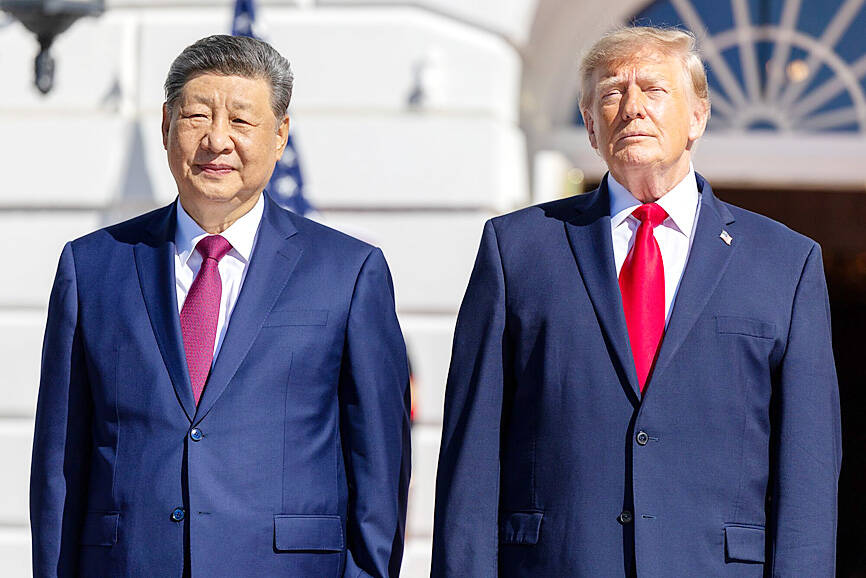
Chinese President Xi Jinping, left, and US President Donald Trump take part in a welcoming ceremony for the Chinese president at the White House in Washington on Sept. 25.
Photo: Bloomberg
“The scandal, in many ways, encapsulates the rivalry, where concerns around national security, export control and foreign policy get intertwined,” Omdia chief analyst Lian Jye Su (蘇連傑) said.
At the heart of the competition to build the most advanced AI is the race to access the most powerful AI chips. US-led restrictions have barred China from getting the world’s most advanced AI chips, a strategy that has led Beijing to accuse the US of pursuing an AI monopoly.
The strategy in Washington has been largely focused on hardware, with officials believing if they controlled where California-based Nvidia’s best chips go, they would be in control of the race for the most capable AI, New York University Center for Global Affairs assistant professor Shaoyu Yuan (袁紹御) said.
That strategy was effective in slowing down Chinese companies, Yuan said, but it assumed the primary threat was the physical hardware, not access to leaders such as Huang.
Yuan said what he called “China hawks” in Congress — who have been bullish on oversight and stronger export controls long before this incident — would have “a story with a name and a face” to support their argument.
“I don’t think anybody in Washington wants to be seen as loosening the controls on chip exports to China right now,” he added.
US lawmakers from across party lines have become more outspoken in their calls for tougher legislation to prevent China from accessing advanced US chip and AI technologies. The Senate version of a defense policy bill includes authorizing Congress to review licenses to sell advanced AI chips to China, authorizing the US Department of Commerce to track AI chips to ensure they are not diverted to unauthorized regions, and compelling US allies to match US restrictions on exports to Chinese chipmakers.
Trump does not plan to confront Xi on the Nvidia issue, said senior US officials who briefed reporters on Friday on condition of anonymity under ground rules set by the White House.
The officials also said they do not expect Chinese retaliation if they close loopholes to existing measures that prohibit China from smuggling or using advanced computer chips.
Meanwhile, the US and China have committed to the idea of a hotline for AI national security-related incidents.
Brookings Institution fellow Kyle Chan (陳凱欣) said the Nvidia scandal — and the possibility of new US export control measures — could throw a wrench in the AI talks.
“The question is whether Beijing can separate export controls from the AI safety discussion or will view them as connected issues,” Chan said.
The US and China have been moving AI technology forward in different ways. US companies are chasing AI frontiers supported by cutting-edge chips and the country’s rapidly expanding data center infrastructure. China is pursuing wider global adoption of its open-source, more affordable models.
The Huang episode could add momentum to China’s domestic chip industry, Tech Buzz China founder Rui Ma (馬睿) said.
“For Beijing, the fallout only adds urgency to its efforts to build a domestic semiconductor supply chain. That was already a strategic priority, but if access to Nvidia computing power becomes even more restricted, Chinese companies will have increasingly few alternatives,” Ma said.
Chinese chipmakers, including Huawei Technologies Co (華為), have been making rapid progress to narrow the gap by finding ways to work around the US restrictions, including by clustering large numbers of less advanced domestic chips.
However, Nvidia’s cutting-edge chips still lead in single-chip capability and outperform Chinese alternatives in training advanced AI models, analysts say.
KioskNews shows a cleaned-up reading view extracted from the publisher’s page — the original always lives on their site, not ours.