From Shenzhen to Silicon Valley: Xi Jinping calls for global association of bay areas
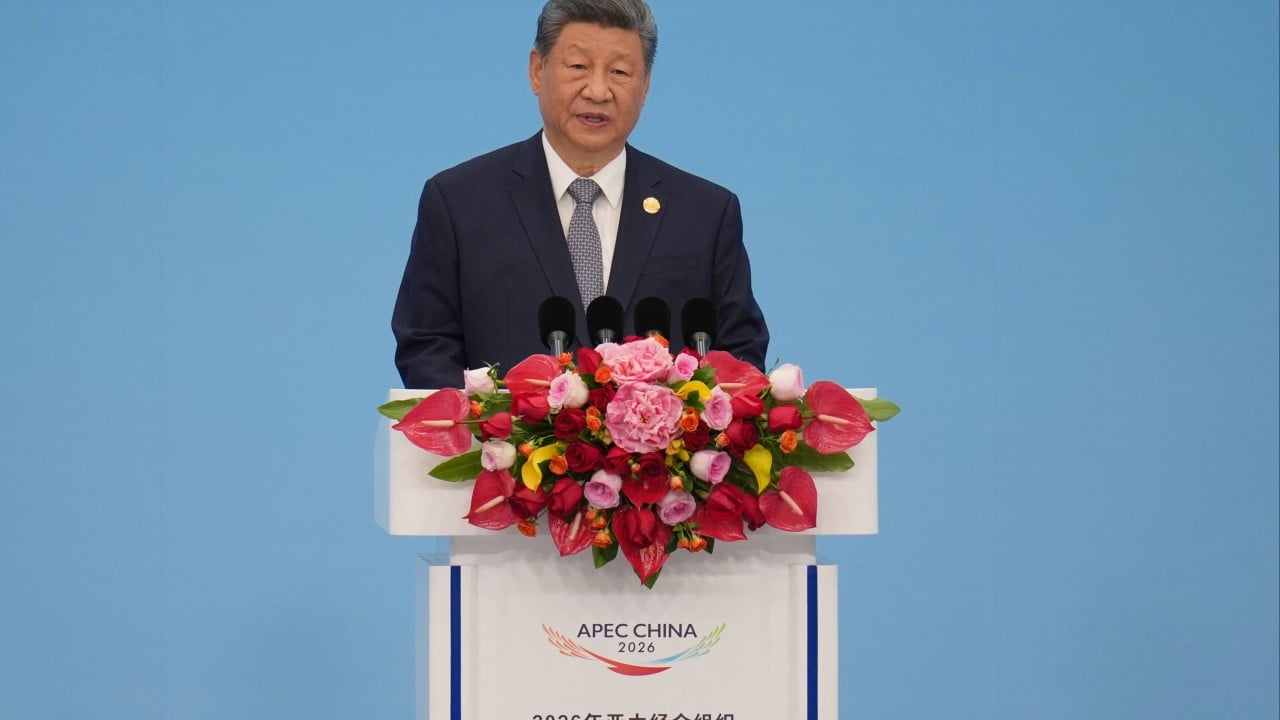
President Xi Jinping has called for closer economic links between major coastal innovation centres across the globe – a proposal observers said could create new opportunities and exchanges for China and the United States.
Speaking at the opening of the Apec CEO Summit in Shenzhen on Wednesday, Xi used the address in the southern Chinese tech hub to strike an optimistic tone on China’s growth prospects, highlighting its strengths in innovation despite mounting economic challenges.
He urged closer cooperation between major metropolitan bay areas, arguing that deeper economic ties could help drive regional growth.
“The Pacific region is home to the world’s most important bay areas, notable for their open, interconnected economies with positive spillovers. Shenzhen, where we are now meeting, is part of the Guangdong-Hong Kong-Macau Greater Bay Area (GBA),” he told business leaders from 21 Apec economies.
“China supports the establishment of a world association of bay areas to deepen exchanges and strengthen economic cooperation in the Asia-Pacific region,” he said, without offering further details.
Observers said the proposal reflected Beijing’s interest in building lasting economic links between China and the United States, including through regional and local-level cooperation.
“Traditional sub-national exchanges are limited by administrative boundaries. Bay areas may transcend city and regional borders, allowing diverse enterprises and institutions to participate and swap ideas,” said Guo Hai, dean of the South China University of Technology’s Institute of Public Policy.
There is tremendous complementarity among China’s GBA and the bay areas surrounding San Francisco, New York and Tokyo
Such cooperation, Guo said, could make business and people-to-people exchanges less vulnerable to political tensions by institutionalising local-level cooperation and keeping such dealings separate from disputes between the two central governments.
“Local authorities are less politically driven, more pragmatic and pro-business. There is tremendous complementarity among China’s GBA and the bay areas surrounding San Francisco, New York and Tokyo,” he said.
However, Guo noted that Beijing still needed to flesh out the details and consult potential partners on the proposed association’s membership and governance structure.
Xi’s call for closer ties between bay areas drew support from some business representatives in the United States. Antonio Yung, an envoy and business representative for the government of Sacramento, California’s capital, welcomed deeper cooperation between the San Francisco Bay Area and China’s GBA.
“The two bay areas are uniquely linked culturally, and there is mutually beneficial business. Now that Xi has underscored bay-to-bay ties, there’s an expectation [that more can be done for] exchanges to expand substantially,” Yung said.
SCMP Plus is a new premium news platform that gives you an
all-inclusive edge to stay ahead on China news.
To access our exclusive content you’ll need to subscribe.
Already a subscriber?
LOG IN
Zak Dychtwald, founder of BridgeWorks, a consultancy that advises American companies operating in China, said Shenzhen and Silicon Valley had similarities and competitive strengths.
“Silicon Valley has been Chinese tech’s ‘innovation city on a hill’ for decades. Walk into any Chinese innovation centre, and you’ll see Silicon Valley’s history on the wall. Proposing a partnership of bay areas signals a new sense of parity,” Dychtwald said.
23:48
Live: Chinese President Xi Jinping delivers opening remarks at Apec summit
“The bay area push is sincere but is foremost in China’s interest. Silicon Valley can’t easily replicate Shenzhen’s hardware innovation strengths. Still, China has a lot to learn from the US on software,” he added.
In his speech, Xi also pointed to innovation as a way to shore up growth. While the performance of the world’s second-largest economy has become increasingly uneven, the Chinese leader called the country a “vast testing ground”, saying it offered an unusually large environment to develop and refine cutting-edge technologies.
“From factory and farm robots to autonomous driving and drone delivery, China is a supersized innovation testing ground where frontier technologies are tested and improved in real-world scenarios,” Xi said. “New technologies will be turned into growth drivers.”
“The economy maintains a strong momentum, demonstrating great resilience and vitality … The green and low-carbon transition is also picking up speed,” he said. “The 15th five-year plan has got off to a good start,” he added, referring to Beijing’s half-decade-long blueprint for socio-economic development.
But while Beijing’s 4.5 to 5 per cent growth target for 2026 appeared within reach, October retail sales and industrial output both trailed expectations. Consumer spending growth slowed to 0.4 per cent from 1.1 per cent in September, while industrial output growth fell to 4.8 per cent from 5.5 per cent.
Against this backdrop, Xi signalled that China wanted to expand market access and increase imports, saying Beijing would accelerate efforts to develop a large, open market for overseas businesses.
KioskNews shows a cleaned-up reading view extracted from the publisher’s page — the original always lives on their site, not ours.