Joint List did not sing the Palestinian anthem; its political positions pose far bigger challenges
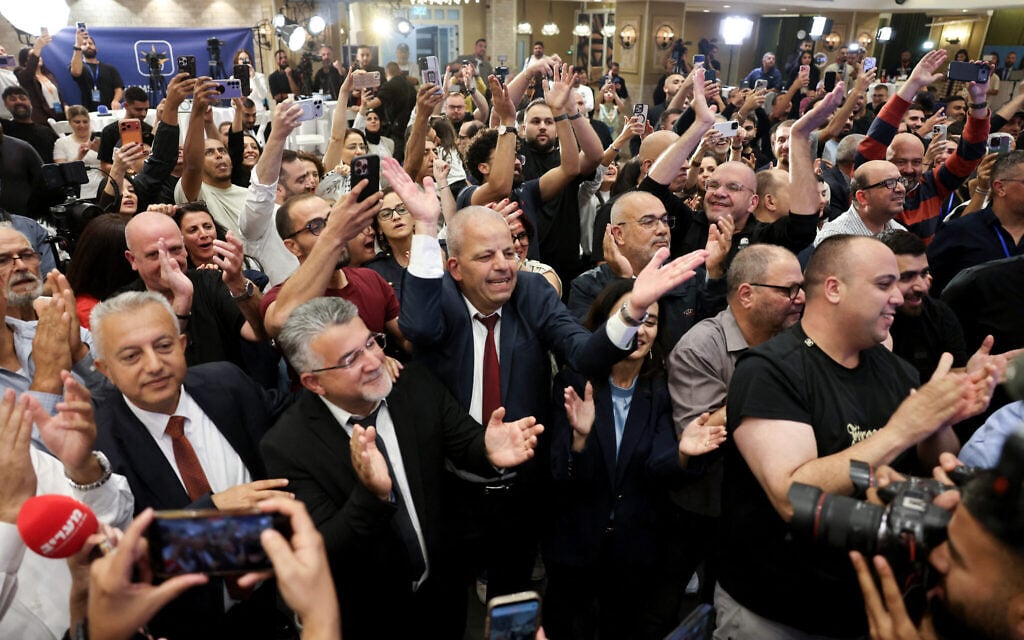
A video that has sparked controversy on social media in recent days shows the Arabic song “Biladi Biladi” being sung at a campaign event held by the Joint List alliance of Arab parties. Not shared on an official account, it began appearing online on October 28, the day after the election. The Joint List told The Times of Israel that the video was filmed at a campaign event in Haifa on October 24, three days before the vote.
Some reports, including a social media post by Prime Minister Benjamin Netanyahu, claimed that the song was sung at the Joint List headquarters and was the Palestinian national anthem, which includes calls for revenge and dying for the homeland. That claim is false; the song is actually the unofficial anthem of Hadash, a mainly Arab, left-wing party rooted in the communist movement that is part of the Joint List. It is primarily about love for the homeland.
Nevertheless, the sentiment behind the song indeed points to the challenges that lie ahead for any potential cooperation between the Joint List and other parties seeking to oust Netanyahu from power.
0:00 / 0:00
Promoted: American Technion Society

The Joint List won 11 seats in the Knesset elections, alongside Ra’am’s eight seats. Cooperation between the two parties and the Zionist opposition is one of the few scenarios that would enable a government to be formed, leading to greater scrutiny of those parties’ positions.
Unlike Ra’am, which made history by joining a governing coalition in 2021–2022; recently included a Jewish candidate on its electoral slate for the first time; and focuses primarily on civil issues; the Joint List places much greater emphasis on political issues, such as the Israeli-Palestinian conflict, and has so far refrained from joining a governing coalition.
Get The Times of Israel's Daily Edition by email and never miss our top stories
By signing up, you agree to the terms
Ra’am’s website lists combating violence and crime in Arab society, housing, the economy, and employment as the party’s top priorities. At the bottom of the list is a relatively vague statement of its political vision: “Supporting a diplomatic process that guarantees security… and enables a better future for both peoples.”
The Joint List’s own 2026 platform is definitively anti-Zionist, stating that the party “constitutes a genuine democratic alternative to the racist Zionist consensus.” The platform also accuses Israel of genocide.
In the 86-second-long clip, several people on stage, including former Hadash MK Ayman Odeh, can be seen singing the song in Arabic. A small number of attendees at the event, which appears to have drawn only a few dozen people, join in, while the rest stand about without singing.
“Biladi Biladi” was written by Samih al-Qasim, a Druze poet who grew up and lived in the Galilee and was active in the Israeli communist movement throughout his life. Born in the 1930s, al-Qasim wrote for the communist party newspaper Al-Ittihad. He was also placed several times in the symbolic, unelectable 118th spot on Hadash’s Knesset slate, until his death in 2014.
An unofficial party anthem
Al-Qasim apparently adapted the song from an Egyptian composition of the same name, “Biladi Biladi,” which is now Egypt’s national anthem. He retained the title and melody of the original song, written in 1923, but changed the lyrics to express love for Hadash and the homeland, while also addressing the alleged oppression of Arabs in Israel.
The song’s central lyrics include: “My homeland, my homeland, my homeland, to you belong my love and my heart. My Front [a reference to Hadash, whose full name is the Democratic Front for Peace and Equality], O victorious one, you are my rebellious spirit.”
Another verse declares: “O remnants of the oppressors… We are a people who will not yield in the hell of oppression,” apparently alluding to Palestinians or Arabs facing oppression by the State of Israel.
The song also includes the line, “Between the Negev and the Galilee, our free blood calls out,” apparently referring to aspirations for some form of liberation among the region’s inhabitants, though the lyrics do not explicitly identify them as Israeli Arabs or Palestinians.

It is unclear when al-Qasim wrote the song. However, former Hadash chairman Mohammad Barakeh referred to it in a speech as early as 2005, and following al-Qasim’s death in 2014, Barakeh described it as the “Hadash anthem.”
The song has been performed at Hadash gatherings in the past, including at a 2013 event during a local election campaign.
In a post published on October 28 alongside footage of the song being performed at the Joint List campaign event, Netanyahu incorrectly claimed it was the official Palestinian anthem. Other reports circulating online also incorrectly identified the song performed at the Joint List event as the official Palestinian anthem.
Netanyahu also quoted lyrics that appear neither in the video nor in the full version of the song, including: “Palestine is my home, it is the land of my victory. Palestine is my revenge and the land of steadfastness.”
Those lines come from an entirely different song, “Fida’i,” which has served as the Palestinian Authority’s official anthem since 2005. Unlike the Hadash song, “Fida’i” does contain references to revenge and sacrificing one’s life for Palestine.
Principles that go beyond a song
MK Ahmad Tibi, chairman of the Joint List’s Knesset faction and the No. 2 candidate on its slate, explained in an interview with Channel 12 on Saturday that “this is a Hadash song, written by Samih al-Qasim, titled ‘Jabhati Ya Zafira’ — ‘My Hadash, O victorious one.'”
Yousef Jabareen, chairman of the Joint List party, also defended the song in an interview with the same channel on Saturday night.
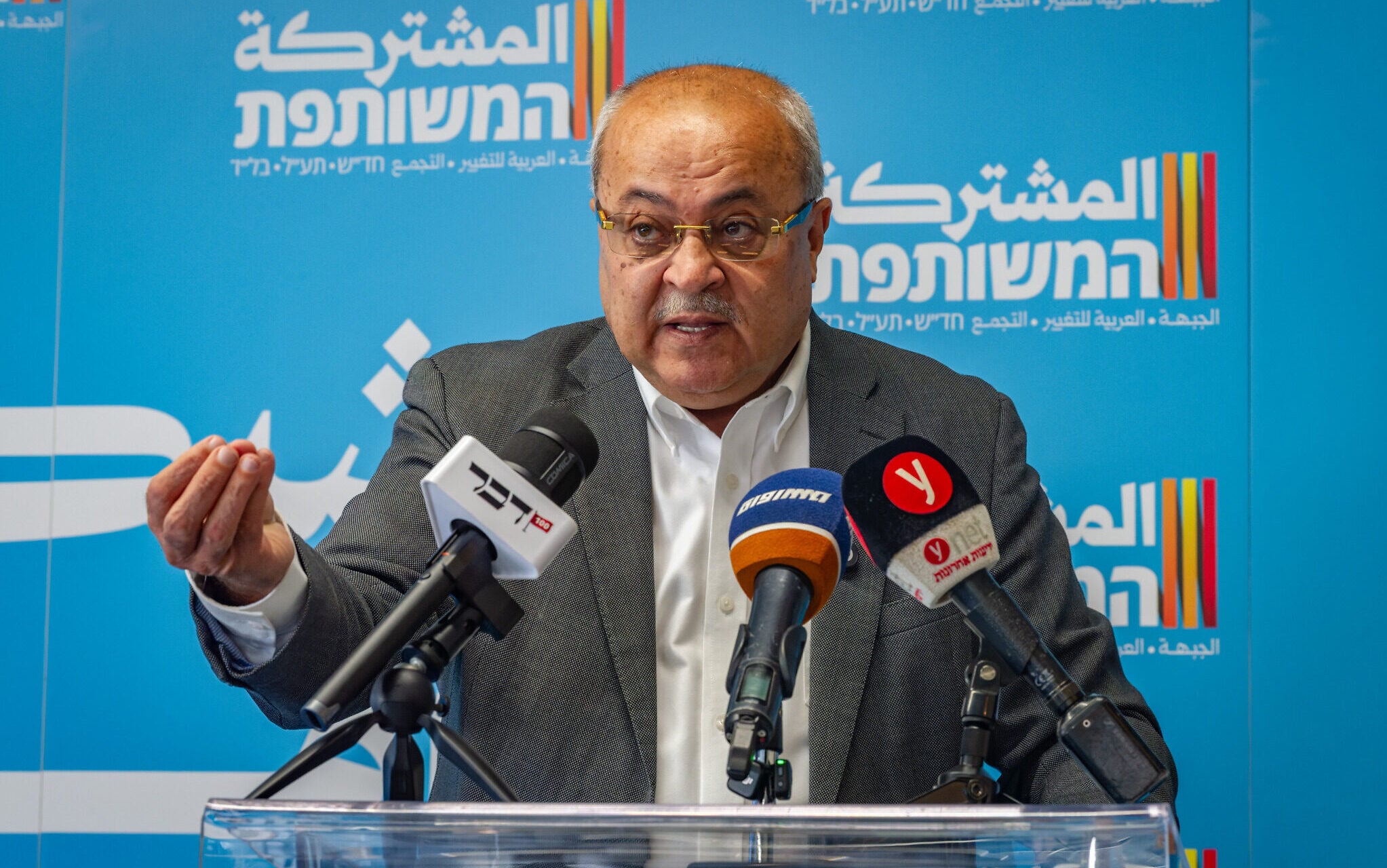
“What is ‘Biladi Biladi’? ‘My homeland, my homeland.’ It’s a song we’ve been singing for decades. ‘My homeland, my homeland, to you belong my love and my heart.’ Is there something problematic about that?” he said.
Both politicians accurately described the song’s lyrics, but did not highlight the fact that it is nonetheless an Arab nationalist song describing oppression, implying that the State of Israel is responsible for that oppression and that its victims are Arabs.
This is tied to the Joint List’s positions, which reflect a broader vision of what its members see as the Palestinian struggle.
The Joint List’s platform calls for the establishment of a Palestinian state along the June 4, 1967, borders. At the same time, it states that the party seeks to establish a constitutional framework for Israel based on equal citizenship for all citizens, regardless of their national or religious affiliation, rather than a Jewish nation-state.
Senior party figures have also refrained from describing Hamas as a terrorist organization. In his latest interview with Channel 12, Jabareen again declined to do so, saying only that his party had condemned the October 7 massacre carried out by Hamas at the time. “You can’t put slogans into the mouth of an elected official. Everyone sees things from their own perspective,” he said.
Those positions point to a broader problem with potential cooperation between the Joint List and leaders of the anti-Netanyahu Zionist bloc — one rooted in the Joint List’s political principles and positions and not a particular song.
KioskNews shows a cleaned-up reading view extracted from the publisher’s page — the original always lives on their site, not ours.