Fresh coat, lighter load: Hong Kong airport puts runway-painting robots to work
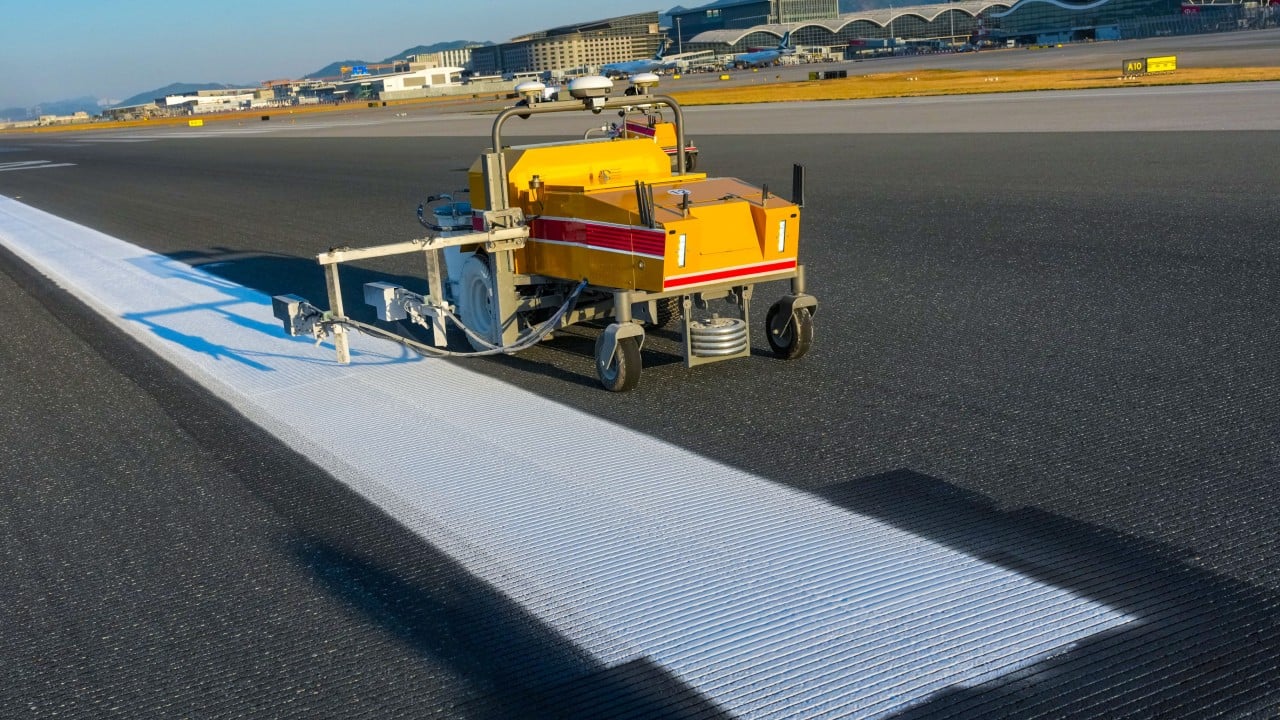
Hong Kong International Airport has become the world’s first to deploy robots to repaint runway markings, cutting the time needed to refresh centre lines by about 67 per cent compared with manual painting, its managing authority has said.
According to the Airport Authority, the AI-powered robots, called “Brushman”, also improve painting accuracy and worker safety, reducing the need for physically demanding overnight work and allowing staff to take on supervisory roles.
Steven Yiu Siu-chung, the authority’s chief operating officer, said repainting the more than 100 centre-line stripes on each runway previously required a team of more than 20 workers. The work took place late at night, when lighter air traffic allowed a runway to be temporarily closed for maintenance.
“Painting the centre lines for a runway used to take around three hours. Now, it can be completed in about an hour by the robots, saving around two-thirds of the time,” he said.
The automation push comes as the airport handles increased passenger and aircraft traffic following the launch of its three-runway system in November 2024.
AI-powered robots repaint runway markings at Hong Kong airport
Spanning more than 11km in total, the three runways feature a complex array of lines and markings that guide aircraft during take-offs and landings. The markings require regular maintenance, with repainting carried out every night.
“Under these circumstances, we worked with Shenzhen-based company FJDynamics to develop Brushman as an alternative to manual painting,” Yiu said. “This makes us the world’s first airport to deploy automatic robots for runway line painting.”
The robot co-developed by the authority and the Shenzhen robotics and technology company was adapted from a machine originally designed to mark sports fields.
Testing on the airport’s runways began in December last year. Brushman met the required technical and safety standards and received approval from the Civil Aviation Department in September. It has now been in official service at the airport for two months.
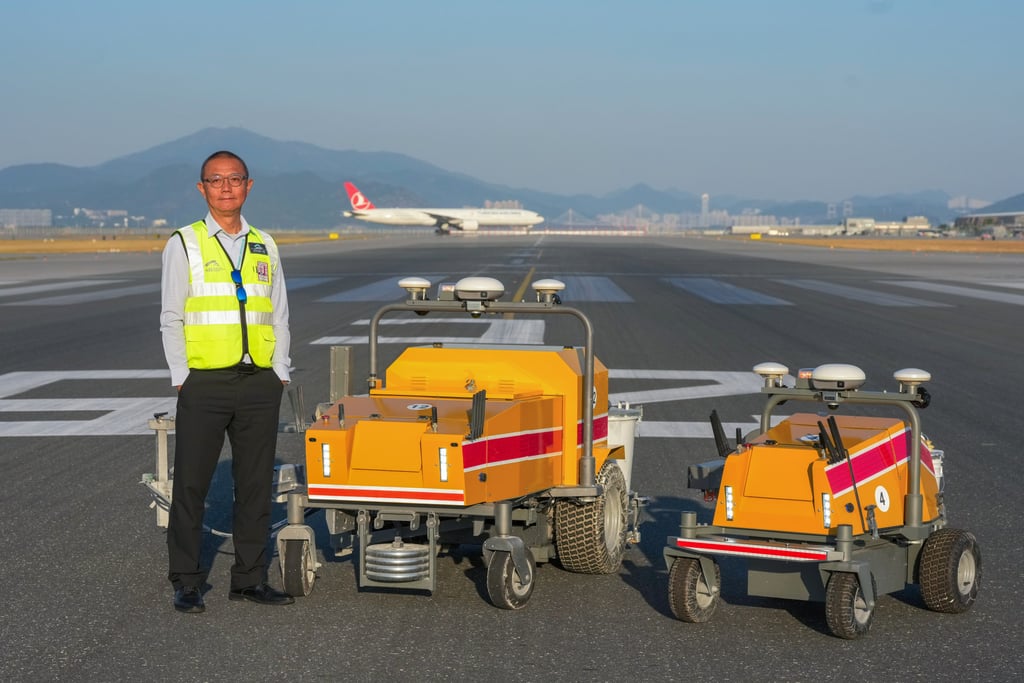
Two sizes of Brushman robots are in use. The larger, dual-nozzle model handles wider markings, including the runways’ 90cm-wide, 30-metre-long centre lines, which wear quickly under aircraft traffic. The smaller, more manoeuvrable model paints narrower markings, such as edge lines and curves.
The robots use AI for mapping and route planning, alongside real-time kinematic positioning technology that provides centimetre-level accuracy. They are also equipped with light detection and ranging sensors to detect obstacles in real time and stop automatically to prevent collisions.
Yiu said precise control over the amount of paint sprayed helped reduce waste, saving the airport about HK$400,000 (US$51,000) in paint costs annually.
He said the technology would improve staff safety and well-being by reducing repetitive, physically demanding overnight work, while helping to address a shortage of skilled workers in airside operations.
“That job is extremely physically demanding and requires a high degree of precision. Workers have to work for hours from 2am to 7am every night, in both extremely hot and cold weather, when it’s easy to get tired,” he said, adding that recruiting people for the work was usually difficult.
Yiu said the airport currently used a mix of manual and robotic painting, with robots handling more than half the work. They were used particularly for markings that needed frequent maintenance and followed relatively simple, regular patterns.
“We plan to have six robots in the operation, and our main goal is not to completely replace humans,” he said.
“We hope that the workers can shift to supervisory roles by controlling the machines in the future, thus using technology to improve safety and efficiency for the airport.”
KioskNews shows a cleaned-up reading view extracted from the publisher’s page — the original always lives on their site, not ours.