Head of EU invites Canada to become ‘associate member’
STRASBOURG — European Union President Ursula von der Leyen extended an invitation to Canada on Wednesday to become the European Union’s first ever “associate member.”
Sign In or Create an Account
Prime Minister Mark Carney, who was seated just a few feet to her left, was beaming while European Parliamentarians erupted in applause.
The rest of von der Leyen’s speech in the EU Parliament on Wednesday would ring strangely familiar in Canadians’ ears.
As global crises abound, the European Union must cut down on red tape and “massively accelerate” project permitting, she said. Europe must double its energy production by 2040. It must boost its defence investments and production and learn to better harness artificial intelligence while managing its inevitable human and social impacts, she argued.
The words she used could have been ripped straight from any number of Carney’s speeches about Canada in the past year.
“We see the world with the same eyes, from AI to climate change, from the Arctic to geopolitics, and we have stood together on Ukraine, on defence, on raw materials and supply chains,” von der Leyen said to Carney.
“But above all, dear Mark, Europe and Canada believe in democracy.”
On Sunday, Carney firmly denied that Canada was seeking EU membership, instead referring to a new “unique alliance” with the block of 27 countries.
Asked about the new status proposed by the EU head, PMO spokesperson Audrey Champoux said the government welcomed van der Leyen’s invitation to build a deeper alliance in a statement that did not mention associate membership.
van der Leyen’s announcement comes as Carney doubles down on efforts to pivot the Canadian economy away from its dependence on the United States amid an escalating trade war with U.S. President Donald Trump.
The EU head’s speech did not detail what that would entail, but she argued Canada and the EU needed to bring their relationship “to the highest level possible”.
She said that meant going well above and beyond the decade-old Comprehensive Economic and Trade Agreement (CETA) deal between Canada and the European Union, which 10 European countries have not yet ratified.
“We will work on intelligent manufacturing. We will create a tech alliance. We will integrate defence industrial bases. We will make the Arctic a flagship joint project. We will work on energy critical minerals and batteries on AI, quantum, cyber, and economic security,” she said.
The announcement was greeted with enthusiastic applause from the hundreds of members of European Parliament attending her speech.
But notably absent from her announcement was talk of boosting mobility between both countries, something Carney alluded to repeatedly in the days leading up to his trip to France.
Specifically, Carney has mentioned easing mobility for labour (facilitating workers’ movement between countries), students and researchers. But the possibility of increased labour mobility from the EU — a key irritant in the U.K.’s Brexit debate — raises hackles in Canada.
For example, Conservatives said Carney “must be absolutely clear that he will not make matters worse by importing Europe’s immigration crisis.”
Carney is scheduled to deliver his own speech to the European Parliament on Thursday in which he is expected to flesh out his vision of what he called a “unique alliance” with the European Union.
Carney is the first non-European leader to be invited to attend a European Union president’s “state of the union” speech.
von der Leyen’s speech Wednesday showed just how aligned her vision for the EU is with that of Prime Minister Mark Carney’s for Canada.
She called for the European Union to slash it’s administrative burden and “move much faster”. She argued that the block needed to better manage record heatwaves and wildfires that tore across the continent this summer. She called out Russia’s ongoing threat to Europe and promised a new security union to better respond to military threats.
But where the EU president’s speech diverged from Carney was on China. Whereas the prime minister has quickly thawed diplomatic relations and advocated for a new “strategic partnership” with the Asian behemoth to boost bilateral trade, von der Leyen called on Europe to do the opposite.
“Our trade deficit with China is now 1 billion euros a day. It has reached a tipping point,” she said. “This is unsustainable, and this is why we are engaged in a dialog with China to rebalance our trade.”
She also insisted that Europe would stay the course on its climate targets, whereas Carney has thrown many of the objectives set by his predecessor Justin Trudeau by the wayside.
Carney — a well known entity in Europe since his days as governor of the Bank of England — received a warm welcome and a standing ovation from the hundreds of Members of European Parliament (MEP) gathered to hear von der Leyen’s speech.
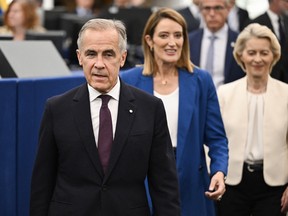
Carney walked into the massive circular Parliamentary chamber alongside von der Leyen and European Parliament President Roberta Metsola.
Just before the speech, Carney met with both European politicians in a trilateral meeting.
Carney is expected to travel briefly to the United Kingdom on Wednesday afternoon for a first bilateral meeting with new U.K. Prime Minister Andy Burnham before returning to Strasbourg.
National Post
cnardi@postmedia.com
Our website is the place for the latest breaking news, exclusive scoops, longreads and provocative commentary. Please bookmark nationalpost.com and sign up for our politics newsletter, First Reading, here.
Join the Conversation
This website uses cookies to personalize your content (including ads), and allows us to analyze our traffic. Read more about cookies here. By continuing to use our site, you agree to our Terms of Use and Privacy Policy.
KioskNews shows a cleaned-up reading view extracted from the publisher’s page — the original always lives on their site, not ours.