‘I cannot carry all of this alone’: the couples kept apart by the war in Gaza
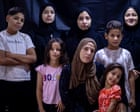
Wijdan Abu Matar, 43, was forced to leave Gaza in November 2023 with her eight children for medical treatment, while her injured husband, Hatem, remained behind.
Wijdan and her family were living in the Nuseirat refugee camp when the Gaza war began with the 7 October 2023 Hamas attack on Israel. Ten days later, on 17 October that year, an Israeli strike hit the al-Muhandseen tower, near their home, injuring Wijdan and every member of her family.
“We were sitting together, just about to start lunch when the bombing happened,” Wijdan recalled. “The ceiling collapsed over our heads. Everything went dark. I couldn’t see anything. I just started screaming the names of my sons and daughters.”
Her daughter Nour, 15, suffered the most serious injuries, including a fractured skull and bleeding in the brain. Five-year-old Amna suffered severe burns to her chest. The family was initially separated after the strike.
Nour spent about 33 days in intensive care, with Wijdan by her side. Amna and Aysel, three and a half, were at a different hospital for 15 days.
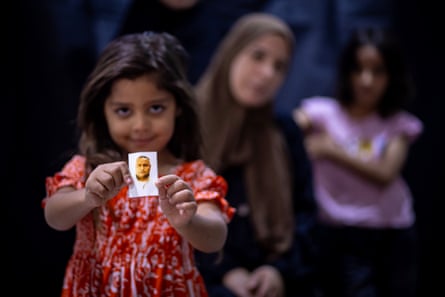
On 30 November 2023, Wijdan travelled with Nour to a hospital in Egypt for treatment. For months, the family remained scattered across Egypt, receiving medical treatment and staying with other relatives.
“I felt completely helpless,” Wijdan said. “There was a fire in my heart because I was away from my husband and my family was scattered.”
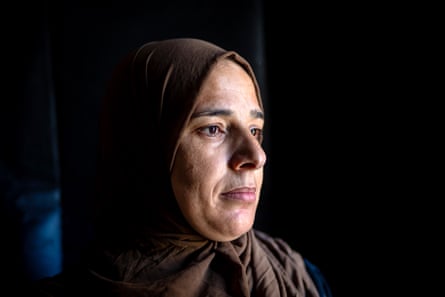
Eventually, Wijdan managed to bring her children together in an apartment in Egypt. Three years on, however, she is still separated from her husband, who remains in Gaza. “I have become both the mother and the father to my children,” she said. “The responsibility is exhausting me, and I am constantly worried about my husband.”
Hatem suffered a serious leg injury that limits his mobility and is now displaced in a tent in Nuseirat. Even speaking to him is difficult because of Gaza’s unreliable internet connection. “When he manages to get online, he calls me and the children. He tells me, ‘I am counting the days until I can see you again.’ I can see the tears in his eyes,” Wijdan says.
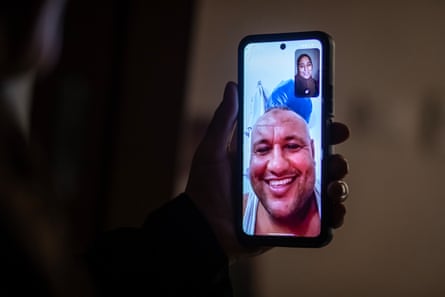
Wijdan has no regular source of income and relies on donations. Hatem stopped receiving a salary 10 months ago and his injury prevents him from working.
In Egypt, life is difficult for Wijdan and her family. She says she cannot afford transportation to send five of her children to school. “I see my children’s future slipping away in front of me, and there is nothing I can do.”
Nour still requires medical treatment, but Wijdan often cannot afford her medication. She sometimes considers returning to Gaza to be with Hatem, but fears exposing her children to further suffering.
“I dream of getting my children the treatment they need, and I hope we can reunite with my husband as soon as possible so he can also receive treatment,” Wijdan said. “I cannot carry all of this alone. Psychologically, I am exhausted. I have lost 35 members of my family in this war.”
Since the war began with Hamas’s attack on Israel that killed 1,200 people, at least 73,783 Palestinians have been killed and 174,738 wounded, according to the health ministry. Earlier this year an independent UN inquiry found that Israel continues to commit genocide by deliberately targeting Palestinian children in Gaza.
Sami Abu Tabaq, a 29-year-old Palestinian photojournalist, was forced to leave the Gaza Strip in April 2024, leaving behind his family and his fiancee, Ola.
“Loneliness kills me every day,” he said. “Life away from the woman I love and my family is incredibly hard. I’m desperately waiting for the day God brings us together again.”
Sami became engaged to Ola five months before the war began. They had met by chance when he chose her family’s home as a location for a photoshoot. Before the war, they saw each other constantly. They went to the sea, had dinner at restaurants in Gaza, and spent months preparing the house where they planned to live after their wedding, which was scheduled for November 2023.
Sami and his family fled their home in Tal al-Zaatar, Jabaliya, early on in the war. Their home was badly damaged and later destroyed, along with the house Sami and Ola had been planning to move into once they got married.
When his sister decided to flee south with her children, Sami accompanied her but he could not reach Ola to say goodbye.
The separation became unbearable. Days, sometimes weeks, passed without Sami knowing whether Ola was alive. Once, he saw reports that an entire residential block near her home in Gaza City had been bombed. “I almost lost my mind. I had never felt so helpless,” he said. Unable to return north, he asked his brother to check on her. Eventually, his brother confirmed that she and her family were alive.
Sami continued working as a photojournalist from southern Gaza. Four journalists who had shared his tent were later killed, including Hamza al-Dahdouh, a son of the Al Jazeera journalist Wael al-Dahdouh.
As Israel threatened a ground invasion of Rafah in 2024, Ola began urging Sami to leave Gaza, fearing he would be killed. Sami paid a company coordinating exits at the time for both of them to cross into Egypt. But Ola could not reach southern Gaza to travel through Rafah. “She told me, ‘You go, and I’ll follow you,’” Sami said. “And here we are, still waiting, nearly two and a half years later.” They still have not managed to get married.
By his second day in Egypt, Sami was overwhelmed by guilt. “The overthinking kills me,” he said. “I felt ashamed to turn on the lights or eat proper food while my fiancee and my family were struggling to find the most basic things.”
In Egypt, his life has become dominated by loneliness and sleeplessness. “There is safety in Egypt and there are beautiful places, but I stay home. Happiness has no meaning without her. I cannot enjoy anything while she is not here,” he said.
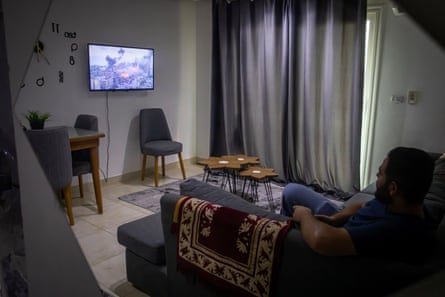
Despite the war, Ola completed her bachelor’s degree in nursing at the Islamic University of Gaza. She has also endured enormous loss: her cousin, the journalist Ayat Khadoura, was killed, along with about 50 other members of her extended family.
From Egypt, Sami tries to create moments of happiness for her. For her latest birthday, he contacted her brother in Gaza and secretly arranged a cake, gift and flowers. “When she woke up and saw everything, she was so happy. I love her reaction when she’s happy.” The only problem was the flowers. “They were artificial,” he said. “I wasn’t happy with them, but natural flowers can’t get into Gaza because Israel does not allow them in.”
Sami says he has tried every possible way to get Ola out, without success. She is now applying for scholarships abroad, hoping education might provide a route to evacuation and, eventually, to him.
Sami recently travelled to Mecca for Umrah, where one prayer remained constantly on his mind. “I prayed, ‘God, please bring us together soon,’” he said. “But one thing I know for sure: I will wait for her for the rest of my life, until God brings us together.”
KioskNews shows a cleaned-up reading view extracted from the publisher’s page — the original always lives on their site, not ours.