Why Kumar Sanu still rules India’s barbershops, buses and construction sites
A corporate office setting. Three men sit in front of their laptops. The only audible sound is the clicking of keyboards. A sudden change in the background score shifts the context. One of them gets up, grabs a towel, and starts mimicking a barber; another pulls up a magazine and pretends to wait for his turn. In the background, the song plays, ‘Mujhse mohabbat ka izhaar karati/Kaash koi ladki mujhe pyar karati’. (I wish she would confess her love to me/If only a girl would love me).
This spatial and temporal transformation of a Savarna-dominated office set-up into a local salon, achieved through a sonic intervention, is neither innocent, ahistorical, nor apolitical. Consumed as “peak male content,” these reels, lately popular on Instagram, are loaded with caste politics, nostalgic longing for a lost time, and a male fantasy. Commonly heard on construction sites, salons, trucks or buses – the spaces where marginalised people try to find solace amid unbearable working conditions – these songs, voiced by Kumar Sanu, reshape the idea of the present and engage in a socio-political discourse far beyond the immediacy of the song or its sonic impression. Still, these spaces, people and their connection to these melodies, produced and popularised in the 1990s, remain under-theorised.
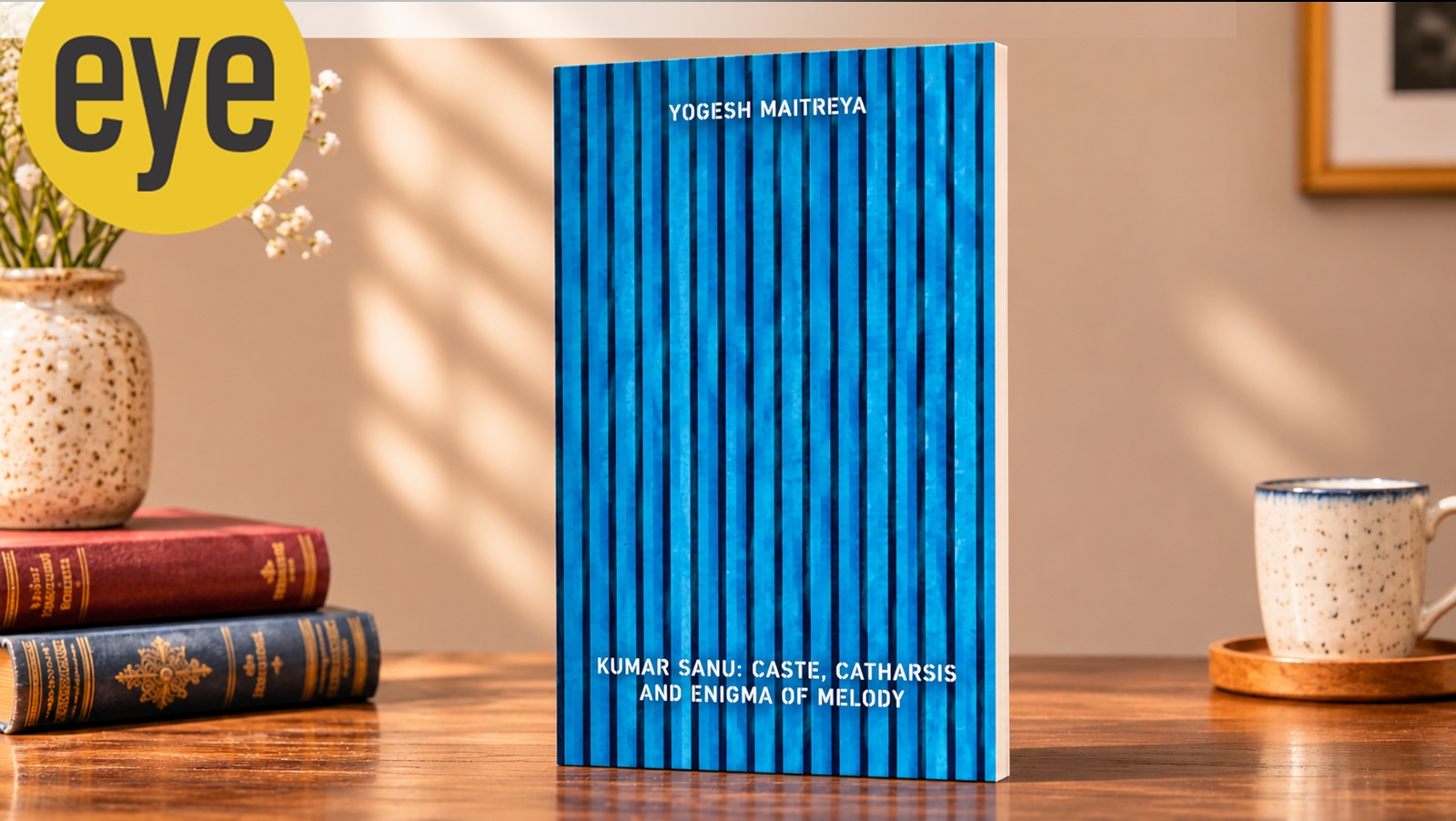
Yogesh Maitreya, founder of one of the leading Dalit-run publishing houses, Panther’s Paw Publications, unpacks these complicated relations in his latest book, Kumar Sanu: Caste, Catharsis and Enigma of Melody. He takes two academic leaps. First, instead of limiting the analysis within the domain of mass culture and production of “false consciousness” – a common theoretical thread to understand popular culture’s impact on the proletariat (mostly extending Theodor Adorno’s understanding of the “culture industry”) – he historicises the context of its production in a violence-ridden caste society. In this sense, it seeks to break the binary of “theoretical brahmins” and “empirical Shudras” by theorising from the margins. Second, he shifts the focus from the producer’s identity to the listener’s identity and visceral experience. This shift reimagines solidarity through a shared sonic space.
Kumar Sanu’s songs, or, for that matter, the songs now known as belonging to the golden era of the 1990s, supplied a constant repertoire of nostalgia, produced at a time when parts of India were subjected to massive violence. From the demolition of the Babri Masjid, communal riots in Mumbai and caste violence like the Bathani Tola massacre to Savarna protests against the implementation of the Mandal Commission report, these events created a socio-political vacuum, where fear, anxiety, and what Radhika Subramaniam calls “culture of suspicion” prevailed over love, romance and the essence of longing. The film industry of this time, due to its epistemic location of production – enabled by the implementation of the LPG (liberalisation, privatisation and globalisation) model – denied sonic or visual space to the memories of violence. Rather, the mass-produced popular culture offered a utopian space of love and sensuality, precisely from a man’s perspective.
People bearing the burden of violence and uncertainty found catharsis through music, sacrificing what is “rational.” This social alienation, leading to the consumption of romantic melodies of Kumar Sanu, is what Maitreya calls “catharsis in negative”: erasing “what is real and replacing it with an imagination that is soothing, tempting, irresistible, yet nonsensical.”
Maitreya further extends his thesis by placing Sanu’s songs in the context of a caste(ist) society where endogamy determines the rules of love and romance. The absence of freedom to love produces, according to Maitreya, a subconscious longing “for a place where they could experience an interaction with another person via romance, sensuality and flirtation.”
Story continues below this ad
In Sanu’s voice, the imposed silence of an endogamous society seems to find an expression – it makes “bleak silence bearable.” Moreover, under Brahminical-patriarchal hegemony where men, trapped in the binary of masculine rationality and feminine emotionality, are not allowed to learn how to express – a “prerequisite for experiencing democracy” – Sanu’s songs open a window, often to hum, Ye dil ye pagal dil mera/Har pal tujhe awaz de/Aaja ke ab to aake sanam/Khamoshio ko alfaz de (My heart, this mad heart of mine/Every moment it calls for you/Come now, and when you arrive/Give words to my silences).
These melodies, with their captivating and sensual lyrics, also become the only support for millions of labourers working in harsh conditions, far from home. When snarls of traffic, thumping sounds of machines, and the ruthlessness of Savarna society, accompanied by the sounds of expletives, overwhelm the sonic space, Sanu’s voice, as per Maitreya, restores the harmony, a necessary component to survive in the world of conflict.
While Maitreya complicates the presumptive simplicity of “barber reels” or “barber song lists” (if you search on YouTube, you can find one) and expounds on the underlying relations between the individual, mass production of a culture, and a caste(ist) society, there is a lack of engagement with the question: Why does every generation always feel nostalgic about past cultural productions? Though he tried to explore the etymology of the word “nostalgia,” he did not expand on it. However, Maitreya’s short but dense book opens avenues for new research on sonic space in a caste(ist) society, a requirement for understanding the world from the margins.
Bhattacharya teaches at Symbiosis School for Liberal Arts (SSLA), Symbiosis International University (SIU). Fathima is a research intern and student at SIU.
KioskNews shows a cleaned-up reading view extracted from the publisher’s page — the original always lives on their site, not ours.