Lines form for N95 masks as haze situation persists, but community shelters see few people
SINGAPORE – People across Singapore flocked to community clubs to collect N95 masks on Oct 15, as the early morning rain across much of the island provided little respite from the haze.
By contrast, air-conditioned haze shelters in community clubs (CCs), and residents’ committee and residents’ network (RN) centres appeared to be less popular.
The People’s Association had announced both the distribution of masks to eligible Singaporeans and the opening of haze shelters on Oct 14, when the dominant haze pollutant, PM2.5, spiked to above 200 in many parts of the country.
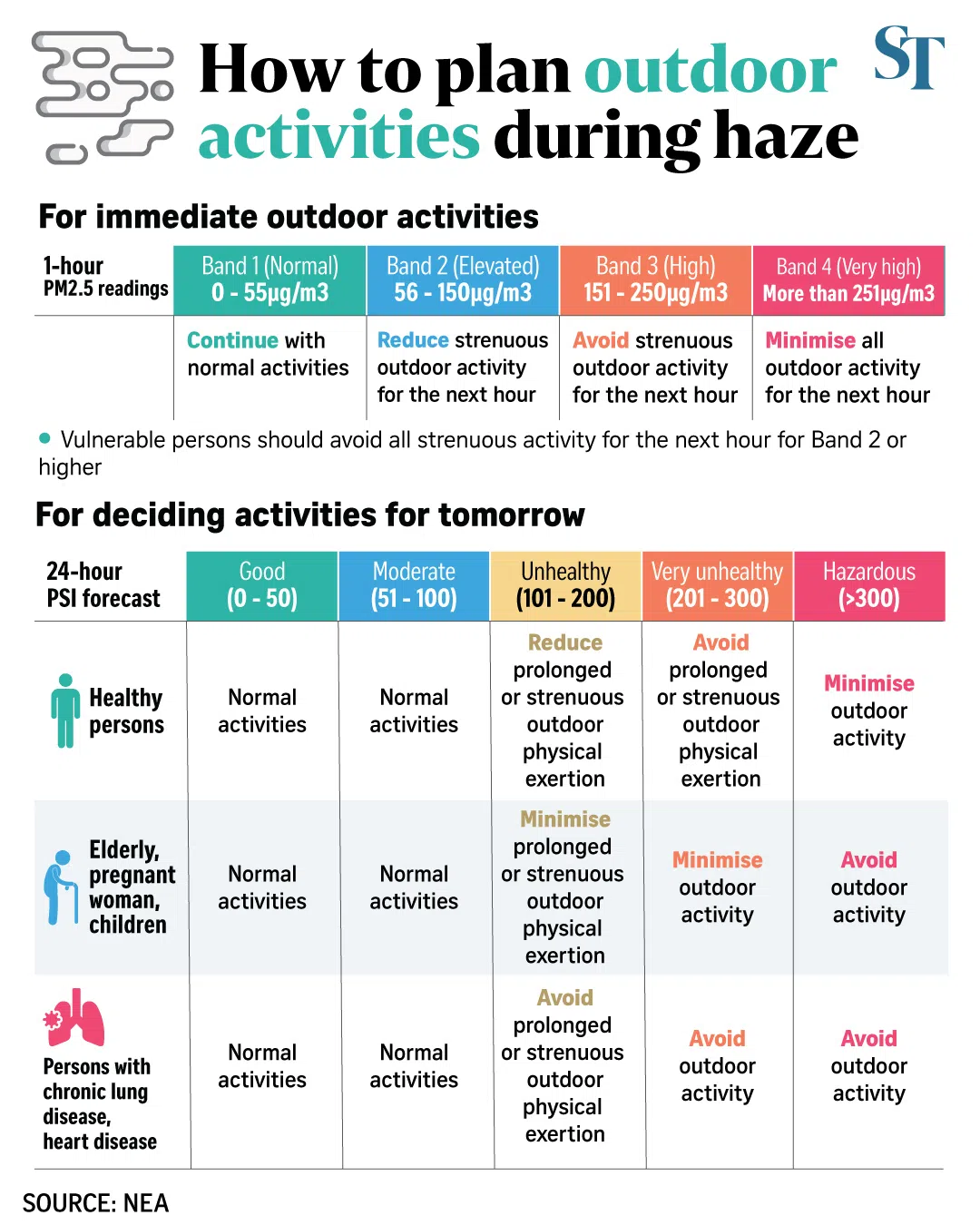
As at 5pm on Oct 15, PSI levels across Singapore was in the unhealthy range, hitting 188 in the west and 186 in the central region.
The PM 2.5 level was in the high range (151 to 250) across the entire island – 205 in central region, 155 in the west, 161 in the east and 157 in the south.
At Punggol 21 CC, mask distribution began at 10am in the multi-purpose hall. About 20 people were queueing up to collect their masks. Those who are eligible for the masks – including seniors, pregnant women, younger children and those with medical conditions – may collect two masks each.
A 73-year-old coffee shop stall assistant, who gave his name only as Tan, told The Straits Times that he collected the masks to be on the safe side, even though he had not encountered any health problems so far as a result of the haze.
“I’m spending less time outdoors because of the haze. After work, I just go straight home,” he said, adding that the distribution of the masks was efficient.
At Jurong Spring CC, about 15 people were in the line to collect their masks at 10.20am.
They included Elien Chan, who was wearing a surgical mask while she was queueing.
Chan, who is in her 50s, said she experienced nose sensitivity and headache when the PM2.5 spiked in the west on Oct 14.
While she appreciated the free pair of masks, she expressed concerned over whether the two masks are sufficient, since one mask only lasts three days.
“Two pieces are not enough, they cannot be washed,” said Chan, who works at a salon.
She added that she would be going with her husband to buy an air purifier after collecting their masks.
At One Punggol CC around 11am, retired aviation officer K.C. Tan was among a handful of people collecting their masks.
“I visited several pharmacies recently, but all were sold out of N95 masks,” said the 68-year-old.
The Punggol resident of seven years said he had a sore throat and had been unable to perform his usual morning workout for several days because of the haze.
At home, he had been using air purifiers and air-conditioning more regularly.
Small crowds were also spotted at other N95 mask distribution points, including Kallang CC and Sengkang CC.
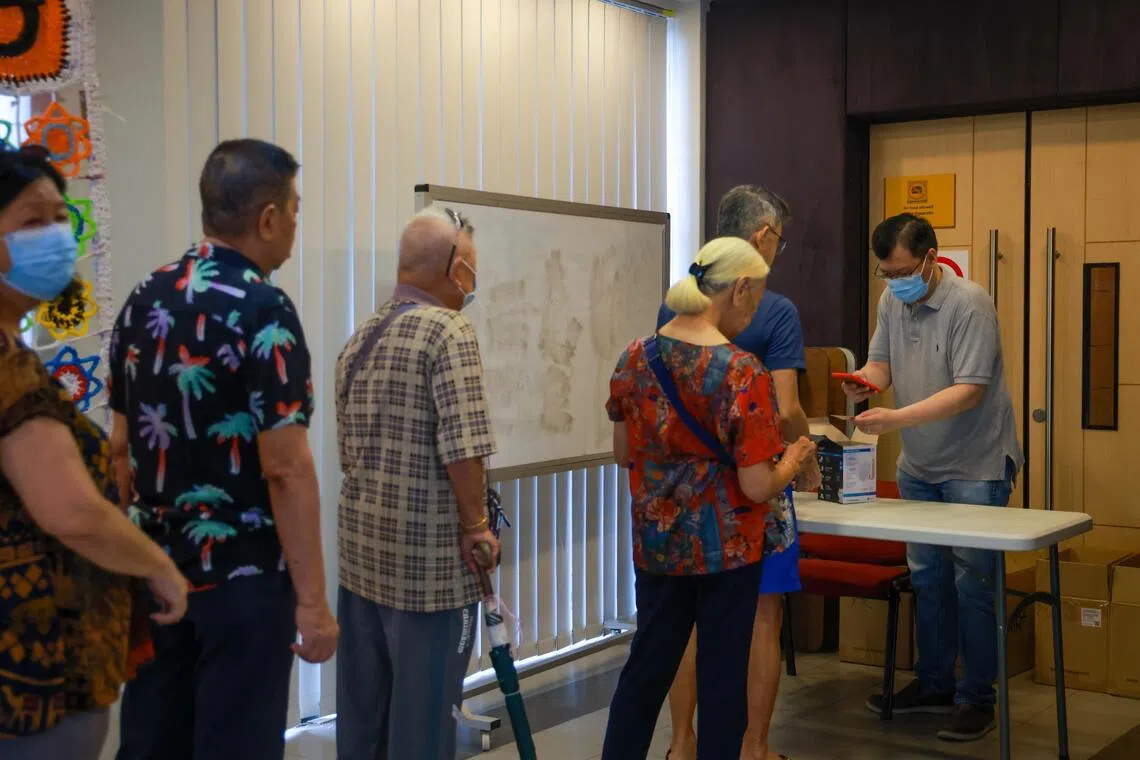
Small crowds were also spotted at other N95 mask distribution points, including Kallang CC.
ST PHOTO: JASON QUAH
The National Environment Agency (NEA) on Oct 14 that the authorities would begin distributing masks, given that PM2.5 levels had entered the very high range (more than 250) in some parts of the country.
That night, shortly after 8pm, several residents – mostly seniors – went to Yuhua CC in Jurong East to collect their masks.
They included real estate consultant Joel Tan, who collected masks for his primary school children as a precautionary measure.
“There isn’t much stock of masks in the market,” said the 40-year-old, adding that the air purifier and air-conditioning have been helping his family cope at home.
His 11-year-old daughter Chloe, who was developing a cough, noted that recess meals at Clementi Primary School would be taken in classrooms, with the children’s own containers.
After collecting masks for herself and her husband, retiree Chew Lai Fong offered to collect them for her neighbours and friends, especially those who were staying alone.
Haze shelters less popular
Unlike masks, community haze shelters – located at selected CCs and Residents’ Committee centres, among others – appeared to be less popular with Singapore residents.
These air-conditioned areas seek to provide residents with a comfortable indoor environment to seek respite from the haze. At Yuhua CC, for example, an air-conditioned room was stocked with drinks, water and snacks for residents needing an escape from the pollution.
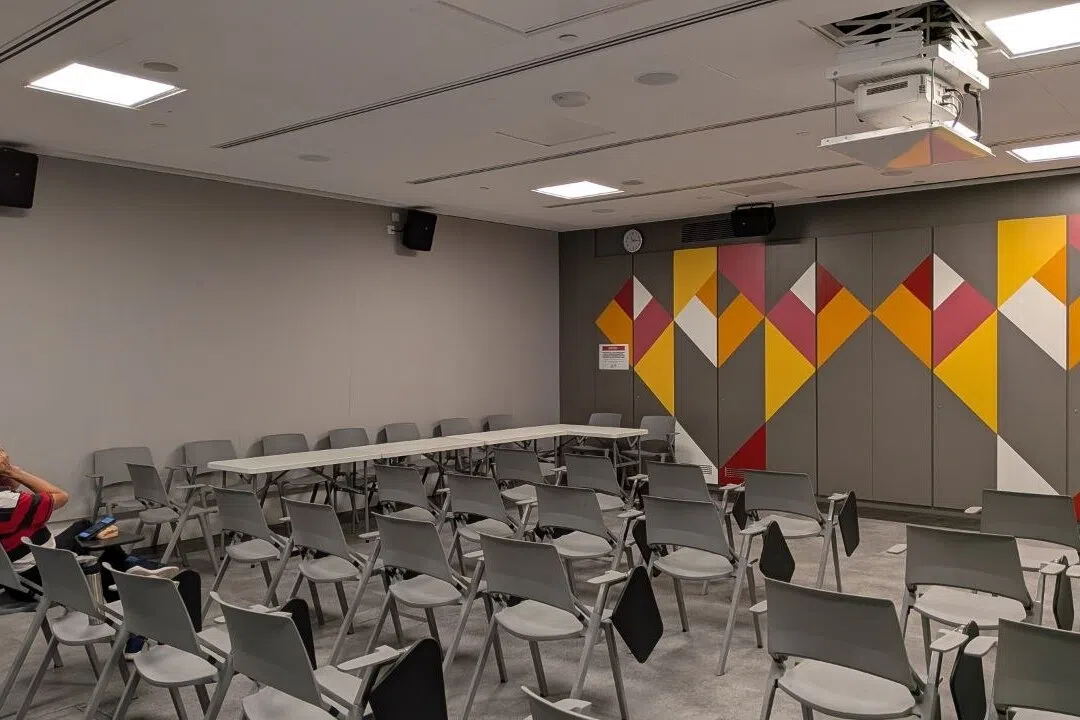
The community haze shelter at One Punggol CC.
ST PHOTO: ZHAKI ABDULLAH
At One Punggol CC’s haze shelter, there was only one person when ST visited at about 11am on Oct 15 – a retired ship captain.
Sarun, who goes by only one name, said he was waiting to pick up his granddaughter from childcare. As a result of the haze, the 62-year-old said he had been experiencing ailments such as sore throat and itchy eyes.
Financial consultant Florence Ong, 40, and her mother were using the haze shelter in a small pre-function room at Kreta Ayer CC at 12.50pm.
She went to the shelter to work, as she tries not to turn on the air-conditioning at home during the day, and her home does not have an air purifier.
The resident of a three-room flat in Sago Lane first went to an RC at Block 333 Kreta Ayer Road, where another shelter is located, but found it closed.
NEA had said on Oct 14 that residents can contact their nearest CCs to find out the operating hours and locations of haze shelters.
While the main office at Jurong Green CC also serves as a haze shelter, those spotted there shortly before noon on Oct 15 were there just to collect their masks and did not stick around.
Other designated community haze shelters ST visited appeared to be locked, including those at the Jurong Spring Zone B and Punggol Bayvue Residents’ Networks.
Staff at Jurong Green CC, located across from the Jurong Spring Zone B RN, told ST the RN would only be opened if there was demand, with residents able to reach grassroots members or PA staff via a hotline.
KioskNews shows a cleaned-up reading view extracted from the publisher’s page — the original always lives on their site, not ours.