UP study: Resort visitors willing to pay P75 to conserve Mt. Makiling

MANILA, Philippines — Visitors to resorts in Calamba City and Los Baños, Laguna, said they were willing to pay about P75 per visit for improved conservation of Mt. Makiling’s groundwater, a University of the Philippines Los Baños (UPLB) study found.
If captured through a proposed water user fee, the amount could generate an estimated P159.52 million a year for groundwater conservation, resort water conservation measures and the management of Mt. Makiling, according to the study.
The estimate was based on an online survey of 492 resort visitors, who were asked how much they would be willing to pay under a hypothetical program that required resorts to recycle and treat pool water and support groundwater conservation. The researchers used a contingent valuation method and interval regression to estimate the visitors’ willingness to pay.
The study, “Potential Contribution of Tourism for Groundwater Conservation in Mt. Makiling, the Philippines,” was written by Margaret M. Calderon, Analyn L. Codilan, Jan Joseph V. Dida, Vanessa M. Palma-Torres, Angela Marie S. Alducente and Canesio D. Predo of the UPLB Institute of Renewable Natural Resources, College of Forestry and Natural Resources. It was published in the Philippine Journal of Science, Volume 154, No. 2, in April 2025.
The researchers stressed that P75 is an estimated willingness to pay under a hypothetical scenario, not an existing fee or money currently being collected from resort visitors.
Resort boom puts pressure on groundwater
Mt. Makiling is a dormant volcano and a vital watershed that supplies water for domestic, agricultural and industrial uses. Its hot springs and groundwater have also supported the growth of the resort industry in Calamba and Los Baños.
READ: Fast Facts: Mt. Makiling Forest Reserve
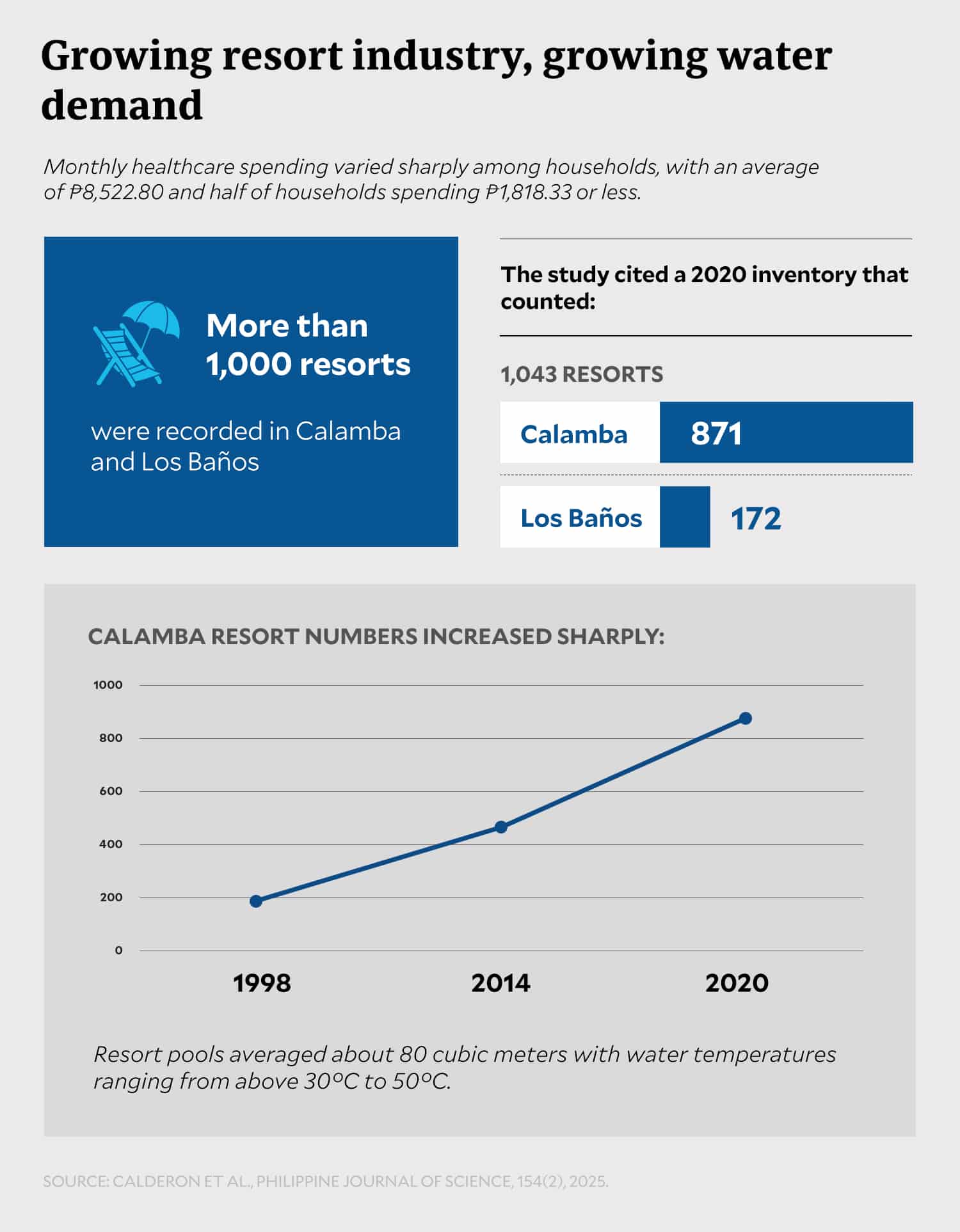
The study cited an earlier inventory that counted 1,043 resorts in the two areas as of 2020 — 871 in Calamba and 172 in Los Baños. The number of resorts in Calamba alone increased from 193 in 1998 to 466 in 2014, according to earlier research cited in the paper.
Graphics by Ed Lustan/Inquirer.net
“The growing number of resorts has naturally led to a surge in tourism,” the researchers wrote.
The expansion of the resort industry has also meant greater use of groundwater. The researchers said many resorts had shifted from naturally flowing hot springs to pumping groundwater for their pools and other uses.
They noted that resorts predominantly use pumped groundwater because it is cheaper than metered water from local water districts, which charge based on the volume consumed.
The paper also cited an earlier survey that found resort pools had an average size of 80 cubic meters, with water temperatures ranging from above 30 C to 50 C. The researchers said drained pool water eventually reaches Laguna de Bay and pointed to the need to regulate and monitor its disposal.
READ: The hot springs in Laguna may cool down soon
Many visitors did not know where the water came from
Despite using resort pools supplied by groundwater or hot springs, many respondents were unsure about the source of the water.
Of the 492 respondents, 52.6% said they knew the source of the resort’s water. Among those who identified a source, 26.2% said hot springs, 14.8% identified Mt. Makiling and only 7.3% identified groundwater.
The researchers also found that 40.7% correctly identified pumping as the way pools were filled, while 34.1% believed the water flowed naturally.
“A notable finding was that while 40.7% of respondents correctly identified pumping as the method for filling the pools, 34.1% mistakenly believed the water flowed naturally,” they wrote.
The paper said this was significant because resorts in the area have increasingly relied on pumped groundwater rather than naturally flowing hot springs.
READ: Deepening water crisis

Graphics by Ed Lustan/Inquirer.net
Awareness was stronger when it came to the role of forests in maintaining groundwater. Some 98.4% of respondents agreed that good forest cover was important to securing groundwater supply, while 66.7% knew that groundwater was not unlimited.
Still, 33% believed groundwater was unlimited regardless of how much water was used, the researchers found.
The researchers described this as “disturbing,” noting that the findings “may imply a need to improve citizens’ understanding of water scarcity.”
Relaxation draws visitors to resorts
For most respondents, resort visits were primarily for recreation. The most common reason was relaxation or enjoyment, followed by the accessibility of resorts for family and friends and their affordability.
“The main reasons of the respondents for visiting the resorts in Los Baños or Calamba are for relaxation (53%), to be with family and friends (39.6%), and because of the resorts’ accessibility (40%) and affordability (37.2%),” the researchers said.
“About a fourth of the respondents went because they heard positive reviews either of a specific resort (28.3%) or the resorts in Los Baños and Calamba in general (27.4%) and for therapeutic or health reasons because of the perceived therapeutic properties of the hot water common in the pools (25%),” they added.

PROTECTING MT. MAKILING’S GROUNDWATER Mt. Makiling’s forests and groundwater help sustain the resort industry in Calamba and Los Baños, Laguna. A University of the Philippines Los Baños study found that resort visitors were willing to pay an estimated P75 per visit for improved groundwater conservation, potentially generating P159.52 million a year if captured through a proposed water user fee. —PHOTO COURTESY OF MAKILING CENTER FOR MOUNTAIN ECOSYSTEMS
The study also found that 81.7% of respondents were repeat visitors, having visited resorts in the area at least twice. Social media and recommendations from family and friends were among the main ways they learned about resorts.
The researchers said the findings showed that the resort industry was not simply providing recreational services but was also drawing visitors who depended on the natural water resources associated with Mt. Makiling.
Willingness to pay P75 fee
The researchers used contingent valuation, a survey method that estimates how much people are willing to pay for an environmental resource or improvement that does not have a conventional market price.
In the hypothetical scenario presented to respondents, local governments would require resorts to reuse and treat pool water rather than routinely replace it. An additional water user fee would be added to existing resort entrance fees.
Under the proposed arrangement, half of the fee would be used to maintain pool water quality, while the other half would go toward the conservation of Mt. Makiling.
Respondents were presented with payment amounts ranging from zero to more than P200 per visit.

Graphics by Ed Lustan/Inquirer.net
Of the 492 respondents, 488 selected an amount greater than zero. The most common choices were P50, selected by 25%, and P100, selected by 25.81%. Another 11.2% chose P20, while 8.1% selected P200.
Only four respondents, or 0.81%, indicated zero willingness to pay.
“The mean [willingness to pay] estimated using the payment card format was P75 [per] visit,” the researchers wrote.
The P75 figure was calculated using interval regression based on the payment amounts selected by respondents. The researchers cautioned that the result represents stated preference rather than actual behavior or a guaranteed amount of revenue.
“Stated preference techniques may be used when it is not possible to infer or observe people’s [willingness to pay] from markets or when markets are absent, as in the case of the groundwater resource of Mt. Makiling,” the study noted.
Conservation was the main reason to pay
The researchers found that the strongest motivation for willingness to pay was concern about Mt. Makiling’s groundwater.
Among respondents who were willing to pay, 82.2% said they wanted to contribute to groundwater conservation on Mt. Makiling, while 52.3% cited the belief that groundwater is a finite resource.
The researchers said only 28.2% cited the perception that current resort water use was wasteful as a reason for their willingness to pay.
“Most respondents were willing to pay, primarily because they wanted to support the conservation of Mt. Makiling’s groundwater resources and recognized its limited availability,” the researchers wrote.
READ: Makiling wildlife takes a breather
The survey also found broad support for the conservation measures presented in the hypothetical scenario.

Graphics by Ed Lustan/Inquirer.net
About 84% agreed or completely agreed that conserving Mt. Makiling would enhance groundwater supply, while 78% agreed or completely agreed that recycling pool water would help conserve groundwater.
About 75% agreed or completely agreed that the proposed groundwater conservation program was plausible.
“For all three questions, there were more respondents who completely agreed than only agreed,” the researchers observed.
The four respondents who indicated zero willingness to pay gave different reasons. Two did not believe groundwater was limited, one cited affordability, and another said visitors “should not be responsible for paying for pool water recycling.”
The researchers said these responses showed that willingness to pay was influenced not only by environmental concerns but also by how visitors viewed the proposed fee and its affordability.
Potential P159.5 million a year
To estimate how much could potentially be raised, the researchers multiplied the P75 mean willingness to pay by average annual resort visitor numbers in the two cities.
For Calamba, they used an average of 2,015,124 resort visitors a year, based on visitor figures from 2013, 2014 and 2018. For Los Baños, they used an average of 111,821 visitors annually, based on available figures from 2013, 2015, 2016, 2017, 2018 and 2019.
This produced an estimated P151.13 million in annual potential revenue for Calamba and P8.39 million for Los Baños, or P159.52 million combined.

Graphics by Ed Lustan/Inquirer.net
The researchers estimated that, assuming the annual benefits remained constant, the amount would have a present value of P1.358 billion over 20 years at a 10% discount rate.
“This present value can be used to decide policy options that will contribute to the conservation of Mt. Makiling’s groundwater resource,” the researchers said.
Under the hypothetical fee arrangement used in the survey, half of the estimated annual revenue — or P79.76 million — could be allocated to improved management of Mt. Makiling, while the same amount could support water conservation practices among resorts.
“These funds could support the enhanced management of Mt. Makiling and help resorts implement water conservation measures while maintaining pool water quality at international standards, reducing unnecessary and excessive water disposal,” the researchers stressed.
Visitors favored frequent water replacement
The survey also asked respondents how often they believed resort pools should be emptied and refilled.
Among visitors to public resorts, 45.5% believed pool water was changed daily, while 38.4% thought it was changed weekly. Among private-resort visitors, 42.5% believed water was changed daily and 19.3% thought it was changed every 12 hours.
When asked how frequently water should ideally be replaced, 27% of public-resort visitors preferred replacement before every group’s use, while 39% preferred daily replacement. Among private-resort visitors, 46.5% preferred changing water before each group and 23% preferred daily replacement.

Graphics by Ed Lustan/Inquirer.net
The study also found a gap in visitors’ knowledge about pool water treatment.
Only 23.4% knew that properly maintained and monitored pool water could remain in use for years without annual replacement, while 76.6% did not know this.
At the same time, 67.9% said they would be less satisfied if they learned that pool water had not been changed for two years, even if it had been properly treated and maintained.
“This points to the need for information dissemination about safe pool water standards,” the study noted.
Age, water-saving habits also mattered
The study also examined factors associated with respondents’ willingness to pay.
Its model found that age and water-conserving behavior were significant predictors. The researchers estimated that willingness to pay decreased by P0.802 for every additional year of age.

Graphics by Ed Lustan/Inquirer.net
Meanwhile, respondents who consistently practiced water conservation also had an estimated P27.23 lower willingness to pay than those who did not consistently practice water conservation.
“Interestingly, respondents who do not consistently practice water conservation demonstrated a higher WTP. Conversely, those who already engage in water-conserving behaviors showed a lower WTP, possibly reflecting costs they have already absorbed for their current practices,” the researchers stated.
Researchers urge policy, public education
The researchers recommended that local governments consider policies that would capture visitors’ stated willingness to pay and use the resulting funds for Mt. Makiling management and resort water conservation measures.
The researchers also called for stronger information and education efforts among resort owners, visitors, the public, and local and national government officials to raise awareness of growing groundwater scarcity in Mt. Makiling and other parts of the country.
“Additionally, resort owners should be informed about the importance of proper pool maintenance to minimize frequent and unnecessary water replacement,” the study noted.
“In contrast, resort visitors should be educated on how pool water can meet international quality standards without excessive water use,” it added.
KioskNews shows a cleaned-up reading view extracted from the publisher’s page — the original always lives on their site, not ours.