‘I’m an everythingist’: How Es Devlin became the go-to for Beyoncé gigs, fashion runways and the Olympics
Four years ago, the V&A East Storehouse in east London got in touch with Es Devlin. The museum’s curators wanted to invite the British artist and designer to respond to a 100-year-old theatrical backdrop by the Russian artist and designer Natalia Goncharova. For a 1926 London production of The Firebird by the Ballets Russes, Goncharova had painted a fortified Muscovite cityscape festooned with onion domes and spires, rust-red and golden against a deep-blue sky. Devlin didn’t know much about Goncharova. But alighting on the term she had favoured for describing her kaleidoscopic approach to art-making, Devlin realised she’d found a kindred spirit. “She called herself an ‘everythingist’,” Devlin says, a smile in her eyes.
-
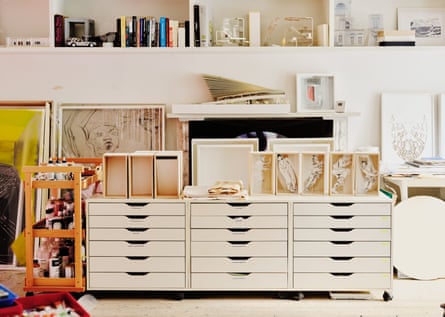
Works in progress in Devlin’s studio
Trawl through Devlin’s own outsized CV and you’ll see immediately why she felt the label fit her too, and why she chose The Everythingists as the title of the large-scale sculptural work she made in response.
In the 30 years since she won the Linbury prize for stage design in 1995, Devlin has established herself as a go-to set designer for highbrow theatre, international opera, global pop (Bad Bunny, Lady Gaga, Beyoncé), official celebrations (two Super Bowl half-time shows, two Olympic ceremonies), fashion runways and public sculpture. She has three honorary doctorates, multiple Oliviers, Tonys, Emmys and Critics’ Circle awards, the London Design Medal, an OBE and a CBE. Much of this has been for services to design. But Devlin’s ability to pair drawing and intricate handicraft with arena-level spectacle and sociopolitical relevance has also routinely caught the eye of contemporary art curators (Hans Ulrich Obrist, Ekow Eshun) and theoretical physicists alike (Carlo Rovelli is a fan).
-
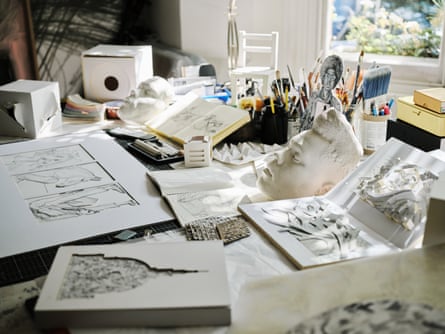
A workdesk in Devlin’s studio
“I’ve been like this since I was very young,” Devlin says from her garden in south London, where we meet ahead of her forthcoming retrospective, Es Devlin: Other Worlds at the Design Museum in London. “When I was at school, the teachers used to say: ‘You’re a jack of all trades and master of none,’ and it’s only recently that I learned that phrase actually has another couplet, which is, ‘But oftentimes better than a master of one.’” To her mind, “it’s an injustice to the condition of being alive to seek only depth at the expense of breadth. I think you actually achieve greater depth if you expand your line of inquiry.”
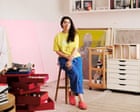
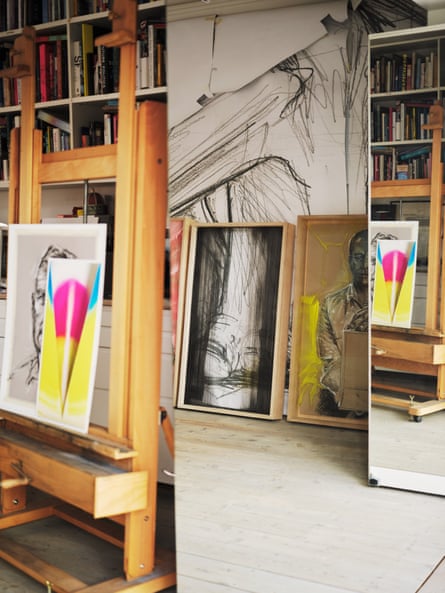
Devlin wears a Barbie pink T-shirt under a knitted vest of a slightly different bright pink, workers’ blue trousers, bright coral-red Crocs and sculptural pendants on long silver chains. Two floor-to-ceiling mirror doors separate her studio rooms from her home, with a light-filled open-plan kitchen and living area beyond them. Two ginger cats mosey about between giant vessels of turned wood on wide marble surfaces and a pair of even bigger sculpted hands, roughly the height of a person. These are maquettes for the floating 25 metre-tall set Devlin designed for Carmen at the Bregenz Festspiele in 2017. The right hand stands guard by the sofas. The left perches in one of the studio rooms out front, surrounded by a sea of materials, works and models. “I’m actually quite excited about moving everything from that studio into the Design Museum because I’ll have every space clear and nothing on the walls. And then I just need to sit in there and make stuff.”
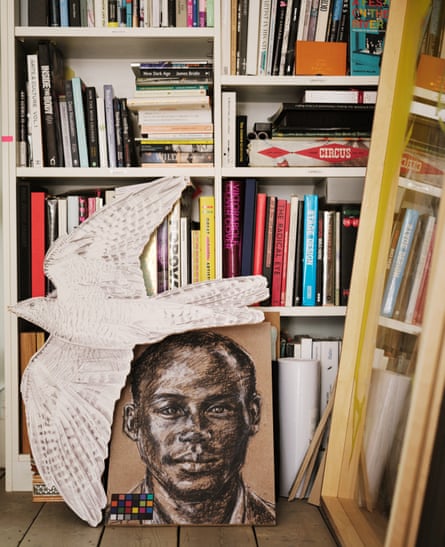
-
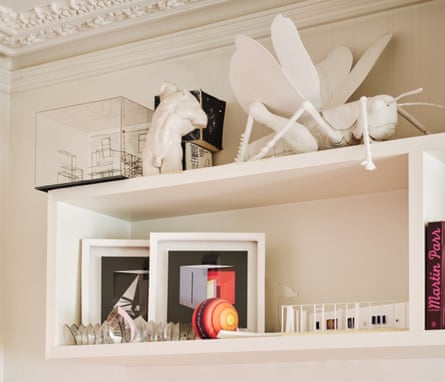
A bookcase at Devlin’s home
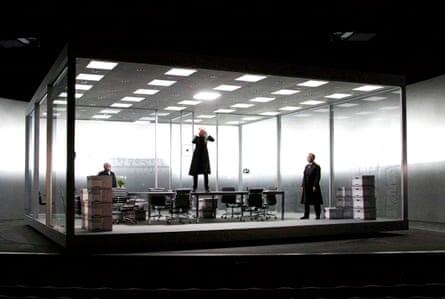
The retrospective maps out 30 years of Devlin’s practice in sculpture, film and installation, with an expansive display of archival drawings, paintings, collages, diaries and prints that give an insight into how she gets things done. At the show’s core is a large circular piece that combines several milestone projects including the 2021 mirror-maze piece Forest of Us; the rotating glass box-based set designed in 2018 for The Lehman Trilogy, directed by Sam Mendes; and the union jack stadium-floor covering designed for the London 2012 Olympics closing ceremony.
In 2023, Devlin published a monograph titled An Atlas of Es Devlin, which comprised a double fold-out list, detailing more than 120 projects she had worked on over 30-plus years. A revised edition now adds 30 new projects to the list, evidence of an unrelenting workflow. Recent collaborations have included the set for a production of Rajiv Joseph’s Archduke at London’s Royal Court theatre; a retrospective at Futura Seoul, South Korea; and London Oratorio, a one-night production at the South Bank, in collaboration with musician Jacob Collier, composer Kieran Brunt and scores of the capital’s choristers. She is designing Olivia Rodrigo’s forthcoming arena tour. She’s writing a book, planning a ball, setting up a new studio in Sussex. When does she sleep? “I get plenty of sleep. But I do have quite a lot of things …” She gestures to the tree above her. “I wouldn’t be able to do what I’m doing today if I hadn’t done what I did yesterday. It’s an accumulation. It’s a tree that’s growing.” The most important thing is to keep feeding the trunk of it, she says, “to be alone in the studio”.
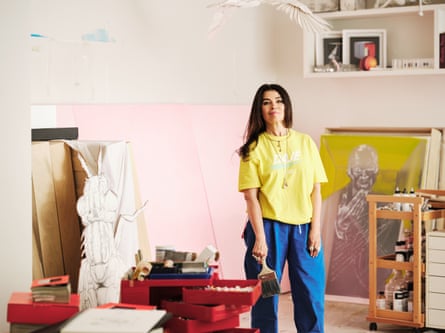
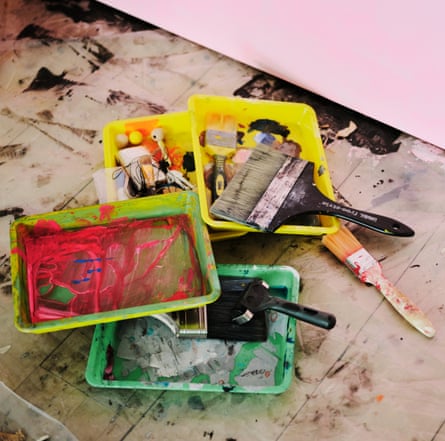
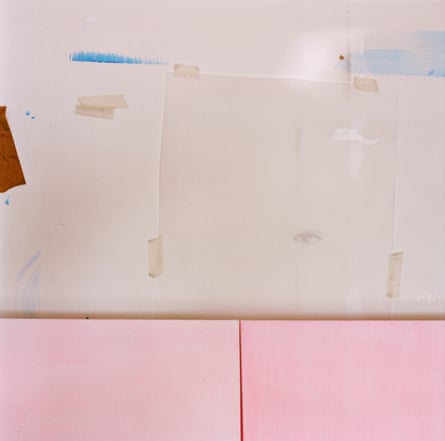
-
Devlin in her studio, with some of the tools of her trade
Esmeralda Devlin was born in Kingston upon Thames in 1971. Her father was a journalist and her mother a teacher – to Devlin’s mind, both artists. When she and her three siblings were all under 10 years old (she’s one of the middle kids), her parents took in three of their cousins for a year, seven children fitting into a three-bedroom house. “Any time there was a Christmas or a birthday, you know, my mum would just say: ‘Well, you can’t buy anything. Make something,’” she says.
Beyond gifts, Devlin would invent systems, follow instructions in craft books to make a periscope, say, with her mother’s makeup mirror, and devise complicated games. “My dad, who’d always take us quite seriously, would say: ‘You know, maybe we should send this to Waddingtons. Maybe this could become a game.’” Every Tuesday night there was a mad rush to find and return the library books they’d each got out for the week. “Mine were always under a pile of yoghurt pots, and cardboard boxes and toilet rolls because I’d be making some elaborate run for the gerbils.”
While she was still little, her family moved to Rye, on the East Sussex coast. She recalls the theatricality of church services there, where she would help to set out the wafers and wine for holy communion and ring the bell during the Kyrie Eleison, plus the altogether more pagan celebrations of the town’s bonfire pageants. She remembers routinely taking any visitors down from London to see the Rye Town Model next door, a son et lumière recreation of the town and its history, replete with lighting and a recorded narration. Nearly 50 years on, Devlin can tell you exactly what was in it: “There was a story about a monk and a nun who got bricked up in the walls for having an affair. There was a story about a butcher murdering somebody.” What really stuck in her mind, though, was that each house would light up as it spoke. Hers told of a wool merchant and a writer, the daughter of a poet. She found it mesmerising that “a building that I lived in was small enough for me to hold. I could look down on my house and think: ‘Oh, I can pick it up.’ But also, I would go next door and I’d be in my house and my house would be holding me.”
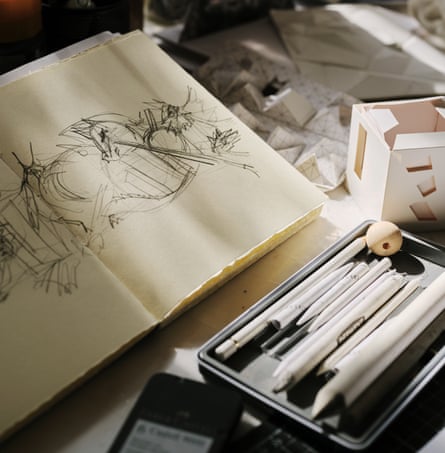
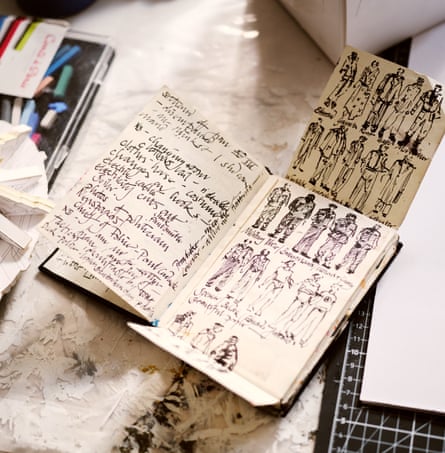
-
Sketchbooks in Devlin’s studio
Along with the power and presence of objects, music has woven a golden thread through Devlin’s life. She took all her grades in violin, clarinet and piano before realising, as a teenager, that her path would be, as she puts it, “something that fused my knowledge of music and my practice of music, with other things”. After a BA in English literature, a foundation course at Central Saint Martins and a year on the Motley theatre design course at Theatre Royal Drury Lane, that path lit up. She won a job to design Marlowe’s Edward II at the Octagon theatre in Bolton. That led to a piece at London’s Bush theatre, which was seen by Trevor Nunn, artistic director of the Royal National Theatre, who promptly hired her for a production of Harold Pinter’s Betrayal. Then came the Rambert Dance Company’s Four Scenes, the show with which the new Sadler’s Wells was inaugurated in 1998. Devlin had just turned 27. “It was a very rapid baptism of fire,” she says.
Was she intimidated, working at that level with established directors so early on in her career? “I think I was insufficiently intimidated,” she says. “By then, I had been in education a long time and there was a lot I wanted to express.”
This unflappable nature, this gung-ho “yes, please!” attitude, has since taken her everywhere – Compton, the Louvre, Morocco’s Agafay Desert, Malawi – collaborating with everyone from Rosalía and Kendrick Lamar to Max Richter. In 2013, she told the Guardian that a low point of her career had been sending groundplans to Shakira while in labour. Young artists, in particular, often ask how she holds on to her identity when collaborating with powerful people. “The best answer I’ve given to this question is: I actually am not too afraid to lose my identity. By being prepared to lose it, you encounter other aspects that are probably more interesting.”
-
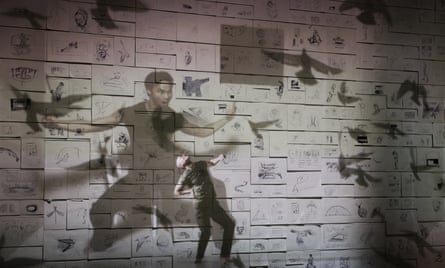
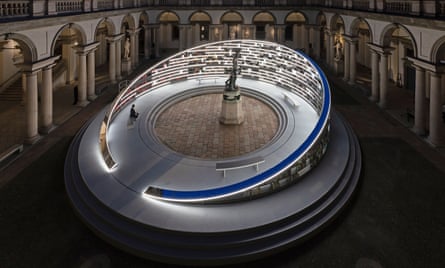
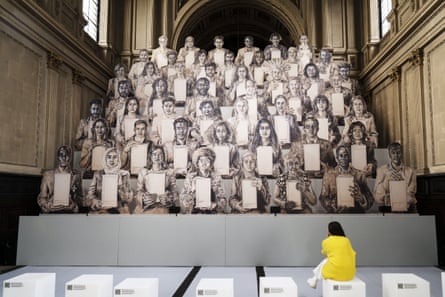
(Clockwise from top left) Devlin’s 2026 installation Sou o Outro do Outro in São Paolo; Library of Light in Milan from 2025; Congregation at St Mary le Strand in London from 2024; The Lehman Trilogy at the National Theatre, London from 2018
That doesn’t mean that she ever actually loses herself in someone else’s world, which, you sense, is exactly why these big names seek her out. “What I’ve observed about powerful people is, it’s unfortunate, but a bit like barnacles on a great whale, there are peripheral structures that accumulate around power and fame. And to the powerful person and the famous person, those structures are really uninteresting.” She looms, instead, like an octopus, tentacles in every direction, drawing the world in an indelible ink that is hers alone. Viewers at the Design Museum will note the coherence, the very Es Devlinness, of her work, regardless of whom it is for. Leitmotivs (the line of light, the glowing box, the map, the tree-lung, the egg that opens) recur. Her conceptual imperatives are clear, too. She has no interest in decoration, everything has to have meaning. The audience must have agency. Materiality matters. And portraiture is fundamental. “Everything is both a portrait of the collaborator and a self-portrait at the same time.”
My second visit, two days later, is to Devlin’s other studio in Peckham, south London, where design associates sit at computers rendering 2D and 3D visualisations for set designs: Olivia Rodrigo’s forthcoming arena tour; the Design Museum show floorplan. The latter will contain multiple maquettes of previous large-scale works. Downstairs, a model-maker is adding finishing touches to a tiny maquette of Devlin’s installation Library of Light, an 18-metre revolving cylindrical bookshelf containing 3,200 books, designed for the Salone del Mobile in Milan in 2025. Beside her are reused takeaway boxes filled with tiny fake books: she reckons she’s made about 1,800.
-
Artworks around Devlin’s studio
Devlin appears in bright yellow and bright white. Sitting down to lunch, she says: “I was speaking with William Kentridge about the way he labels his projects, and he has ‘urgent’, ‘desperate’, ‘emergency’ and ‘SOS’. That’s definitely how we could label our projects.”
What is SOS right now? “The Design Museum is SOS,” she says. So too, the 2026 British Museum Ball in October, for which she is the artistic director. She and a member of her team went on a tour of the museum and met “six people who’ve worked there, a combined number of 137 years; profound knowledge, profound understanding of objects which tell our history and explain who we are”. What she wants her design to communicate, she says, is the museum’s staff, all 1,000 of them. She sees them as protagonists, much like the 50 refugees of whom she did portraits for her UNHCR installation Congregation in 2024, or the 55 million adults invited to take part in her A National Portrait project for London’s National Portrait Gallery.
That people and real lives are central to what Devlin does is tangible in the way she includes her team in our chat. She wants their perspectives. She clearly treasures their work. One associate tells me she trained as an architect but, on graduating, thought: “There’s got to be something else out there. This is surely not it.” Devlin’s studio is a haven for like-minded seekers, who are interested in everything and want more.
Over coffee and dark chocolate, Devlin shows me her rings. She is testing intriguing prototypes of kinetic silver with her designs: an iris, a spinning cube, a minute Venus of Willendorf, an egg that opens up to reveal a tree or a lung. “I’m writing a book called The Compass of Es Devlin,” she says, “which is sort of elucidating various practices that have helped me. And these are to help me remember them. It’s almost like they’re little cues.”
To watch her manipulate these tiny sculptures, or draw her signature into a book, is to see what she must have been like as a small child – utterly engrossed in the creative task at hand: Es Devlin, the everythingist.
Es Devlin: Other Worlds is at the Design Museum, London, from 2 October to 4 April. Other images courtesy of Es Devlin and Daniel Devlin.
KioskNews shows a cleaned-up reading view extracted from the publisher’s page — the original always lives on their site, not ours.