Shaurya squadron to change how India's tank formations will fight future wars
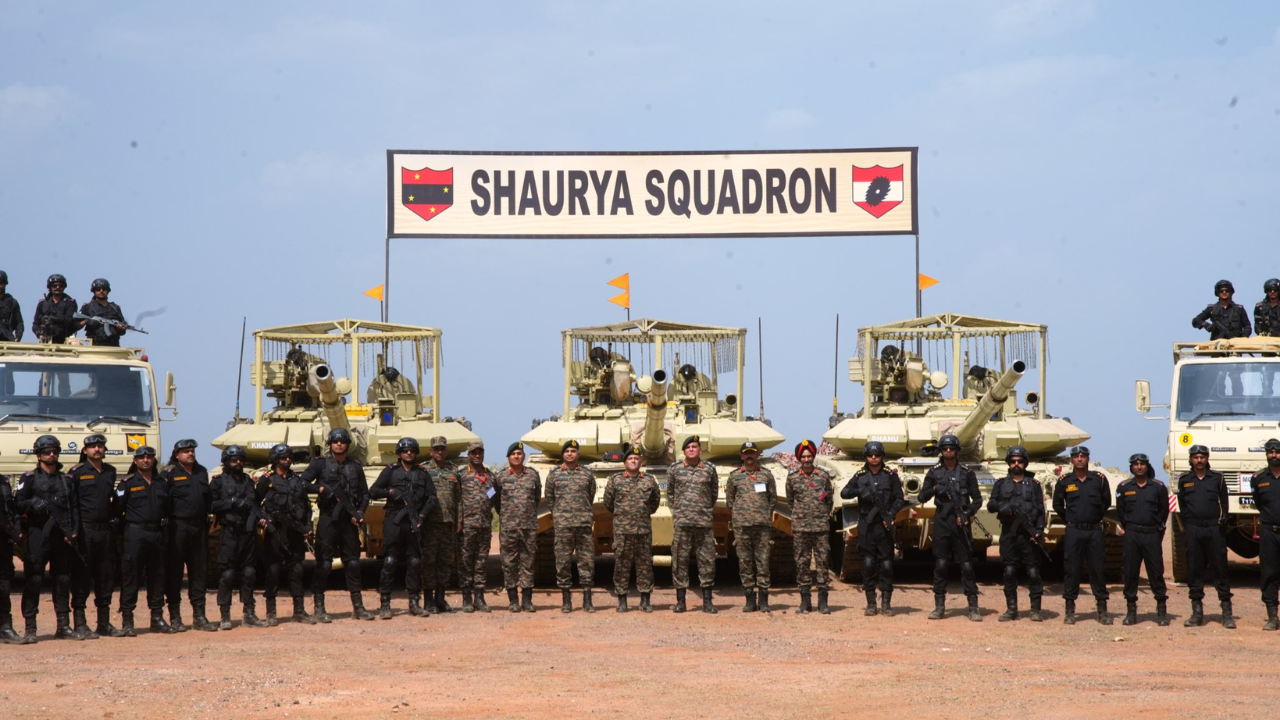
Shaurya Squadron was first revealed during Exercise Amogh Jwala, held in March this year. (Image credit: Indian Army)
After artillery and infantry, the Armoured Corps of the Indian Army is now working to operationalise drones within the organic structure of its regiments through the Shaurya Squadron. The Army, in the midst of a modernisation drive, is working towards becoming a more agile fighting force.
As part of this change, the force is reshaping and adopting newer structures, units and sub-units in response to the evolving nature of combat. Some of these structural changes include the formation of Integrated Battle Groups (IBGs), the raising of Bhairav battalions and the formation of Ashni platoons for the infantry. Other changes have also been announced, such as the Shaktibaan Regiment and Divyastra Battery, both of which will be part of the artillery.
What is the Shaurya Squadron
The new sub-unit, will be the fifth squadron of an armoured regiment, as per a source close to the issue. Currently, an armoured regiment has three sabre squadrons equipped with tanks and a headquarter squadron. The headquarters squadron also contains the regiment's reconnaissance (recce) troop. As per the source, the recce troop will form the core of the new squadron and will also have drones for both observation and strike roles.
Apart from this the new squadron could also be equipped with light tanks, according to the source.The introduction of this squadron will expand the ability of the armoured regiment to see better, this increased level of situational awareness is expected to improve the combat effectiveness of the army's armoured spearhead in both offensive and defensive operations. Each operational command of the army has an armoured regiment that is working to fine tune the use of in its own operational environment, as per the source.The concept first came to light in March this year at Exercise Amogh Jwala, when the then southern army commander and now army chief General Dhiraj Seth was briefed on it. Pune-based southern command said the embryonic squadron was tested under realistic battlefield conditions, combining precision strikes with deep surveillance and close-combat reconnaissance. It was designed, the command said, to "seek further, strike deeper and stay longer", showing that real-time reconnaissance can be paired with a quick, precise strike.It surfaced again in July, when Lieutenant General Rajesh Pushkar, the present General Officer Commanding-in-Chief of Southern Command, visited the 31 Armoured Division, also known as the White Tiger Division, which demonstrated its capabilities and briefed him on new equipment.
Part of a wider drone structure
The Armoured Corps is following the infantry and the artillery. The Army has raised its first dedicated drone battalion, the Baaz Battalion, under 11 Corps (Vajra Corps) in Jalandhar, on the western front with Pakistan.
Unlike the smaller drone platoons embedded in infantry units, it is designed to operate a wider range of platforms, including Searcher drones and long-endurance systems such as the MQ-9B, Heron and Hermes.
It is expected to act as a hub for flight management, maintenance, software updates, data exploitation and coordination with troops, with artificial intelligence-based decision-support systems helping to process the data.For the infantry, Ashni platoons will provide battalions with their own drones for reconnaissance and offensive operations. The artillery is preparing Divyastra batteries and Shaktibaan regiments, which will use longer-range drones and loitering munitions. These sit alongside Integrated Battle Groups and Bhairav battalions, and the Shaurya Squadron extends the same approach to armour.
Protecting the tank
The changes draw on lessons from the standoff with China along the Line of Actual Control, Operation Sindoor in May 2025, and the wars in Ukraine and West Asia, where drones have been used for reconnaissance, artillery targeting and direct attack.
Armies have responded by adding roof protection, including cage-like structures, along with electronic countermeasures and active protection systems. Camouflage, concealment, dispersal and mobility have again become important for armoured formations.These changes fit into a wider shift towards multi-domain operations under a joint doctrine issued by the headquarters integrated defence staff in August 2025, which seeks to combine satellite imagery, drone feeds, electronic intelligence and artillery targeting to speed up battlefield decisions. The new formations signal a move away from manpower-heavy structures towards a network-centric force in which infantry, artillery and armour use unmanned systems as part of their routine operations, while being able to defend against the same threats from an adversary.
KioskNews shows a cleaned-up reading view extracted from the publisher’s page — the original always lives on their site, not ours.