‘Block the Merger’ push continues as Paramount settles with state AGs
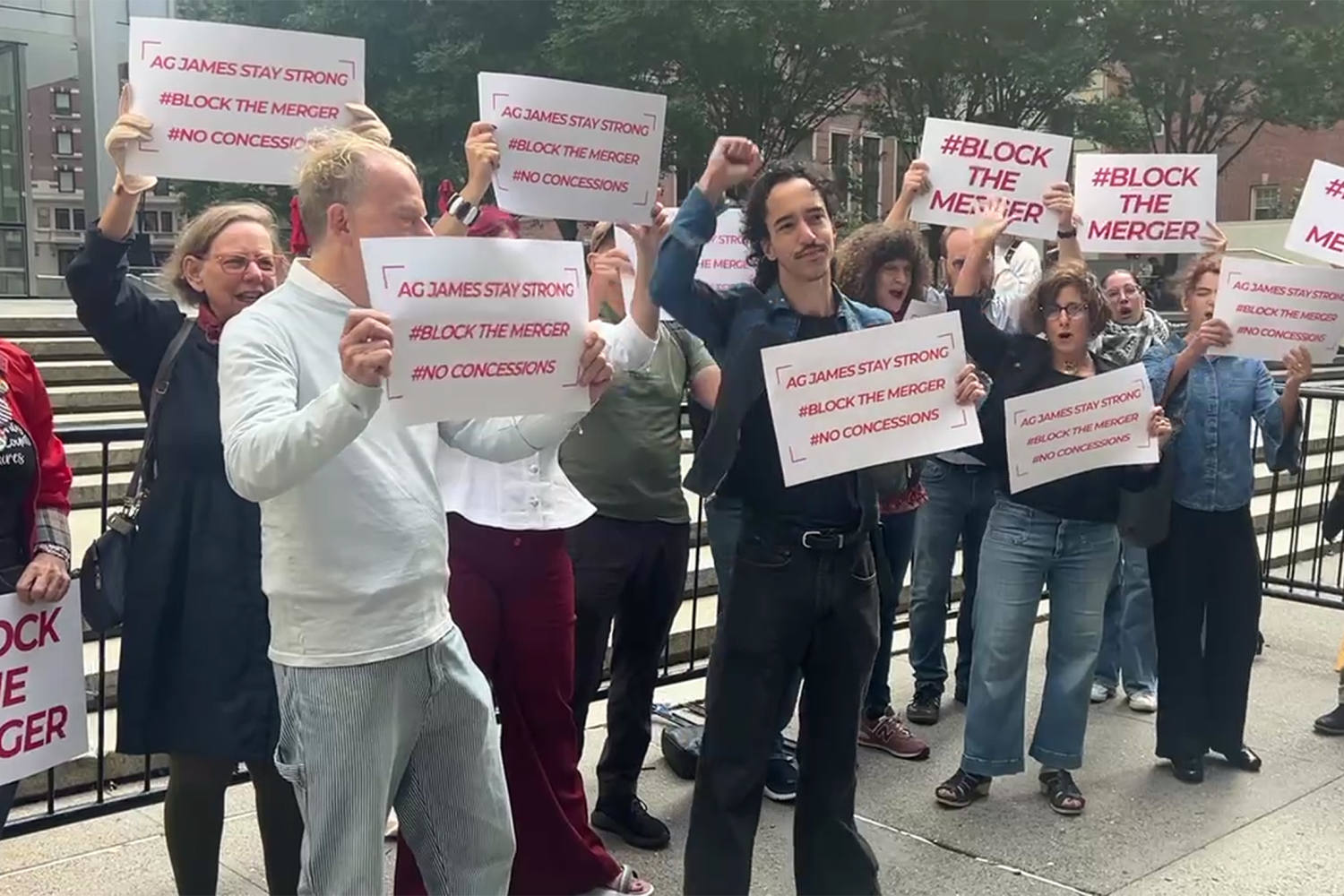
Outside the New York attorney general’s office Monday, about 20 opponents of the Paramount Skydance-Warner Bros. Discovery merger gathered to urge Letitia James not to settle the states’ legal challenge to the deal.
Holding signs reading “#BlockTheMerger,” the protesters — led by members of the Committee for the First Amendment, a free-speech advocacy group headed by actor Jane Fonda — called on James to “stay strong” and resist making concessions in negotiations with Paramount.
But their appeal may have come too late. As the rally wrapped up, reports circulated that a possible settlement between Paramount and the 12 states suing to block the $110 billion merger had been reached.
The states, which include New York and California, argued in a 38-page complaint filed in July that the deal would “extinguish competition” in Hollywood. Paramount, led by CEO David Ellison, has repeatedly maintained that the deal is “lawful, pro-competitive, and will benefit consumers, creators, workers, and the entertainment industry.”
Representatives for Paramount did not respond to requests for comment. The New York and California attorneys general offices also did not respond.
The rally was one of three planned merger opposition events — one was held in Oakland outside California Attorney General Rob Bonta’s office Sunday; and an additional rally is scheduled to take place in Los Angeles on Tuesday outside the Writers Guild of America office.
“We just want to thank everyone for listening, we want people to spread the word and let everyone know: this merger is bad,” said Bruce Cohen, a producer who was among the rally attendees and speakers on Monday. “It’s bad for Hollywood, it’s bad for workers, it’s bad for democracy.”
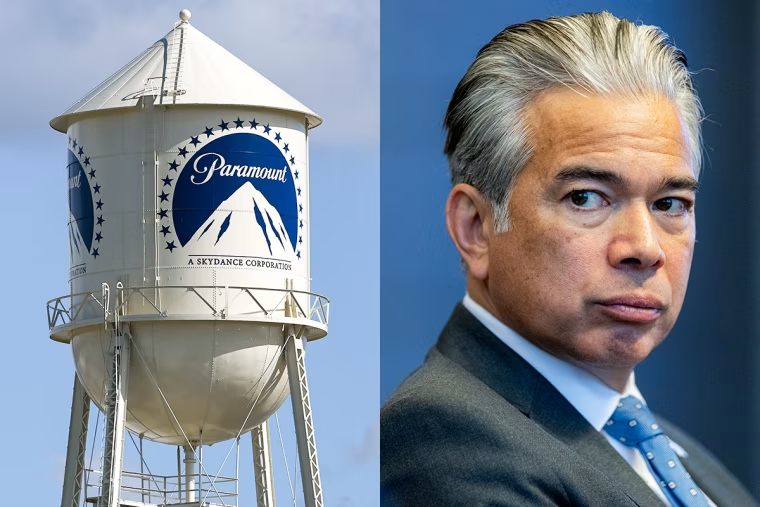
Paramount executives have been eager to wrap up the deal as soon as possible partly because the company agreed to pay Warner Bros. shareholders a “ticking fee” of 25 cents a share each quarter if the transaction does not close by Sept. 30 — a penalty worth more than $600 million every three months.
In August, Paramount’s lawyers asked Judge Araceli Martínez-Olguín of the U.S. District Court for the Northern District of California, who is presiding over the case, to require the merger’s legal opponents, which also includes the WGA, to put up nearly $1.9 billion. The money, the company said, would cover the costs of delays caused by the antitrust lawsuit.
The Justice Department threw its support behind Paramount’s demand that the opponents should be forced to post a bond as the price of continuing to block the merger. Martínez-Olguín had scheduled a hearing on Paramount’s bond request for Sept. 24.
01:54
Why Paramount leaving Hollywood would be a big deal
00:0000:00
Ellison had threatened to move Paramount out of its traditional headquarters in California unless Bonta opened settlement talks, according to a source who was in a closed-door meeting last month but wasn’t authorized to speak about it on the record.
Paramount has already received regulatory clearance from the Justice Department, and it has touted similar approvals from other foreign territories, including Australia, China and the European Union. The merger also has the backing of AMC Theatres and Regal Cinemas, the largest movie theater chains in the U.S. by number of locations and screens.
But many outspoken actors, writers and producers in Hollywood have continued to rally behind efforts to block the merger, arguing in an open letter earlier this year that further corporate consolidation of the entertainment industry will “threaten the sustainability of the entire creative community.”
Ellison has pledged that the combined company will release 30 movies a year theatrically.
Brian Hansbury, a member of the actors’ union SAG-AFTRA who was at the rally Monday, expressed skepticism over the promise.
“I don’t believe that. I mean, why should we believe any major business person who buys things up for profit and then says that it’s going to increase the quality of the product?” he said.
“It will lead to layoffs,” he added. “It will lead to probably less production overall, which will impact every type of worker in the industry ... any piece of art and culture will be negatively affected.”
Paramount had agreed to freeze the merger until either the antitrust challenge was resolved or June 1, 2027 — whichever came first.
Martínez-Olguín had scheduled an antitrust trial for early March.
KioskNews shows a cleaned-up reading view extracted from the publisher’s page — the original always lives on their site, not ours.