Another unremarkable win shows Arsenal’s strength is in depth rather than creativity | Jonathan Wilson

Pass. Pass. Pass. Pass. Sideways. Square. Backwards. Pass. Pass. Recycle. Pass. It wasn’t much of a spectacle. But in the end, for the second week running, thanks in no small part of their bench, Arsenal won. Fireworks in the autumn are for Bonfire Night; titles require relentless accumulation. Since the international break, Arsenal have won three games out of three despite not being in the lead at half-time in any of them.
Hammered at Brighton and having endured a drab first hour at home to Leeds last week, there has been a rare sense, for the first time really since Manchester City dropped points at Everton at the beginning of May, of Arsenal not being quite at their best, needing to reassert their quality. This was not a performance that would terrify any opponent, but it did highlight Arsenal’s consistency and it did demonstrate just how deep their squad now runs.
There were long periods when they were extremely flat. In the first half the ball was moved too slowly, too risk-aversely, for Bukayo Saka and Eberechi Eze consistently to isolate their full-backs. There were very few attempts to play the ball in behind an admittedly well-organised Forest backline. It was all very safe, seemingly predicated more on waiting for Forest to make a mistake than on trying to break the game open with a moment of genius.
The breakthrough, ultimately, was delivered by Noni Madueke who, when he got a run at Daniel Múñoz, took full advantage, albeit with a substantial deflection off the thigh of Jair Cunha. It was Arsenal’s only shot on target – and it wasn’t even on the bit of the target it ended up going in.
Arsenal may have been working with Germán Castaños, a creativity coach who has worked in handball, in designing TV gameshows and with his local council. By challenging the players and presenting them with unusual situations during the week, the theory goes, he can help them to come up with innovative solutions at the weekend. It must take a lot of creativity to make a team as unremarkable as this.
Mikel Arteta is a great believer in the sort of team-building techniques that to outsiders might look like high-performance gimmicks but you dread to think how hard a watch his side would be if their collective imagination wasn’t constantly being stimulated.
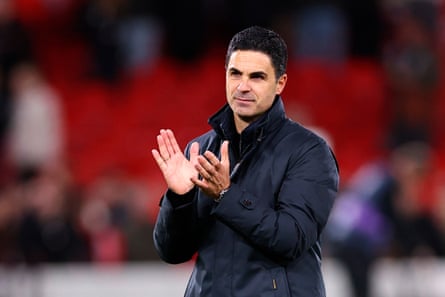
Castaños got a boxer to fight two opponents and a Japanese football team to play against a side with 16 men. You wonder how a team might prepare to face an Oliver Glasner side in full stifle mode. Running headfirst into a line of three brick walls, perhaps? Or rather, given how Arsenal played for the first two-thirds of the game, running parallel to three walls looking suspiciously at them? For an hour, this was about patience and risk aversion, the only occasional flurries of something approaching unpredictability coming via Saka on the right.
The England winger perhaps suffers the curse of those who emerge young, that consistent excellence seems somehow not quite enough, a betrayal of that teenage potential. Familiarity in football often breeds, if not quite contempt, then at least a sense that there could be more. He is certainly not playing badly, and he has scored three league goals, but equally, at 25, he is not the exhilarating presence he was at 21.
Perhaps that is simply how Arteta wants his wide players to play, prioritising consistency and efficiency over the spectacular. Perhaps the fears of those who felt Saka was being played too consistently are being realised and he is experiencing an element of fatigue. Or perhaps this is just what regular mature performances look like in the modern Premier League.
after newsletter promotion
There was one delightful early turn that drew Neco Williams into a trip that earned him a yellow card, which it might have been thought would encourage Saka to run at the wing-back, but the pattern remained the patient sideways passing. Saka, though, did at least offer more than Eze on the other flank, and it was no great surprise when the former Crystal Palace man was withdrawn at half-time for Madueke. Staying wider more consistently, Madueke did perhaps offer a greater threat but he did have more space for him to exploit as an encouraged Forest began to push forward more.
That, in fact, for a long time seemed Arsenal’s best chance, playing with such an absence of threat that it lured Forest into the thought that there was more for them in the game than a worthy clean sheet and a notable point. Leeds, perhaps, might argue they were suckered by something similar last week. As in that game, what turned things Arsenal’s way was a triple substitution midway through the second half.
The arrival of Jurriën Timber, Mikel Merino and Viktor Gyökeres gave Arsenal legs and purpose that Forest could not match. Even as Forest were forced out of their defensive shape to chase an equaliser, the bulk of the game was played in their half. It may not have been especially thrilling, but it was enough and it was, in its own understated way, an expression of Arsenal’s strength. Thrills can come later.
KioskNews shows a cleaned-up reading view extracted from the publisher’s page — the original always lives on their site, not ours.