Army unveils Stinger simulators, highlights counter-drone role
Taiwan’s Army unveiled simulators for United States-made Stinger missile systems yesterday, highlighting their use in training personnel to engage airborne targets, including drones.
The Army Artillery Training Command demonstrated simulators for man-portable and dual-mounted Stinger (DMS) systems during an open house for local and foreign media.
Taiwan received "a few dozen" man-portable Stinger missile systems from former US president Joe Biden’s administration in 2023 under the US Presidential Drawdown Authority, according to the Chinese-language Liberty Times (sister paper of the Taipei Times).
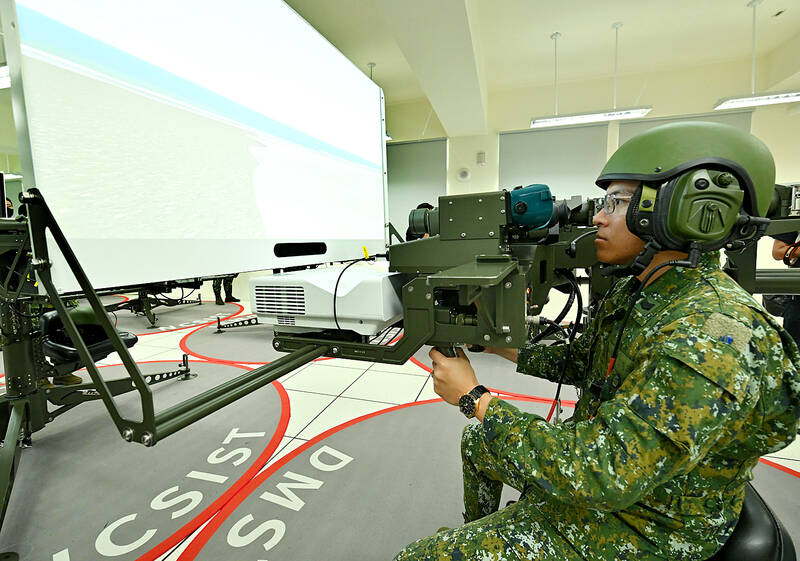
A soldier demonstrates the operation of a dual-mounted Stinger missile system simulator in Tainan yesterday.
Photo: Tien Yu-hua, Taipei Times
The simulators for the man-portable Stinger missile systems were also included in the US military assistance package, according to the command.
Army Major Bu Yi-wen (卜逸雯), an instructor for the man-portable Stinger systems, said physical strength and balance were key aspects of training because the system weighs nearly 16 kilograms.
Meanwhile, the DMS simulators are connected to a screen displaying a simulation of Jiupeng Bay in Pingtung County, where Jiupeng Military Base is located.
The simulators allow trainees to track and lock on to airborne targets, including drones, while communicating through built-in intercoms and sharing location information, according to the command.
"The simulator systems can be configured based on different parameters to simulate different weather conditions, terrains or engagement targets, including drones," instructor Lieutenant Colonel Chen Yu-wen (陳郁文) said.
Chen said trainees undergo 30-45 days of training to acquire the necessary skills, while those seeking to qualify as instructors undergo twice as much training.
He said quarterly and yearly refresher programs are also held, each lasting one to two months.
Simulator training helps keep training costs down, allows trainees to familiarize themselves with the systems, and prepares them for live-fire drills, such as the Shen Kung Exercise held in Jiupeng Bay in July, Chen said.
The US approved the first batch of 250 man-portable Stinger missiles in 2015 and a second batch of the same size in 2019. Taiwan expects to receive them in phases beginning at the end of this year.
Taiwan later requested to purchase an additional 2,121 missiles but has yet to receive a letter of offer and acceptance from the US.
KioskNews shows a cleaned-up reading view extracted from the publisher’s page — the original always lives on their site, not ours.