Blind. Hong Kong dissident. Refugee. And as of Monday, she’s a Toronto lawyer
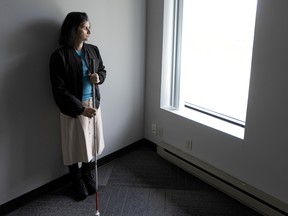
Joy Luk can’t leave behind the time she spent on the front lines of Hong Kong’s massive democracy protests in 2019.
Sign In or Create an Account
Seven years after the movement was crushed, the city’s first and only blind lawyer lives in Toronto as a refugee, and is reminded frequently of her worst moments during the uprising.
Luk says she has nightmares about being struck by police and is startled by a knock at her apartment door, a reminder of the visits to her home from belligerent officers amid a Chinese-government-backed crackdown on opposition.
But the spirit behind her extraordinary role in the Hong Kong protests hasn’t dimmed, even as she’s treated for post-traumatic stress disorder.

Get a dash of perspective along with the trending news of the day in a very readable format.
By signing up you consent to receive the above newsletter from Postmedia Network Inc.
A welcome email is on its way. If you don't see it, please check your junk folder.
The next issue of NP Posted will soon be in your inbox.
We encountered an issue signing you up. Please try again
The 47-year-old has spoken at vigils here commemorating the anniversary of the Tiananmen Square massacre, given talks on the “criminalization” of dissent and picketed outside China’s Toronto consulate.
A ceremony on Monday, though, will mark what might be Luk’s most impressive accomplishment since arriving in Canada. After obtaining a Global Professional Master of Laws degree at the University of Toronto and passing bar-admission exams made all the more challenging by her lack of sight, she’ll be officially admitted to the profession in Ontario.
“In the very beginning, when I arrived in Canada, I didn’t think I could be a lawyer again,” Luk said in an interview Wednesday. But she says she reminded herself of a favourite message from Apple founder Steve Jobs: “I accept failure, but I do not accept not trying … The worst case is I would not pass.”
She passed, on her first attempt.
Luk is grateful for the welcome she received in Canada, especially its willingness to provide care for her many health needs even before her refugee application was accepted. That said, she’s dismayed by one issue – the current federal government’s push to improve relations with China as a response to the massive tariffs imposed by the U.S.
She understands the motivation, but worries that Prime Minister Mark Carney is forsaking those whose rights Beijing tramples.
“I guess they are not eager to fight for freedom of the people in Hong Kong and other parts of China under that kind of tyranny,” she said. “Because they want to sell some things to China … We are very disappointed by this.”
The way she tells it, Luk’s own determination to combat injustice started early.
Born almost entirely blind, she said she realized from a young age the law was needed to protect the rights of the disabled. She first dreamt of being a lawyer in kindergarten, Luk says.
She later passed law school and obtained her first Masters degree, in human-rights law, though she began her career practising general law, while also becoming an advocate for the disabled.
Then China began to tighten its grip on the city, and her life changed irrevocably.
The Beijing-loyal Hong Kong government proposed a new law that would allow extradition from Hong Kong to the mainland, raising fears of dissidents and others being dragged into China’s notoriously oppressive justice system.
The legislation sparked historic protests in 2019 that brought as many as a million people into the streets. The demonstrations, generally peaceful though occasionally more unruly, led to violent clashes with the police and finally a crackdown that would erase most of Hong Kong’s political freedoms.
Despite her blindness, Luk put herself in the midst of the maelstrom, offering on-the-spot legal advice to other demonstrators and passing on information about police tactics she gleaned with her acute hearing.
“I told myself, if some young people sacrifice their future for Hong Kong, why could I not do this?” she says. “So I was not afraid of being arrested or being injured … or even dying or having my licence removed. That was not my first concern.”
Her commitment to the cause meant being struck by police, enduring repeated searches at her home and being arrested, without charges, at a demonstration outside a police station. She says she sometimes stood in the street at the front of crowds of protesters, arguing with the police to ensure demonstrators had a chance to get away if necessary.
She once broke her arm when stampeding police barrelled into her.
Yet through it all, Luk says she had a unique power that made her actions possible.
“I was not afraid because I could not see,” she said. “If you see the police, they are running toward you, your direct reaction is to leave. But I could not see.”
Luk became a well-known figure in the movement, a blind woman seemingly fearless in the face of aggressive police tactics, said Cheuk Kwan of the Toronto Association for Democracy in China.
“She stood out,” said Kwan. “Despite all the oppression and suppression by the police, she was willing to stand up front and be counted.”
In the end, Chinese-backed forces prevailed. In the protests’ wake, a Beijing-endorsed National Security Law barred most forms of dissent, independent journalists and democracy-touting politicians were jailed, and even Hong Kongers living in exile in Canada and elsewhere were targeted with charges and bounties for criticizing Beijing.
Luk says she realized she had no future as a human-rights lawyer and feared bringing more trouble to her parents, so decided to leave, choosing Canada because she felt it would be more accepting of a disabled person than other safe havens. The association helped Luk when she arrived in Toronto in 2021, one supporter providing her with 18 months of free rent in a Toronto apartment, others eagerly helping with living expenses and immigration legal costs, said Kwan.
The donors included former Conservative Senator Con DiNino, who according to Kwan called Luk the most courageous person he’d ever known.
She managed to get into the U of T Masters program in 2024 and eventually sat for the bar-admission exams. It was grueling, Luk says.
The exams were lengthy and to complete them she had to have her computer convert the text to speech, to the point where she began dreaming of the electronic voice. The computer can also convert text to braille, but that’s a much more time-consuming process.
A particular challenge were exam questions that required looking at an image, such as a land-titles document.
“I had to ask A.I. … ‘Using a blind person’s perspective, describe this picture, this figure, to me and let me know what it’s showing.”
Luk is now working part-time at a law firm in Markham, north of Toronto. But even as her career restarts in a new country, she wants the world to remember what she and thousands of others fought for in Hong Kong seven years ago.
“We believe that after several years, if we do not do anything, then people will forget what happened in 2019,” just like 1989’s Tiananmen massacre, she said. “We have no choice but to do something.”
Our website is the place for the latest breaking news, exclusive scoops, longreads and provocative commentary. Please bookmark nationalpost.com and sign up for our newsletters here.
Join the Conversation
This website uses cookies to personalize your content (including ads), and allows us to analyze our traffic. Read more about cookies here. By continuing to use our site, you agree to our Terms of Use and Privacy Policy.
KioskNews shows a cleaned-up reading view extracted from the publisher’s page — the original always lives on their site, not ours.