Why Indians are investing billions abroad amid shaky domestic stock markets

Last week, artificial intelligence giant Anthropic filed documents with the US capital markets regulator, the Securities and Exchange Commission (SEC), for its Initial Public Offering (IPO). Interest is sky-high, with Anthropic aiming for a valuation of up to $2 trillion. And while Indians may find it difficult to directly invest in the IPO, some will surely look to snap up some shares once the company is listed, possibly as soon as in two weeks’ time. Why? Because it might ‘pop’.
Starved of returns in the domestic stock market — the Nifty is still down 6% in 2026 despite a 7% surge over the last week — Indians are increasingly investing abroad to the tune of billions of dollars. In fact, 2026-27 may see these investments in foreign equity and debt cross $4 billion for the first time.
According to data from the Reserve Bank of India (RBI), investment in equity and debt under the Liberalised Remittance Scheme (LRS) was at $1.73 billion in April-August 2026, averaging just under $350 million per month. More importantly, the $1.73 billion invested abroad in the first five months of the fiscal is more than double the $823 million in the same period last year. For 2025-26 as a whole, the figure was $2.65 billion — these numbers are much smaller than what individuals invest domestically. In September alone, around $3.4 billion was put in the domestic stock market via Systematic Investment Plans, or SIPs, of mutual funds.
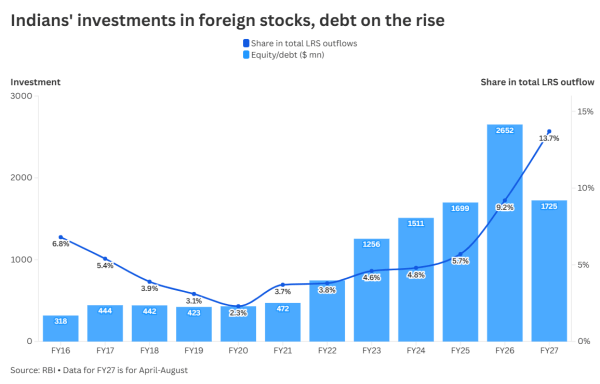 Indians investments on the rise.
Viram Shah, Founder and CEO, said business is brisk for global investment platforms such as Vested, which saw its new active users rise by 133% in 2024 and 79% in 2025, with the figure for 2026 until October already 33% higher than that of 2025. In terms of deposits, the rise has been similarly rapid: 250% in 2024, 140% in 2025, and 20% until October this year.
“Overall, annual deposits have grown nearly 10-fold since 2023, reflecting the increasing adoption of global investing among Indian investors. This suggests that international equities and other global assets are gradually becoming a more meaningful part of portfolio diversification,” Shah told The Indian Express.
Vested manages $1.5 billion worth of assets and has around 1.5 lakh active investors.
Capital outflow worries
But it’s not just individuals who have been investing abroad heavily in recent years. Even Indian companies’ direct investments abroad – or, outward Foreign Direct Investment (FDI) – have shot up. From $85 billion in the six years from 2018-19 to 2023-24, FDI by Indian companies has jumped to $82 billion in the subsequent two years and five months due to geopolitics and reshoring of production by developed economies.
Story continues below this ad
Add these two outflows to foreign investors booking profits on past FDI into India and the widening trade deficit due to elevated energy prices, and the sharp weakening of the rupee over the last year-and-a-half is not hard to explain.
Which is why the authorities have looked to encourage inflows: eliminating withholding and capital gains taxes for foreign investments in government debt, bearing the exchange rate risk of banks’ Foreign Currency Non-Resident deposits, and floating the idea of removing long-term capital gains and transaction taxes on equities too.
Pressure on the rupee has also been alleviated through certain regulatory measures which have made it more expensive to get protection from a weaker rupee. But how tenable would it be to reduce the $250,000 per-year-limit on outward remittances under LRS?
Introduced in February 2004 with an initial annual cap of $25,000 per individual, only once has the RBI ever reduced the limit. This was back in August 2013, in the midst of the global turmoil caused by the US Federal Reserve’s taper tantrums. The move led to the RBI being accused of implementing ‘capital controls’ – or imposing restrictions on the outflow of money, something which no economy hoping to attract foreign funds wants to be seen doing.
Why invest abroad
Story continues below this ad
Indians putting their money to work in overseas markets is not just to make higher returns but to diversify their portfolio with assets from across the world — no one wants to put all their eggs in one basket. And while foreign stocks are crucial, “there is growing interest in fixed-income strategies, private credit, private market funds and other alternative investments available through the GIFT City ecosystem”, said Gautami Gavankar, President, Kotak Mahindra Bank.
“Investors are using GIFT City or other routes to complement their India exposure by accessing global opportunities, diversifying currency risk and participating in sectors and themes that may not be readily available in domestic markets like AI infrastructure, semiconductor, defence technology, chip making, biotechnology, and space tech either through fund route or direct exposure to unlisted or listed companies,” Gavankar said.
The movement of non-stocks investments also shows up in data. With the US Federal Reserve raising interest rates sharply from nearly zero at the start of 2022 to over 5% by mid-2023, global interest rates surged. Consequently, Indians put in nearly $2 billion in foreign deposits in 2022-23 and 2023-24 combined.
Immovable property has also been a key asset of interest, with purchases worth a record $529 million being made under the LRS route in 2025-26.
Story continues below this ad
There is also the fact that incomes in India are rising. And as people grow richer, their horizons extend beyond the domestic economy. Consider tourism: Indians spent $7 billion on foreign travels in 2019-20. After the coronavirus pandemic induced lull of 2020-21 ($3.2 billion) and 2021-22 ($6.9 billion), 2022-23 saw the amount almost doubling to $13.7 billion before rising to a record $17 billion in 2023-24.
KioskNews shows a cleaned-up reading view extracted from the publisher’s page — the original always lives on their site, not ours.