‘Black Mirror’ Meets ‘The Man in the High Castle’ in Apple TV’s Near-Perfect 2-Season Sci-Fi Series

Chelsea Adelaine Hassler is an award-winning editorial, social, and creative director with two decades of media and entertainment experience and an all-consuming obsession with TV. A native New Yorker, she always completes the Sunday crossword, reads at least 100 books per year, and has Knicks season tickets.
Much like how a fable internalizes a moral lesson, the best science fiction doesn't use its core mechanisms to escape reality but to get closer to its truths. Using the fantastic as a lens to examine the fundamental aspects of human nature enables a clarity impossible to achieve with realism, as looking at life straight on doesn't account for what we don't fully admit to ourselves. In Apple TV's Dark Matter, the fantastic lens is the multiverse and quantum physics, used to make an abstract, internal regret tangible by posing a deceptively simple question and building its story around it: "Are you happy with your life?"
It's something often considered in the depths of sleepless nights, but not a fascinating core premise – until it takes the form of something inescapable by externalizing it into a far more complicated plot. Combining the alternate-history dread of The Man in the High Castle with the moral thought experiments of Black Mirror, Dark Matter's core mechanism allows its characters to see (and choose) every life they didn't live. But the show takes the mechanism a step further: the first season is about superposition, a protagonist existing as every possible version of himself until collapsing into a single chosen reality, and the second embodies entanglement, its three storylines inextricably linked, and its characters continually impacted, regardless of how far apart in the multiverse they may be.
What is 'Dark Matter' About?

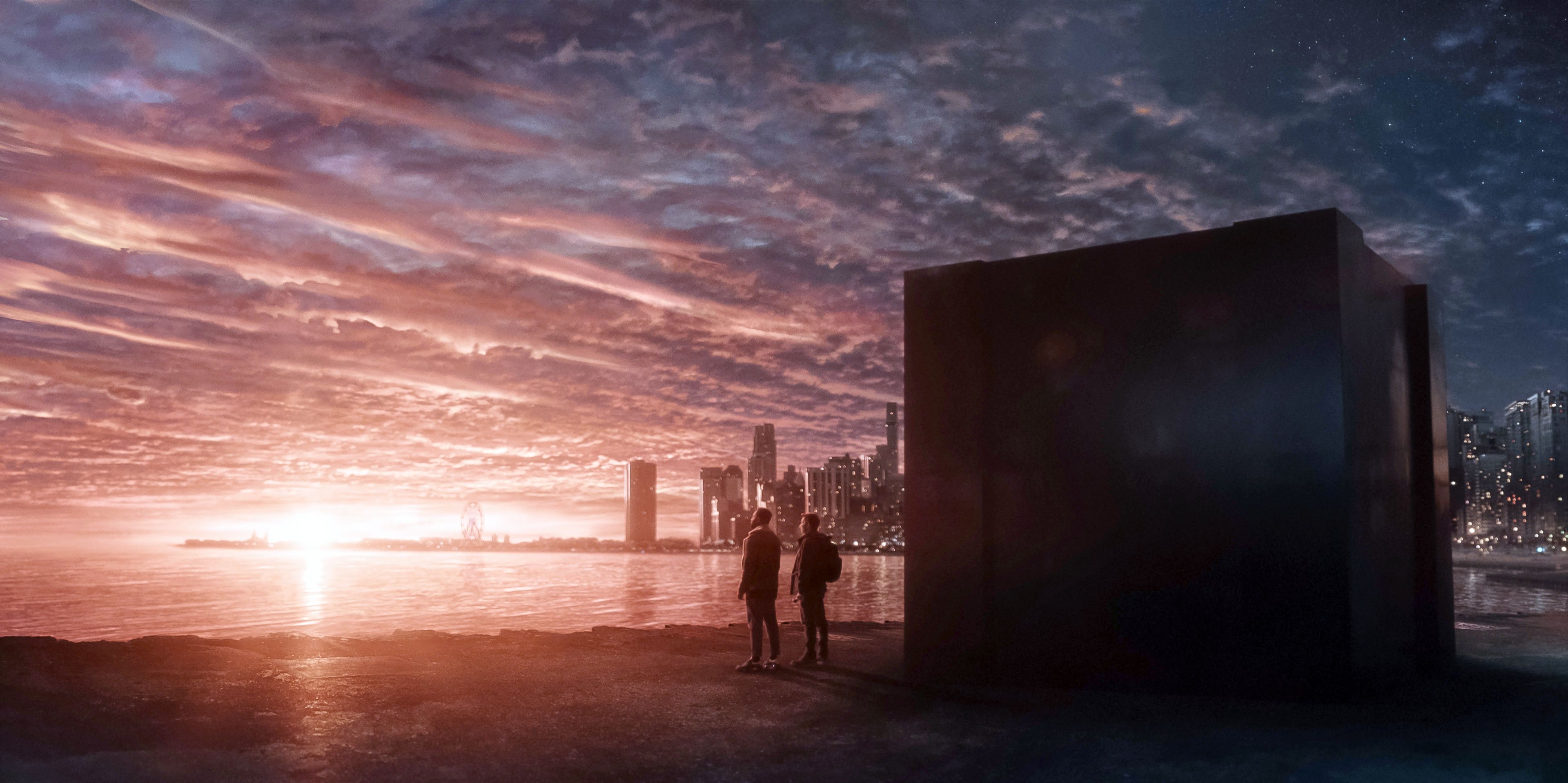
Dark Matter began as a novel by Blake Crouch, who adapted it for Apple TV and now serves as showrunner. Crouch used the book as the basis for the show's first season, tracking Chicago family man Jason Dessen (Joel Edgerton) after being abducted and replaced by an alternate version of himself who didn't choose his path of settling down with Daniela (Jennifer Connelly), having Charlie (Oakes Fegley), and becoming a college professor, and the wild quest he embarks on to return home where he belongs. The alternate version, known as Jason2, chose to continue his path as a quantum physicist, co-founding Velocity Labs with Leighton Vance (Dayo Okeniyi) and, alongside psychologist girlfriend Amanda Lucas (Alice Braga) and Blair Caplan (Amanda Brugel), building a massive stimuli-blocking cube known as the Box that, when entered after using the mind-altering drug created by chemist best friend Ryan Holder (Jimmi Simpson), enables the prefrontal cortex to be blocked and for a person to enter a state of quantum superposition, opening the doors to the multiverse.
If this all feels a bit complicated and crazy, that's because it is, but for a good reason: it's the lens through which human truths are glimpsed. Jason2 is consumed by regret, so driven by the idea that he would've been happier with Daniela, that he sought out a world where he could experience the life he didn't choose to live. After kidnapping Jason, Jason2 asks him, "Are you happy with your life?" and it's the moment where you first see how powerful the show's mechanism truly is. Jason has spent time internalizing this question, especially after Ryan wins a prestigious award that he knows should've been his in another universe, but comes to the rational place of recognizing he's lucky to have what he does. Jason2 is the outward manifestation of this question, actively doing something about it and externalizing that feeling into the overall plot, allowing us to see how it shakes out for all the characters in the series.
From Superposition to Entanglement in 2 Seasons of 'Dark Matter'

In the first season, Amanda helps Jason escape the alternate world in the Box, embarking on a quest to find his home world and traveling through some of the most harrowing realities imaginable. At the same time, Jason2 tries to become Jason; at first, it seems like he may actually pull it off, but after booting Ryan into a different world and almost killing Charlie with peanut butter, things start to fall apart. But after Amanda and Jason grow too close, she decides to stay behind in a world she thinks might be capable of giving her a better life – which so happens to be the same world Jason2 put Ryan in – and it's a decision that enables Jason to finally find the home he's been so desperately searching for. But instead of the planned confrontation with Jason2, he's forced to confront something far more sinister: every decision made in the Box spawned a new version of himself, each taking a slightly different path but all landing in his world.
After a lot of mind-boggling multi-Jason chase and combat scenes, the season comes to a head as it diverges from its source material and becomes something entirely new in its final episode. In the book, Jason and Jason2 have a standoff, and Jason2 is killed; in the show, Jason2 admits he acted selfishly, accepts the blame for the consequences of his reckless actions, and lets Jason escape into the Box with Daniela in pursuit of another home world. It's a far more equitable ending to what at times felt like a hopeless scenario, and marks the start of a two-season plan Crouch mapped out to bring a new story to life on the screen that didn't exist in the book – one that doesn't completely leave the multiple Jasons of superposition behind, but introduces the far more dangerous element of entanglement.
In the second season, we split into three storylines: Jason and his family attempting to find a world free of Jasons to start over, Leighton assembling an army of alternate versions of himself to build a better world, and, in the first open acknowledgment of there being an entanglement problem, Amanda and Ryan uniting in the utopian world and setting off on a quest to get revenge on Jason2. While only a few episodes have aired at the time of publication, it's safe to say none of these storylines are isolated and are instead correlated outcomes of the same underlying system, which means things are about to get a lot more complicated in the best possible way. It also begs a slight amendment to the simple question at the heart of a must-watch, two-season series: "Do I have the right to choose what life I live, when that choice isn't just mine to make?"
KioskNews shows a cleaned-up reading view extracted from the publisher’s page — the original always lives on their site, not ours.