Experts on how to get more comfortable with death
We are all going to die, and so is everyone we know. So how can you not be terrified?
By Madeleine Aggeler / The Guardian


For most people, death is not a standard conversation topic. Once, at lunch, a friend began talking about her mother’s death several years earlier. Her voice caught occasionally, but she spoke about it plainly — like a simple fact of life. As we talked, I noticed another friend was shifting uncomfortably in his seat; he didn’t say much.
Afterwards, I asked him what was wrong. “I really don’t like talking about death,” he said, his hands twitching anxiously. “I don’t even like thinking about it. It freaks me out.”
His discomfort struck me as silly — and also the most normal thing in the world. We are all going to die, and so is everyone we know. So why be terrified? And how can you not be terrified?
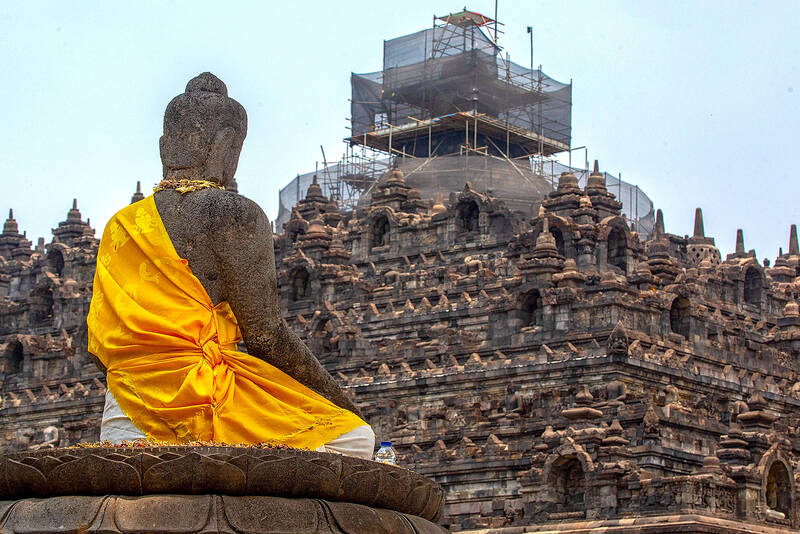
A seated statue of Buddha, draped in yellow robes, is seen on Tuesday in the foreground as restoration work continues on the Mahastupa, the main and largest stupa of the UNESCO World Heritage-listed Borobudur temple, in Magelang, Central Java.
Photo: AFP
My friend is far from alone in his discomfort. “We live in grief-illiterate and grief-phobic societies,” says Lucy Hone, a resilience and grief researcher and author of the book How Will I Get Ever Through This?: A Practical Guide to Navigating Life’s Toughest Times.
Hone began researching grief over a decade ago, after the sudden death of her daughter, Abi. On our video call, she wears one of Abi’s old hats, an orange and white beanie with polka dots and a big orange pouf on top. It’s ridiculous, Hone says, but it makes her laugh.
For someone who has experienced such intense loss and spends so much of her time talking to people about their grief, Hone is remarkably cheerful and bubbly. This is in part because of her work, she argues. Hone and several other experts I spoke with said that thinking and being around death was “life-affirming”.
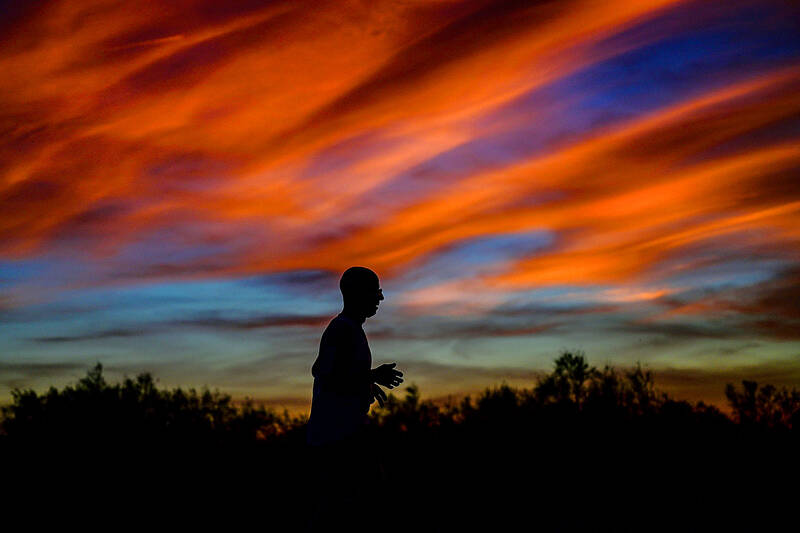
A jogger last month runs at sunset in Portirages, southern France.
Photo: AFP
Below, experts share why so many of us are so scared of death, and how we can learn to get a little more comfortable with it.
WHY WE ARE UNCOMFORTABLE WITH DEATH
Death disrupts the usual orientation of our lives, argues Todd May, instructor of philosophy at Warren Wilson College.
“People in the west and elsewhere are forward-looking,” May says. We do not just exist in the moment — we engage in projects and relationships that we see unfolding over time. “The thought of our lives ending violates this future orientation we all have,” he explains.
The typically western, individualistic approach to life affects how we feel about death, says Sister Chan Tri Nghiem, an Australian-born Zen Buddhist nun. In the Judeo-Christian tradition, “there is a strongly shared belief that God created individuals separate from each other … we have a certain lifespan, and we die at a certain time”. This view causes fear and anxiety, argues Tri Nghiem.
In the Buddhist tradition, beginnings and endings are far less defined. Take a question as simple as when you first began to exist: was it when you were born? The nine months you were in your mother’s belly? When you were just a precursor cell within your unborn mother? “In Buddhism, we have always existed and there was no time when we didn’t exist,” says Tri Nghiem. Seen through this lens, death is less of an ending and more of a continuation.
The idea of finitude can bruise our fragile egos, says Alua Arthur, author and death doula. “We have no control at all, and that’s very disquieting,” she says. “We think we’re infallible, and death reminds us how small we are, and that’s uncomfortable.”
And the thought of death brings about big feelings that most people would prefer to avoid, says Luyi Kathy Zhang, a hospice and palliative care doctor.
“So many of us are ill-equipped to deal with uncomfortable emotions, and death is probably one of the peak uncomfortable experiences,” she says. “It is easier for us to say that death is an eventuality that we will deal with when it comes rather than to face the feelings now.”
Finally, dying increasingly happens out of sight, says Hone — in hospitals or care homes. But it wasn’t always this way.
“Throughout human history, we had death around us,” Hone says. “We’d care for the sick and dying at home, so we were forced to talk about it and think about it.”
This shift accelerated in the mid-20th century. “In Boston in 1912, about two-thirds of residents died at home,” the New York Times reported in 2019. “By the 1950s, the majority of Americans died in hospitals and by the 1970s, at least two-thirds did.”
Removed from our immediate surroundings, for many death became something more distant and abstract.
KioskNews shows a cleaned-up reading view extracted from the publisher’s page — the original always lives on their site, not ours.