OBITUARY: Ben Dekker — forester, actor, philosopher who stood for Parliament from a fruit barrow
The acting station commander at Port St Johns had been in town for three months, posted from conservative Aliwal North, when he drove his wife past the Umzimvubu Lagoon and saw a naked man lying in the shallows with a woman sitting on top of him. Sarel Venter slowed the car. The man looked up, smiled, waved and went back to what he was doing.
Venter took his wife home, drove back and waited on the bank until the couple came out of the water. He let them put on their clothes before he made the arrest. “I was shocked,” he told the press. The man was Ben Dekker, and the woman was Loretta Toon. Dekker had not been alarmed, Venter reported, because he saw no offence in what he did with her on an isolated beach.
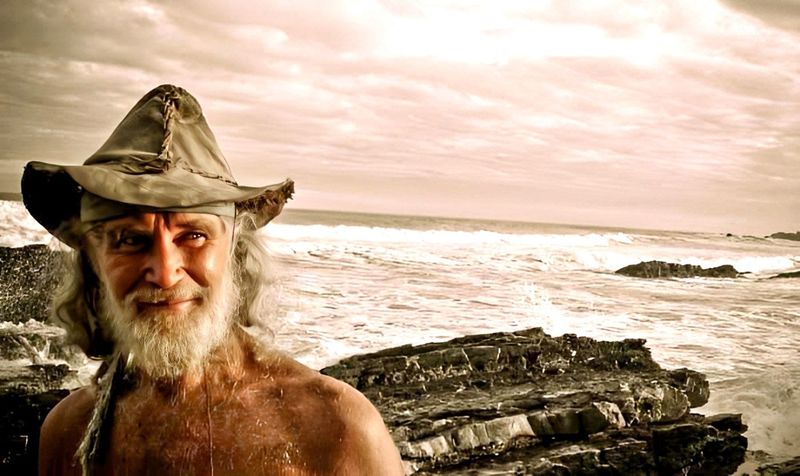
Dekker was 86 when he died on 9 November at Isilimela Hospital near Port St Johns, where he had been cared for during the month before. He died of natural causes. Dekker had once suggested that he might live to 98, as his father had. He was a nomad by habit, but he spent much of his life on the Eastern Cape coast, in a hut near Port St Johns, surrounded by wild bush and overlooking the sea.
He needed very little. In his healthier days he foraged for his meals in the ocean, deciding each day, as he looked out at the water, what he fancied: mussels, abalone or oysters. He made his own bread.
Once in a television interview he said that if he ever felt himself dying, he would swim towards the South Pole and drown there, so that the animals of the sea could eat his body. The ocean had fed him for decades and he thought it fair to give some of it back.
Benito Adolfo Dekker was born on 21 October 1940 in Centane, in the Eastern Cape, and died 19 days after his 86th birthday. He grew up in Vincent, in the old East London, the child of Dutch immigrants. In his dotage he remembered that his mother had long black hair and crooked feet, because she never wore shoes. He grew to nearly 2m. At six, he said in another television interview (there were many over the years), he hiked from East London to Port St Johns and back, a distance of several hundred kilometres each way. It was how he was raised. Feral.
He said he wanted a life modelled on that of Piet Hein, the 17th-century Dutch sailor, naval commander and privateer. Hein went to sea as a teenager, survived years of captivity as a galley slave and came back a celebrated adventurer. To a boy of Dutch descent in the Eastern Cape he stood for movement, independence and freedom from ordinary conventions. Dekker made his own rules for the rest of his life.
A forester who read philosophy
After matriculating from Selborne College in East London at 17, he took a five-year contract with the Department of Forestry and studied at Saasveld Forestry College, near George. The department posted him to the Lottering Forest Station in the Tsitsikamma, where he qualified in surveying and in driftsand reclamation, the work of stopping moving dunes from burying land.
The qualifications took him all over the country, and he learnt its forests, plants and coastlines at a pace no tourist could manage. When the contract ended he enrolled at Rhodes University in Grahamstown for a degree in philosophy and fine arts, working as a lifeguard to pay his way.
Philosophy was where he began to make trouble. His master’s thesis, Bantu Philosophy, argued that African thought deserved to be taken seriously and that European ways of thinking were not the summit of human development. The thesis asked whether technological advance, industrialisation and wealth made a society more civilised.
Against the Western idea of Being, Dekker set what he described as an African idea of Presence. “Africa has something real and significant to contribute to the world,” he wrote. This was apartheid South Africa at the end of the 1960s, when the government’s official position was the opposite.
Examiners turned down the thesis. They rejected it again when he resubmitted it, and every South African university then blacklisted it. When he sought to register as a master’s student at the University of Cape Town, the council refused and gave no reasons. The decision brought protests to the campus and days of newspaper coverage.
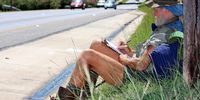
One section of the thesis dealt with immortality. People go on existing, Dekker proposed, through the skills and knowledge they leave in others. A friend had taught him archery, and each time he drew a bow the friend’s influence was alive in the movement. When he taught someone else, it passed to another generation.
Cape Town
He moved to Cape Town in 1966 to work as an actor and lighting technician for Capab, the Cape Performing Arts Board, and to carry on with his studies. Dekker was among the first actors at the Space Theatre, the experimental venue that was one of the few places in the city where apartheid could be mocked on stage.
He appeared in Gilgamesh and in Donald Howarth’s Othello Slegs Blankes (Othello Whites Only), a staging of Shakespeare’s play without Othello, because the law did not allow a black actor to share a stage with a white Desdemona. Over his career, he appeared in 84 filmed productions. He was a natural actor, with a deep, resonant voice and the upright bearing of a soldier. Dekker was rugged, with an almost animalistic sex appeal. This obituarist once met him briefly. The smell of testosterone and a hint of sweat hung about him.
He had strong elements of the Jungian Wild Man archetype, with something of the Wanderer and the Lover. His domestic arrangements were as nonconformist as his politics.
When he lived on Dunkley Street in Gardens, he opened his home to eight children who had nowhere to stay, looking after them until suitable homes could be found for them. For a time he also lived in a hut he had built in the bush at Oude Skip, between Sandy Bay and Duiker Point. In the sixties, he said, he had shot tahr, the feral Himalayan goats of Table Mountain, with a crossbow, and found the meat delicious.
He was rough but courteous. Sumien Brink, founding editor of House and Leisure magazine and a stylist, remembered how he carried a fridge on his back all the way from Dunkley Street to her flat in Tamboerskloof. He never arrived without a little bunch of flowers picked along the way. “He was a true gentleman,” she said.
The candidate
In 1970, he stood in the general election against Sir De Villiers Graaff, leader of the United Party, in Rondebosch. Graaff was a wealthy farmer and a gentleman politician. Dekker was a student with long hair and no money, so he bought a hawker’s licence and ran his campaign from a fruit vendor’s barrow at the Rondebosch fountain, where he would speak, or just recline, as the mood took him. His slogan was “Stem lekker, Stem Dekker” (“Vote well, vote Dekker”). He challenged Graaff to a swimming race to Robben Island. His stated aim was to “put the comedy back into politics”.
The comedy came with a serious demand. Dekker called for universal suffrage, which at that point lay outside the discourse of every major white party. He polled 1,694 votes, enough to keep his deposit, and was swamped by the middle-class loyalty of the southern suburbs. Students packed halls to hear him.
The oppressive National Party apparatchiks would have nothing of his outspokenness. They suspended his passport, and he toured the whole continent anyway, travelling on an Amnesty International passport or on none at all.
He hitched, he walked, and sometimes he got a flight by helping pilots load cargo. As an Amnesty peacekeeping delegate in war-torn countries he preferred to arrive on foot. By the time the rest of the convoy turned up, he had usually established a rapport with the locals.
Second Beach
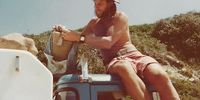
In 1980 he left Cape Town for Port St Johns and built himself a hut in the Mthumbane forest, next to Second Beach. For the next 38 years he lived off the sea, the forest and a small vegetable garden. He opened walking trails around the town and wrote and illustrated a booklet about them, Operation Footprint.
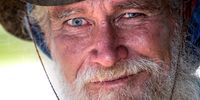
He guided hikes, painted, wrote poetry and made sculpture from driftwood. Lily’s Lodge, a short walk away, named its bar Ben’s Bar. Before the Aids orphanage at Qunu opened, he took in local children orphaned by the disease until someone could take them in or they could fend for themselves.
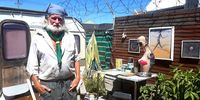
The journalist Chris Marais met him in 2002 on an assignment in Port St Johns, and saw him stride past the porch of the lodge in a headscarf, a beaded waistcoat and a leather flap over short shorts. Marais went to the hut at five o’clock the next day, as arranged, and found Dekker at work on a sneezewood sculpture.
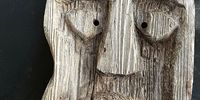
Driftwood became the creatures of local myth under his hands: the snake, the one-legged lightning bird, the baboon that is ridden backwards, the three-legged tree hyrax. He handed out goblets of Tassenberg red, and at dinner at the lodge he came out of the kitchen with a plate of umngqusho, the maize and bean dish, laced with calamari and crayfish sauce.
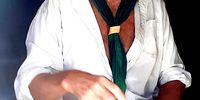
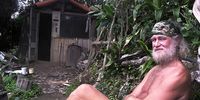
Marais asked whether he had a cell number. “I had one once,” Dekker said. “But I threw it into the sea and told the crayfish to phone when they were ready for me.”
Asked why he lived next to the sea, he said: “The accessibility of a huge bath. The rhythm of it. And all that seafood.” A craft shop in the town, Pondo People, gave him a new beaded waistcoat every year on his birthday.
A true character
Dr Div de Villiers, a Wild Coast conservationist who was often mistaken for Dekker and was nearly as tall, first heard of him as a student in Cape Town. The story going round then was of Dekker in a Tarzan-like loincloth and a hat, walking past all the girls on Clifton Beach and on into the freezing waves until only the hat showed above the water. He would make no visible attempt to swim, De Villiers says.

The two met in the 1990s in Port St Johns, at one of the first meetings about the N2 toll road through the Wild Coast, where they sat side by side and raised concerns about its planned coastal route. Dekker knew the region’s forests and cared about them. His carbon footprint, De Villiers said, “must have been close to zero, unlike mine and so many other environmentalists”.
De Villiers was in court when Dekker pleaded guilty to smashing the window of a vehicle whose driver refused to stop driving on the beach, and to throwing the man’s keys into the sea. The community paid his admission-of-guilt fine, because it shared his view of what the beach was for.
The journalist Charles Smith wrote that many people wanted to live as Dekker did, alone in a hut overlooking the sea, and lacked the nerve. “He was the real deal, a true hippie who lived in nature,” Smith wrote. “Without SARS, Eskom or a municipality.”
Saved twice
Tracy Skinner was saved by him twice: she ran away from art school near Port Elizabeth, wanting silence, and Dekker let her live in his barn. “I arrived, he looked me up and down, snorted and showed me the top level covered in straw on the floor,” she recalled. He lived downstairs.
They did not have to talk. She slept on the straw and woke to a plate of huge fresh strawberries from his garden and a “skop-skiet moer koffie”. She helped collect firewood. He cooked her meals.
The second time, in the Transkei, she was young, foolish and hitchhiking out of Port St Johns to get back to school when a group of very drunk men tried to drag her into a car.
“People drove past, not him,” she said. He spoke fluent isiXhosa, and with a big solid stick he drove the men back into their “skorokoro”. He put her in his car and drove her home listening to the Beach Boys and Bach.
They did not speak. She hugged him goodbye. “Look after yourself, Tracy,” he said, in what she called his raw, commanding voice, and gave her the broadest warm smile. She remembered him as “a truly wild man with a truly free, happy soul”.
Final years
In his seventies Dekker said he would love to marry four women and start a brand-new tribe. It was hard to tell if he was serious, or simply sending you up.
In 2019 he returned to Cape Town, true to his wandering style, and lived in a caravan in Woodstock. It did not suit him, and he went back to Port St Johns.
Over the final years he often visited Nico and his wife, Dr Lydia Dekker, on the Bluff in Durban, where he would stay in their spare room. At one stage, he became frightened of the police in Port St Johns, whom he claimed had a vendetta against him.
“When he stayed with us,” the Dekkers (no relation) said, “he would often sweep the pavements clean wherever he walked. People got to know him for that. He would stay for two weeks or sometimes a month.
“He was also a familiar figure at the Bluff library, where he would sit and read for hours, sometimes the whole day.”
For some South Africans, Ben Dekker occupied the same place in the national imagination as the dancer Glenda Kemp, the rugby player Mannetjies Roux, the singer Margaret Singana, the boxer Elijah “Tap Tap” Makhathini and the familiar voices of Springbok Radio – figures who, in their different ways, became part of the country’s shared cultural memory.
Natalie Richards of Amapondo Accommodation & Restaurant, one of the people who looked after him in recent years, told Die Burger that she and her colleagues prepared his food and sometimes took him to the doctor.
Moving about had grown harder for him in recent months, and the path to his dwelling turned slippery in the rain. He kept to it, she said, and went on doing his own thing, albeit at a slower pace.
Ben Dekker once imagined that, when his time came, he would swim towards the South Pole and surrender his body to the creatures of the ocean. It was an ending of his own choosing, in keeping with a life lived on his own terms.
He never made it to the silent ice desert. But he left behind the trails he opened, the people he helped along the way, and the stories that will continue to be told about him. In his thesis, he had argued that we live on through what we pass on to others.
KioskNews shows a cleaned-up reading view extracted from the publisher’s page — the original always lives on their site, not ours.