Trump hints at response from North Korean leader after scaling back Seoul drills
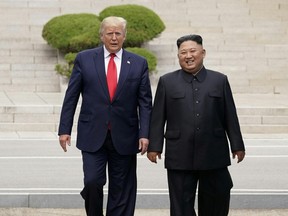
U.S. President Donald Trump said Monday that Kim Jong Un had responded to his recent overtures, a day after he scaled back military drills with South Korea and praised his relationship with the North Korean leader.
Sign In or Create an Account
Trump said he was making the situation “much safer” through his ties to Kim, whom he met three times in his first spell in the White House, but has yet to encounter during his second term.
While praising the leader of nuclear-armed North Korea, he rebuked key ally Seoul for failing to help Washington fight Iran — a war Trump says is aimed at stopping Tehran from getting the atomic bomb.

Get a dash of perspective along with the trending news of the day in a very readable format.
By signing up you consent to receive the above newsletter from Postmedia Network Inc.
A welcome email is on its way. If you don't see it, please check your junk folder.
The next issue of NP Posted will soon be in your inbox.
We encountered an issue signing you up. Please try again
Asked why Kim hadn’t replied to his requests for a conversation since returning to office last year, Trump told reporters in the Oval Office: “How do you know he hasn’t responded?”
When pressed about whether Kim had actually responded, Trump said: “Yeah, he has.”
Asked what stage the conversations with Kim were at, Trump said “it’s very positive,” but provided no further detail.
Trump then doubled down on his praise for Kim, saying their ties reduced tensions.
“You see, I’m actually making it much safer. Kim Jong Un has always treated me with great respect,” Trump said. “I understand him. He understands me.”
Trump initially took aim at South Korea on his Truth Social network on Sunday night, abruptly announcing that he had ordered the Pentagon to scale back “inappropriate and hostile” military drills with Seoul.
He also linked the decision to South Korea’s refusal to help with the U.S.-Israeli war with Iran.
“Wait a minute. We have 39,000 soldiers over there, guarding you from Kim Jong Un, your next-door neighbor, and you’re not going to help us on a very easy military operation in Iran. That’s strange,” Trump said in the Oval Office.
Trump once again called into question U.S. support for both South Korea and NATO allies that have refused to contribute to the Iran war.
“We can’t go around and protect all of these countries, especially when they’re not there to help us,” he said.
South Korean officials said the exercises had begun as planned and that they hoped the personal chemistry between Trump and Kim would bring them back to talks.
North Korea has not responded publicly, although it has previously voiced anger at the regular joint maneuvers that take place in the South.
The top U.S. Senate Democrat on military affairs slammed Trump’s order to downsize the Korean drills, and said China and Russia were “watching how easily this president abandons America’s allies.”
“This is another inane, haphazard decision by President Trump and his chaotic administration,” Senate Armed Services Committee ranking member Jack Reed said.
The 11-day Ulchi Freedom Shield exercises are designed to prepare for a possible war with North Korea.
Colonel Ryan Donald, spokesman for the U.S. and South Korean Combined Forces Command, has said they will simulate combat against North Korean troops hardened by their deployment on Russia’s side in its invasion of Ukraine.
Seoul’s presidential office told AFP it remained in “close coordination” with Washington over the exercises.
Pyongyang decries the drills as dress rehearsals for an invasion.
It recently test-fired a ballistic missile over the Sea of Japan, and warned on Friday it could respond to the exercises with a “new level of deterrent”.
During his first term, Trump said after his initial meeting with North Korea’s Kim in Singapore in June 2018 that Washington would suspend the “provocative” drills.
The United States stations about 28,500 troops in South Korea to bolster the country’s defenses, a legacy of the 1950-53 Korean War that ended with an armistice rather than a peace treaty.
But Trump’s repeated criticism of time-honoured alliances has cast doubt on U.S. commitments to security in East Asia.
The announcement of the scaled-down drills came as the only U.S. aircraft carrier operating in the Pacific region, the USS George Washington, is being redeployed to the Middle East to relieve the long-deployed USS Lincoln, which has been the focus of concerns over mental health and supply issues.
Our website is the place for the latest breaking news, exclusive scoops, longreads and provocative commentary. Please bookmark nationalpost.com and sign up for our newsletters here.
Join the Conversation
This website uses cookies to personalize your content (including ads), and allows us to analyze our traffic. Read more about cookies here. By continuing to use our site, you agree to our Terms of Use and Privacy Policy.
KioskNews shows a cleaned-up reading view extracted from the publisher’s page — the original always lives on their site, not ours.