Experts caution cancer cachexia an urgent issue
SUPER-AGED SOCIETY: With no medication that can cure the weight loss syndrome directly, early lifestyle interventions have become a shared focus, an expert said
By Lee I-chia / Staff reporter


Many people might think it is normal to experience weight loss and weakness during cancer treatment, but medical experts yesterday warned that it could also be “cancer cachexia,” and that insufficient muscle mass can even cause treatment to fail.
The 3rd International Conference on Sarcopenia, organized by Taipei Medical University (TMU) and focusing on “Sarcopenia, Cachexia and Frailty” was held at the university in Taipei yesterday.
With the global population aging, sarcopenia has become a pressing health challenge that significantly impacts the well-being and quality of life of elderly people, and surveys in Taiwan estimate that more than one-third of elderly people are affected or at risk, the TMU said.
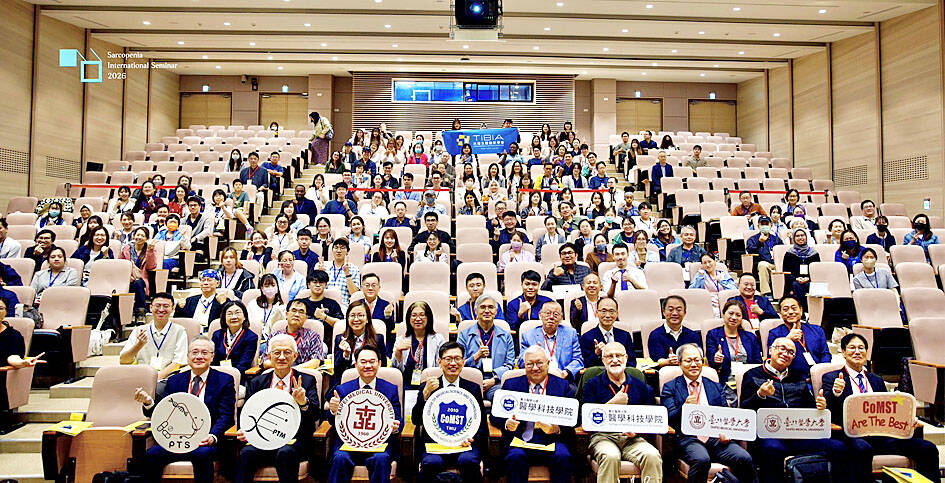
People attending the International Conference on Sarcopenia in Taipei yesterday hold placards during a group photograph.
Photo courtesy fo the Taipei Medical University
Experts from the UK, Japan, South Korea and Singapore, across sectors and disciplines — covering neurology, rehabilitation, cardiology, regenerative medicine, biomarkers, genetics and more — joined the conference to address this urgent issue, it said.
Some people become increasingly thin and frail during cancer treatment and believe that it is a normal side effect, but TMU Graduate Institute of Cancer Biology and Drug Discovery chair professor Yen Yun (閻雲) said it could be a sign of “cancer cachexia.”
Cancer cachexia is a tumor-driven metabolic syndrome that is characterized by systemic inflammation, which accelerates the breakdown of muscle mass and fat tissue, he said.
People with cancer cachexia might experience extreme weight loss and exhaustion, and it could even force the patients to discontinue cancer treatments because their body is no longer strong enough to tolerate them, he added.
Studies have estimated that cancer cachexia affects about 50 percent of people with cancer, Yen said.
In his keynote speech, National Cancer Centre of Singapore deputy chief executive officer Bin Tean Teh said that muscle loss occurred in cancer patients through transcriptomics, and shared exploratory pathways for future treatments.
TMU executive vice president Liou Tsan-hon (劉燦宏), who is also TMU Shuang Ho Hospital superintendent, said preserving muscle mass has become a public issue, as in a super-aged society, “maintaining muscle strength and preventing disability” is the key to health and longevity.
As people age, inactivity causes muscle mass and strength to decline much faster, and continued muscle loss might ultimately severely impair their ability to manage daily self-care, he said.
As there is no medication that can directly cure or treat sarcopenia globally, early lifestyle interventions combining a “nutritional diet” and “resistance exercise” have become a shared focus of preventing and managing age-related muscle loss, he said.
KioskNews shows a cleaned-up reading view extracted from the publisher’s page — the original always lives on their site, not ours.